Key Takeaways
- Purchase order automation in MRO is not the ERP raising PRs faster. MRP already does that, against a min/max set at go-live. It is an agent that recomputes what is actually needed first, then raises, cuts or cancels the PO, under a policy the customer wrote.
- Autonomy is earned per item class, not switched on. Every item starts at "recommend, a person approves"; consumables graduate to auto-requisition, auto-release and auto-cancel as acceptance rates prove the agent right.
- Eight guardrails travel with every tier: value caps, a criticality shield, contract price and approved suppliers only, a months-of-cover ceiling, a reversal window, a full log, an acceptance-rate floor and a global pause.
- Critical spares never climb the ladder. The buyer's week moves from approving gloves to owning the parts that can stop the plant.
Read the full article below to learn more.
Last year a buyer at a multi-site industrial operation approved several hundred purchase orders for gloves. Each one was correct. Each one took four minutes. None of them needed a buyer. Meanwhile the one PO that mattered that quarter, a long-lead seal for a single-train compressor, sat in the same queue, behind the gloves.
That is the consumables problem in one paragraph. The long tail of low-value MRO items (PPE, fasteners, filters, lubricants, janitorial, shop supplies) generates most of a buyer’s transactions and a sliver of the spend, and the ERP’s answer is to raise more of them automatically against parameters nobody has reviewed in years. This article is for the procurement director, MRO buyer or supply chain planner who has looked at the queue and asked the obvious question: why is a person doing this? It explains what purchase order automation means in MRO, what a policy-approved procurement agent should and should not be allowed to do, and how a North American utility is designing the ladder from “recommend” to “cut the PO without asking”, one item class at a time.
The autonomy ladder for MRO consumables
Eight guardrails travel with every tier
The autonomy ladder: earned per item class, bounded by policy, reversible at any time. Critical spares never climb it.






Why Do Low-Value Consumables Eat Your Buyers’ Week?
Because the ERP is doing exactly what it was told. A min/max was typed in at go-live. Consumption drifts, the parameter does not, and every MRP run raises a requisition the moment stock dips under a number nobody remembers setting. The requisition becomes an exception message, the exception becomes a PO, and the PO lands in a buyer’s queue next to the compressor seal. In most MRO estates the bottom 80% of items by value account for well under a fifth of spend and the majority of purchase orders. Multiply by forty storerooms and the queue is the job.
A North American utility we are working with put it plainly. Tens of thousands of MRO SKUs across dozens of generating stations, service centres and storerooms; a small central planning team; and an ERP that generates exception messages faster than anyone can read them. Their ask was not “automate procurement”. It was this:
Make the queue tell us which of these actually matter, and then stop asking us about the ones that don't.
A North American utility we are working with
What Is Purchase Order Automation in MRO?
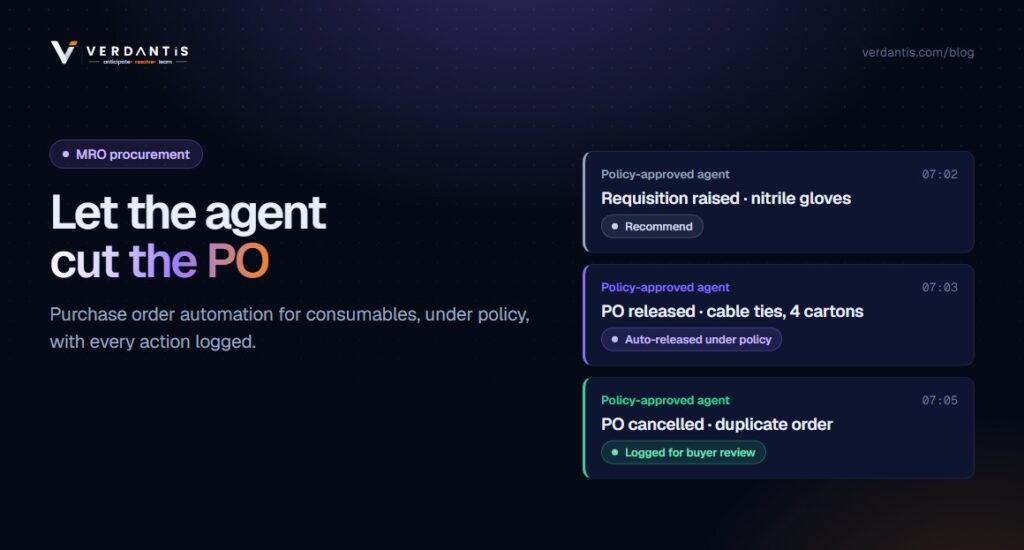
Purchase order automation in MRO is the use of AI agents to decide, under a customer-written policy, whether a requisition should be raised, released as a purchase order, reduced or cancelled, by recomputing the real need for the item (forecast demand over lead time, dynamic safety stock by criticality, stock at other plants) before any transaction is created, and then executing the transaction without human review for item classes where the agent has earned that right.
The contrast with what most plants already have matters. ERP auto-ordering automates the transaction and keeps the decision frozen: the static parameter is still in charge, so the system raises the wrong PO faster. Punch-out catalogues and vendor-managed inventory move the clicking to a supplier and keep the parameters. Tail-spend outsourcing moves the clicking to a third party. None of them recompute the need.
An agent that recomputes the need first is the only version of automation that cancels POs as readily as it raises them, which is where the money is.
Count the purchase orders under $500 your buyers approved last quarter
Then count how many were raised by MRP against a parameter last changed more than three years ago. If the second number is most of the first, your buyers are approving a decision the ERP already made badly. Send us the list and we will show you, line by line, which POs today's computed need would have cancelled, reduced or never raised.
Send us the list →What Is a Policy-Approved Procurement Agent Allowed to Do?
Exactly what its policy says, and nothing else. In MRO360 Recommendations, every action begins life as a card in the Action Queue: cancel this PO, reduce that one, raise a requisition for a part below its computed safety stock, transfer from plant A instead of buying at plant B. A person approves, rejects with a reason or defers. That is Tier 0, and every item class starts there. Autonomy is then granted per class, by the customer, as the evidence accumulates.
The autonomy ladder, tier by tier
| Tier | What the agent does | Who qualifies | What a person still does |
|---|---|---|---|
| 0 · Recommend | Queues every action as a card with its coverage math and the parameter the ERP is still obeying | All items, day one; critical spares, forever | Approves, rejects with a reason, defers |
| 1 · Auto-create PR | Drafts the requisition with quantity, need-by date and supplier, and routes it | Classes with sustained acceptance above an agreed floor (for example 80% over 60 days) | Releases the PO |
| 2 · Auto-release PO | Cuts the PO within policy: value cap per line and per day, contract price only, approved supplier only, months-of-cover ceiling | Consumables: PPE, fasteners, filters, lubricants, janitorial, shop supplies | Reviews the daily log; owns the policy |
| 3 · Auto-cancel / reduce | Cancels or trims open POs the forecast no longer supports, inside a reversal window | Same classes, non-critical only, no cancellation-window restriction with the vendor | Can reverse within the window; reviews exceptions |
Tier 0 is available in MRO360 today. Tiers 1 to 3 are in design-partner development with the utility above, and the thresholds in the table are the shape of the design, not a promise. Two rules do not move at any tier: no number in any card comes from a language model (every quantity is computed by the forecasting, criticality, lead-time and reorder agents and shown with its confidence), and nothing changes in the ERP without a person or a policy that person wrote.
What Guardrails Keep a Policy-Approved Agent Safe?
Eight guardrails, set and owned by the customer, travel with every tier.
Eight guardrails that keep a policy-approved agent safe
01
Value cap
Per line and per day, set by the customer per class.
02
Criticality shield
Items whose criticality class says they protect critical equipment are never automated, in either direction. Storm-response and restoration spares at the utility are explicitly outside the ladder.
03
Contract price and approved supplier only
The agent never shops.
04
Months-of-cover ceiling
Where stock already covers the next twelve months of forecast demand, buying pauses, whatever the parameter says.
05
Reversal window
On every cancellation and reduction; the buyer can undo within it.
06
Full log
Every action carries its inputs, reason, confidence and the policy clause that allowed it, replayable later.
07
Acceptance-rate floor
If a class's recommendations start being rejected, the class steps down a tier automatically.
08
Global pause
Owned by the customer, it returns every class to Tier 0 in one click.
Notice what the guardrails are for. They are not there because the agent is unreliable; they are there so that a regulated utility can put the design in front of its auditors and its rate-case team and show that an automated cancellation is a more evidenced decision than the manual one it replaced.
See this on a live walkthrough
In a 30-minute walkthrough of MRO360 you will see:
01
The Action Queue
Open POs ranked by value × criticality × urgency: fourteen lines, a six-figure total, the top one a gearbox nobody needs because the plant already holds six.
02
The cancel card
The coverage math line by line (on hand, in transit, forecast over lead time, computed safety stock, headroom) beside the parameter the ERP obeyed and the year it was last changed.
03
Transfer instead of PO
The same part short at a sister plant: two units move across the network at a fraction of the purchase price and 87 days faster, with both plants' analysts approving.
04
The approval and the log
The click, the write-back task, and the audit snapshot that lets anyone replay exactly what the analyst saw. At Tier 2 the same card would have executed under policy, and the log would look identical.
Thirty minutes on a screen share, on sample data or on yours. No slides.
Book the walkthrough →How Is a Utility Designing It?
The plan the utility and Verdantis are working from has three phases, and none of them starts with autonomy.
Three phases, and none of them starts with autonomy
Transactions first, everyone approves
The Action Queue runs nightly across every storeroom: open POs the forecast no longer supports, parts below their computed safety stock, transfer opportunities between stations. Analysts approve instead of investigating. Acceptance rate and realised value are measured against a baseline from day one.
Parameters second
Safety stock and reorder points are re-derived per SKU from lead-time variability, demand and criticality, with the derivation attached, and a months-of-cover rule stops buying where stock already covers the year. This is what stops the queue refilling.
Consumables graduate
Once a class of low-attention items (gloves, fasteners, filters, lubricants, janitorial) shows sustained acceptance, the customer moves it up the ladder: auto-requisition, then auto-release under the value cap, then auto-cancel inside the reversal window. The analysts' week moves to the parts that can stop a station.
What the utility gets from the sequence is evidence. By the time anything executes without a human, the organisation has months of approved cards showing that the agent’s decisions on that class were the ones its own analysts would have made, and a log that proves it.
The consumables test
List your top twenty consumable item classes by purchase-order count. For each, write down the parameter that drives the orders and when it was last reviewed. Any class with a parameter older than the people approving its POs is a candidate for the ladder. We will run the first pass on a sample extract, with no system access, in two weeks.
How Is This Different From VMI, Punch-Out, ERP Auto-Ordering and Tail-Spend Outsourcing?
Each of the usual answers automates something. The question is what it leaves frozen.
What each approach automates, and what it leaves frozen
| Approach | What it automates | What it leaves frozen | Where it fits |
|---|---|---|---|
| ERP / MRP auto-ordering | The transaction: PR raised when stock dips under min | The decision: the min/max is still the one from go-live | Fine for the handful of items whose parameters are actually reviewed |
| Vendor-managed inventory | The clicking, moved to a supplier | The parameters, now set by someone paid per unit shipped | Commodity bins with a trusted supplier |
| Punch-out catalogues | The shopping | The need; a person still decides what to buy | Ad-hoc, non-stock buys |
| Tail-spend outsourcing | The clicking, moved to a third party | The parameters and the stock on the shelf | When headcount, not stock, is the only problem |
| MRO360 Recommendations with graduated autonomy | The decision first (recompute need, check the network), then the transaction, under a policy the customer wrote | Nothing: parameters, POs and transfers all move | Multi-site estates with a long tail and a small team |
What Does the Buyer Do Instead?
The buyer owns the decisions that still need a person: critical spares and their suppliers, long-lead strategy, contract coverage, supplier performance against real receipts, and the exceptions the agent escalates. A buyer who approved several hundred glove POs last year will approve none next year, and will spend the time on the compressor seal, which is where a buyer’s judgment was always worth the most.
See it on your own data
Share a sample extract of 200 to 400 SKUs per plant straight out of your ERP, with open POs. In two weeks, with no system access, you see which open POs today's computed need would cancel or reduce, which parts are under-protected, what could move between plants instead of being bought, and which consumable classes are ready for the ladder. You keep the output either way.
Frequently Asked Questions
What is purchase order automation in MRO?
Should an AI agent be allowed to raise or cancel purchase orders?
What is a policy-approved procurement agent?
Which MRO items are safe to automate?
How is PO automation different from MRP auto-ordering?
Related reading: MRO Inventory Replenishment Software Should Cancel the Wrong PO · Spares-Ready Work Orders · MRO360 · MRO360 Recommendations and the Action Queue · Demand Planning & Optimization · Inter-plant transfer