Key Takeaways
- MRP replenishes against parameters, not need. The parameter was set at go-live; the need moved. Most of the excess in an MRO estate was ordered correctly against a wrong number.
- MRO360 Recommendations runs nightly across every plant: detect what is in motion that today's computed need does not support, signal the counts, let an analyst pull a ranked queue, show one card with the coverage math beside the parameter the ERP obeyed, record the decision, act, measure.
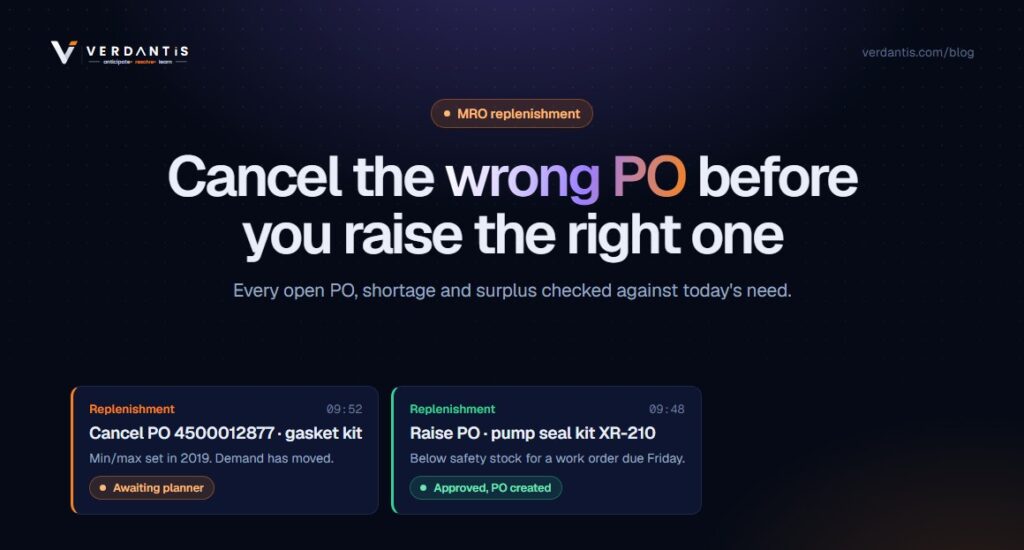
- Three recommendation types at launch: cancel or reduce the PO, raise stock below computed safety stock, transfer from a sister plant instead of buying. The third is a decision classic MRP cannot make.
- No number comes from a language model; nothing changes in the ERP without a person. The proof is the acceptance rate and the realised value against your own baseline.
Read the full article below to learn more.
On Tuesday night your ERP raised a purchase order for four gearboxes. The plant holds six. Forecast demand over the ninety-day lead time is a little over one. The order went out because a safety stock of five, typed into the material master in 2019, said it should. Nobody was wrong. Nobody was asked.
That is the replenishment problem in asset-intensive operations, and it is why “inventory replenishment software” for MRO cannot mean a smarter way to raise orders. It has to mean a layer that compares what is in motion (open POs, planned buys, stock about to be transferred) with what is actually needed, and queues the fix for a person.
This article is for the supply chain planner, MRO analyst or materials manager whose ERP generates exception messages faster than anyone can read them. It explains what MRO360 Recommendations is, the three decisions it queues every night, what a recommendation card shows, and how a multi-site utility is using the approach to work tens of thousands of SKUs with a small team.
How MRO360 Recommendations works
1
Detect
A deterministic check across every open PO, stock position and surplus
2
Signal
One digest with counts only
3
Pull
A queue ranked by value, criticality and urgency
4
Card
The coverage math beside the parameter the ERP is still obeying
5
Decide
Approve, reject with a reason code, or defer to a date
6
Act and measure
A task or an ERP write-back; realised value posts against the baseline
Detect, signal, pull, card, decide, act and measure: nightly, across every plant, with a person in the middle.
Type 1
Cancel or reduce the PO
Type 2
Raise stock below safety
Type 3
Transfer instead of buying






Why Does MRP Keep Raising Purchase Orders for Stock We Already Have?
Three reasons, all structural.
Three reasons, all structural
01
The parameter is frozen
Safety stock and min/max were set when the material was created, from a rule of thumb or a supplier's suggestion, and the review that was going to happen every year never did.
02
The exception message is the interface
MRP tells the analyst that stock dipped under min; it does not tell them whether min is right, so the analyst approves the requisition because the alternative is investigating twenty thousand SKUs.
03
MRP sees one plant
A shortage at station B raises a PO at station B even when station A holds a surplus of the same part, because each plant's MRP runs alone.
Industry studies find 30 to 50% of MRO parts have not moved in 24 months.
Very little of that stock was bought by mistake. It was bought on schedule, against the wrong number.
Figures in this section are industry benchmarks and illustrative ranges, stated as such. They are not Verdantis customer results. Customers are anonymised.
What Is MRO360 Recommendations?
MRO360 Recommendations is the layer of the MRO360 platform that compares every open purchase order, stock position and surplus across all plants, nightly, with today’s computed need (forecast demand over lead time plus dynamic safety stock by criticality, from the platform’s AI agents), and queues the resulting actions (cancel or reduce a PO, raise a requisition, transfer between plants) as explainable cards in an Action Queue for an analyst to approve, reject with a reason or defer. Approved actions become tasks or ERP write-backs, and acceptance rate and realised value are measured against a baseline.
Six steps, with a person in the middle:
Six steps, with a person in the middle
Detect
After the AI agents refresh overnight, a deterministic check runs across every open PO line, stock position and surplus: “If this PO arrived, would the plant hold more than it needs?” “Is net stock below the computed safety stock?” “Does another plant hold what this one is about to buy?”
Signal
One digest with counts only: “7 open POs totalling $84,300 may no longer be needed.” No part numbers, no advice in the inbox, so nobody triages by email and bypasses the evidence.
Pull
The analyst opens a queue ranked by value, criticality and urgency. Nothing is generated until someone asks.
Card
One screen: the coverage math line by line, every number traceable to a stored field, beside the parameter the ERP is still obeying and the date it was last changed.
Decide
Approve, reject with a reason code, or defer to a date. The card is snapshotted into an immutable audit store.
Act and measure
A task to the buyer, or a write-back to the ERP; realised value posts against the baseline; rejection reasons feed the next refresh.
The open-PO sweep
Export your open purchase orders for MRO materials with on-hand, in-transit and the date each material's safety stock was last changed. We will run the detect step on it, with no system access, and return the lines today's computed need would cancel or reduce, with the value, in two weeks.
What Are the Three Recommendation Types?
Each type starts from a simple check against AI-computed values, proposes one action on the card, and carries its own guardrail.
The three recommendation types at launch
| Type | Trigger (a simple check against AI-computed values) | What the card proposes | Guardrail |
|---|---|---|---|
| Cancel or reduce the PO | Open PO line where on-hand plus in-transit already covers forecast demand over lead time plus computed safety stock; or the demand that raised it was cancelled | Cancel, or reduce to the quantity coverage supports; value released; forecast confidence shown | Never auto-cancel at launch; criticality-flagged materials always routed to review; vendor cancellation windows respected |
| Raise stock below safety | Net position below the computed safety stock, net of open supply | Raise a requisition for the computed quantity with a need-by date from lead-time variability and the criticality service level | Critical spares can be raised here, never reduced; the network is checked for transferable surplus first |
| Transfer instead of buying | Surplus at plant A (above computed max or above twelve months of forecast cover) and a shortage or open PO at plant B for the same or an interchangeable part | Transfer the quantity; freight against purchase price; lead-time gain; interchangeability from the data layer | Both plants' analysts see it; the receiving plant approves the need, the sending plant concurs the release |
The second type matters more than its share of the value suggests. The first visible acts of the layer in most estates include raising stock on a critical spare the old parameter under-protected. That one card buys the analyst’s trust for every reduction card that follows, and it is the honest proof that criticality-shielded optimisation cuts fat, not muscle.
What Does a Recommendation Card Show?
Take a fictional paper mill on SAP and a helical gearbox at $3,200 a unit. The nightly check sees: on hand 6; in transit 0; an open PO for 4, raised by MRP in May; forecast demand over the 90-day lead time 1.2; computed safety stock 2 (forecast variability, lead-time P95 and a class-B service level); and, in the material master, a static safety stock of 5 last changed in March 2019. Projected position without the PO is 4.8, above the computed need with margin. The card reads:
Fictional worked example · paper mill on SAP
Why this PO is not needed
The side-by-side
This PO was raised by MRP against the 2019 parameter. At today’s computed need, stock on hand covers demand through December with margin.
source: Reorder agent + Demand Forecasting agent · computed 02:10 today · data as of Monday end of day
Three things to notice. The left block is arithmetic on stored fields; anyone can check it. The right block is the mandatory side-by-side, the old number and when it was set against today’s number and why, which is what makes the card persuasive to an analyst who has heard “trust the model” before. And the sentence under the table is a template filled with those exact fields: generative AI may rephrase it, but it can never change 4.8 to 5.
Reading time, under a minute. If the analyst knows something the forecast does not (a rebuild moved to October), the reject reason “demand known upcoming” is recorded, the line is not re-raised for thirty days, and the pattern of reasons tells the forecasting team which feed is missing.
The side-by-side on fifty SKUs
Pick your fifty highest-transaction MRO materials. Send on-hand, open POs, consumption history and the current safety stock with its last-changed date. We will return the side-by-side for each: the parameter the ERP is obeying against today's computed need, and what that means for the open orders. No system access, two weeks.
How Does a Multi-Site Utility Use It?
A North American utility with tens of thousands of MRO SKUs across dozens of generating stations, service centres and storerooms brought us a familiar picture: a small central team, an ERP generating exception messages at estate scale, and inventory that had grown every reported quarter for years. The approach being designed with them runs in two passes.
Pass one
The transaction layer
- Of everything currently in motion (open POs, planned buys), what is actually still needed?
- The queue ranks the high-transaction materials first
- Reviews every open PO against network-wide stock and forward demand
- Recommends cancel, reduce or fulfil by transfer, before receipt
- The value lands as cash never spent, visible within weeks
Pass two
The parameter layer
- Of everything routinely held, what is the right amount?
- Safety stock is re-derived per SKU from lead-time variability, demand and criticality
- Overstock is flagged with a disposition
- A months-of-cover rule pauses buying where on-hand already covers the next twelve months
- This is what stops the queue refilling
Storm-response and restoration spares are shielded by criticality throughout.
Throughout, storm-response and restoration spares are shielded by criticality, so the estate gets leaner without getting riskier, and every recommendation carries its derivation for a regulator to follow.
The next step on their roadmap is the one described in the companion article: once low-attention consumable classes show sustained acceptance, they graduate to policy-based execution, and the analysts’ week moves to the parts that can stop a station.
How Do You Know It Is Working?
Four metrics, and only four.
Four metrics, and only four
01
Signal-to-pull rate
Are the digests worth clicking, or is this alert fatigue in a new coat?
02
Acceptance rate by type
Are the recommendations right, in the judgment of your own analysts?
03
Time from signal to action
Is the team reviewing, or still investigating?
04
Realised value against baseline
Cancelled and reduced POs, transfers instead of purchases, expedites avoided, and capital released, in your numbers.
If a vendor cannot show the second and fourth on a dashboard, the recommendations are opinions.
What It Will Not Do
Will not
Invent a number
Every quantity comes from the forecasting, criticality, lead-time and reorder agents and is shown with its confidence. Generative AI narrates computed fields; it never sets a quantity.
Will not
Change your ERP on its own
At launch nothing executes without an approval. Policy-based execution for consumable classes is in design-partner development, and when it arrives it is the customer's policy, reversible in one click.
Will not
Run in real time
The contract is a nightly batch on an ERP extract, which is also why it works before, during and after an ERP migration, with no integration project to start.
Will not
Replace your analysts
It replaces their investigating. The judgment stays with them, and every reject reason makes the next night's queue better.
How Is It Different From MRP, Dashboards and Other Optimisation Tools?
MRP replenishes against a parameter and sees one plant. Inventory dashboards and analytics tools find the problems and hand you a report; the open PO is still open the week after. Some optimisation tools recompute the parameter and stop there, so the recommendation to cancel a specific PO raised against the old parameter never reaches a buyer.
MRO360 Recommendations is built around the transaction as well as the parameter, across plants, with the decision recorded and the value measured. The comparison that matters is not features; it is whether, ninety days in, you can point to a queue of specific, quantified, explained, approved actions and a number against baseline.
Competitor capabilities change; verify any product statement against the vendor’s current documentation before relying on it.
See it on your own data
Share a sample extract of 200 to 400 SKUs per plant straight out of your ERP, with open POs and the last-changed dates on safety stock. In two weeks, with no system access, you see which open orders today's computed need would cancel or reduce, which critical spares are under-protected, what could move between plants instead of being bought, and the dead capital beside the stockouts. You keep the output either way.
Frequently Asked Questions
What is MRO360 Recommendations?
Why does MRP keep raising purchase orders for stock we already have?
What does a replenishment recommendation show?
How does inventory replenishment software work across multiple plants?
How do you know inventory recommendations are working?
[email protected] · www.verdantis.com
Related reading: MRO360 Recommendations / Action Queue · MRO360 · Demand Planning & Optimization · Reorder Point Optimization · Inter-plant transfer · Purchase Order Automation for MRO Consumables · Safety Stock Reassessment