Global gold miner

Five mines, five SAP instances, one view of every spare.

~$26M
working capital released
47%
less emergency procurement
10 wks
to go live, SAP kept
Read the story
Product
Solutions
Customers
Resources
Company
Book a demoGet a free diagnostic
MRO360 Work Order Planner & Scheduler

AI maintenance planning and scheduling software From notification to sign-off, planned by AI.

MRO360 Work Order Planner & Scheduler is the AI agent that turns every maintenance notification into a ready, scheduled job. It drafts the scope, checks parts, skills, permits and safety, keeps the schedule current and guides technicians on mobile. Agents prepare. People decide.

Software digitised the paperwork. The thinking is still done by hand.

Triage, scoping, readiness and scheduling still happen in people's heads, inboxes and spreadsheets. Each role feels it differently.

Planners

Free-text notifications from many channels, duplicates, and scopes rebuilt from scratch. They want notifications that arrive complete, and a clear list of what each job still needs.

Schedulers and supervisors

Break-ins that wreck the week, with crews, parts and production windows held in separate places. They want a schedule that absorbs an emergency without a manual rebuild.

Technicians

Waiting on parts, permits and information, then paperwork after the job. They want the next job, its steps and its safety requirements in hand.

Reliability engineers

Failure records that are incomplete or coded inconsistently. They want consistent failure codes and failure modes ranked from live data.

Six steps, from a reported problem to a lesson learned.

At each one the agent prepares and a person decides.

  1. 1

    Capture

    A problem enters from anywhere: a reporter's phone (photo, tag scan, voice or text), an ERP alert, a sensor, an email or a portal form.

  2. 2

    Enrich

    The agent identifies the equipment, classifies the failure, drafts the scope of work, scores the priority and flags duplicates.

  3. 3

    Make ready

    The agent checks parts, skills, permits and safety, names what is missing and proposes how to close each gap.

  4. 4

    Schedule

    Ready work is placed against crew capacity, parts and production windows. When priorities change, the AI Rescheduler proposes the moves and explains them.

  5. 5

    Execute

    The technician gets the job on mobile with a seven-step flow from review and safety to test and sign-off, and logs time along the way.

  6. 6

    Learn

    Completed work feeds the reliability scorecard, the failure-mode ranking and the skill forecast, and the history the next scope is drafted from.

Eight capabilities, on the web and on mobile.

Smart Notifications

Notifications from the ERP, sensors, email, voice and photos arrive in one queue with a draft scope of work, a failure code, a priority score and duplicates already flagged.

Work order readiness

Every work order shows how ready it is across parts, skills, permits and safety, what is missing, and the next action to take.

AI Scheduler

The agent reviews the schedule up to 30 days ahead and recommends changes. Each recommendation comes with its reasoning and is applied in one click.

Parts and procurement

Late parts are flagged against work order dates, with options to expedite, push the date or find stock at another plant.

Annual Skill Estimator

Twelve months of demand against capacity by craft, plus a six-week shortfall window that separates a hiring need from a temporary gap.

Reliability KPIs

MTBF, MTTR, PM compliance, planned maintenance, schedule compliance and backlog, computed live from work order data, with the top failure modes ranked.

Mobile app for reporters

Snap, say or type what is wrong. The AI identifies the equipment, fills in the report and shows similar open issues before a duplicate is raised.

Mobile app for technicians

Prioritised jobs, a seven-step checklist from safety to sign-off, a calendar of planned work and a record of hours.

Agents prepare. People decide.

Every AI output shows its reason, classifications carry a confidence score, and a schedule change applies only when a person accepts it.

The AIWhat it doesWhat people keep
ClassifiesAssigns a failure code and problem type with a confidence score, and fills in missing data.Override the code
DraftsWrites the scope of work from job plans and past failures: tasks, likely cause, remedy, crew, hours and parts.Review, regenerate, approve
ChecksTests readiness across details, parts, skills, permits, safety and schedule, and names the gap.Decide how to close it
WeighsBalances crew load, parts, production windows and downtime cost, then proposes moves with a reasoning trace.Accept, reject or reverse
ForecastsProjects demand against capacity by craft, and flags parts that will arrive after the work order needs them.Hire, contract, expedite or push the date

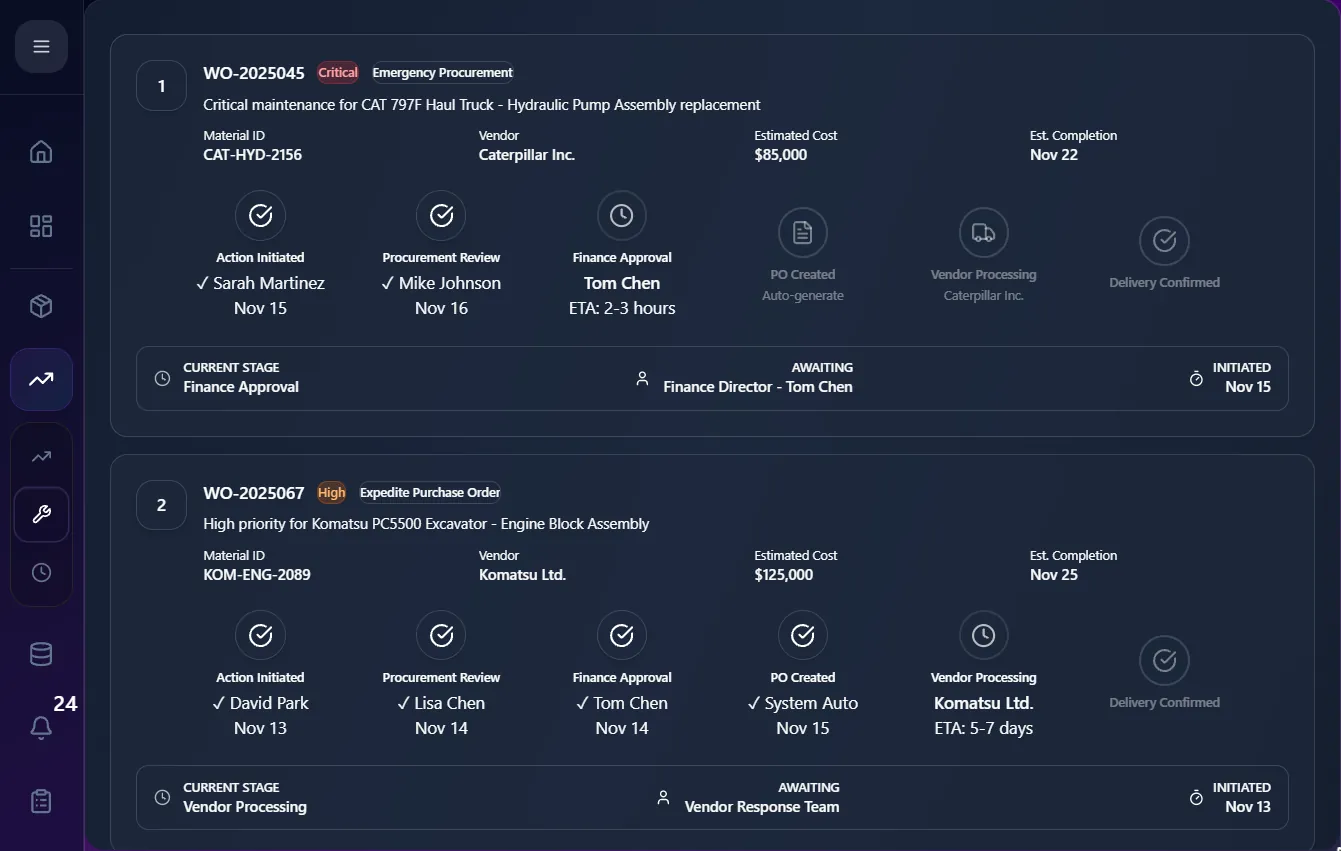
Maintenance and spare parts, together.

Planning sees what the storeroom sees: stock, lead times and late deliveries against each work order. When a part is short, the options come from the rest of MRO360.

MRO360 work order procurement tracker

What is at stake.

$125Kan hour: median cost of an unplanned outage at a typical industrial business (ABB, 2023)
25–35%of a technician's shift is typical hands-on time, against about 55% best practice (Doc Palmer, via Reliable Media)
30%more planning and scheduling productivity at one chemicals company with digital work management (McKinsey, 2021)
1.9MUS manufacturing jobs that could go unfilled by 2033 (Deloitte and The Manufacturing Institute, 2024)

Industry benchmarks that size the problem, not MRO360 results.

Further reading on AI maintenance planning and scheduling software

Questions about AI maintenance planning and scheduling

How is it different from a CMMS or EAM system?

A conventional CMMS or EAM system is built to record and route work. MRO360 prepares it: it drafts the scope, checks readiness, proposes schedule changes and explains each recommendation.

Does it replace our ERP or EAM?

No. It works with the ERP of record. It reads notifications, work orders and parts data from it and writes approved changes back.

Do people stay in control?

Yes. Every recommendation shows its reason, schedule changes apply only when a person accepts them, and an applied change can be reversed.

Who uses it?

Planners, schedulers, supervisors, technicians, operators who report problems, storeroom and procurement teams, and maintenance and reliability leaders.

What results should we expect?

That depends on your baseline. Industry benchmarks put typical hands-on time at 25 to 35% of a technician's shift against a best practice of about 55%, and the median cost of an unplanned outage at about $125,000 an hour, so those are the first places to look.

See it on your own work orders.

A short walkthrough on demo data from your industry: notifications, readiness, scheduling and the mobile app.

  • Smart notifications and drafted scopes of work
  • Readiness checks and the AI Scheduler
  • The mobile app for reporters and technicians

Book a work order demo

Tell us about your maintenance team and we'll tailor the session.

What would you like?

Thanks. Now pick a time that suits you.

A short call with an MRO specialist, on demo data from your industry. Bring your toughest stocking question.

Open the calendar in a new tab

Book A Demo

MRO Master Data Management for a leading $12Bn Oil and Gas company

Oil and Gas organizations face huge unwanted costs in the form of losses, penalties and compensation due to industrial accidents, taking a sizable chunk of their revenues. One of the important reasons for failures and accidents is the breakdown of key industrial infrastructure arising from ineffective management of the material base and inefficiencies in the MRO supply chain that are highly critical for the production and maintenance cycles.

More and more organizations are now looking to establish Master Data Management (MDM) implementations in order to manage their assets through informed decision-making based on reliable data and ensure optimal industrial safety across the enterprise.

About the company:

This US based company is a global leader in providing essential mechanical components for both land and offshore drilling rigs, complete drilling and well servicing rigs, as well as a comprehensive range of tubular inspection, internal coatings, drill string equipment, lifting and handling gear, and downhole drilling tools. It also offers supply chain services through distribution centers strategically located near major drilling and production sites worldwide. With over 800 manufacturing, sales, and service centers globally and annual revenues exceeding $12 billion, the company delivers customer-focused solutions tailored to meet the energy industry’s quality, productivity, and environmental needs.

Material Master Data Challenges

The company faced significant challenges with their master data.
• Lack of consistency and standards for the master data
• Incorrect, incomplete, unclassified and outdated attribute fields of master
data High volumes of data in multiple languages
• Multiple ERP and other legacy instances across the company
• Poorly structured material descriptions
• Lack of data governance and collaboration across cross-functional divisions and locations

Solution & Results Achieved

Solution: Material Master Data Harmonization & Ongoing Maintenance

The company implemented Verdantis Material Harmonize to cleanse and enrich its historical material master data. Using AI-powered tools and the Verdantis Content Repository, the solution classified, standardized, and eliminated duplicate materials.

Once the data was harmonized, Verdantis Material Integrity was deployed for ongoing data governance. It ensured continuous data accuracy through real-time validation, AI-driven classification, and duplication prevention, maintaining high data quality across enterprise systems.

Key Actions Taken:

  • Classified 150,000 materials into 1,210 UNSPSC and 500+ HTS codes
  • Parsed and normalized unstructured material attributes
  • Eliminated duplicates and enriched material descriptions
  • Established real-time data governance and approval workflows
  • Created a centralized repository for cross-functional data access

Results Achieved:

  • Improved Data Accuracy – Eliminated duplicate and inconsistent material records
  • Enhanced Classification – Standardized materials with UNSPSC & HTS codes
    Better Inventory Management – Optimized stock visibility and usage
  • Faster Procurement & Compliance – Enabled seamless material search & regulatory adherence
  • Sustainable Data Governance – Ensured ongoing accuracy with AI-driven maintenance
  • Informed Decision-Making – Centralized data repository for improved operational efficiency

By integrating Material Harmonize & Material Integrity, the company achieved a scalable, AI-powered Master Data Management framework, ensuring long-term data consistency, efficiency, and compliance.

Your data is secure and used solely for intended purposes. We prioritize your privacy and protect your information.