Live in 8–12 weeks, on the ERP you already run.
Book a demoNot sure where MRO360 fits? See what your own plants hold, from one ERP extract.
Get a free diagnosticFive mines, five SAP instances, one view of every spare.
Your dead stock, duplicates and transfer options, from one ERP extract.
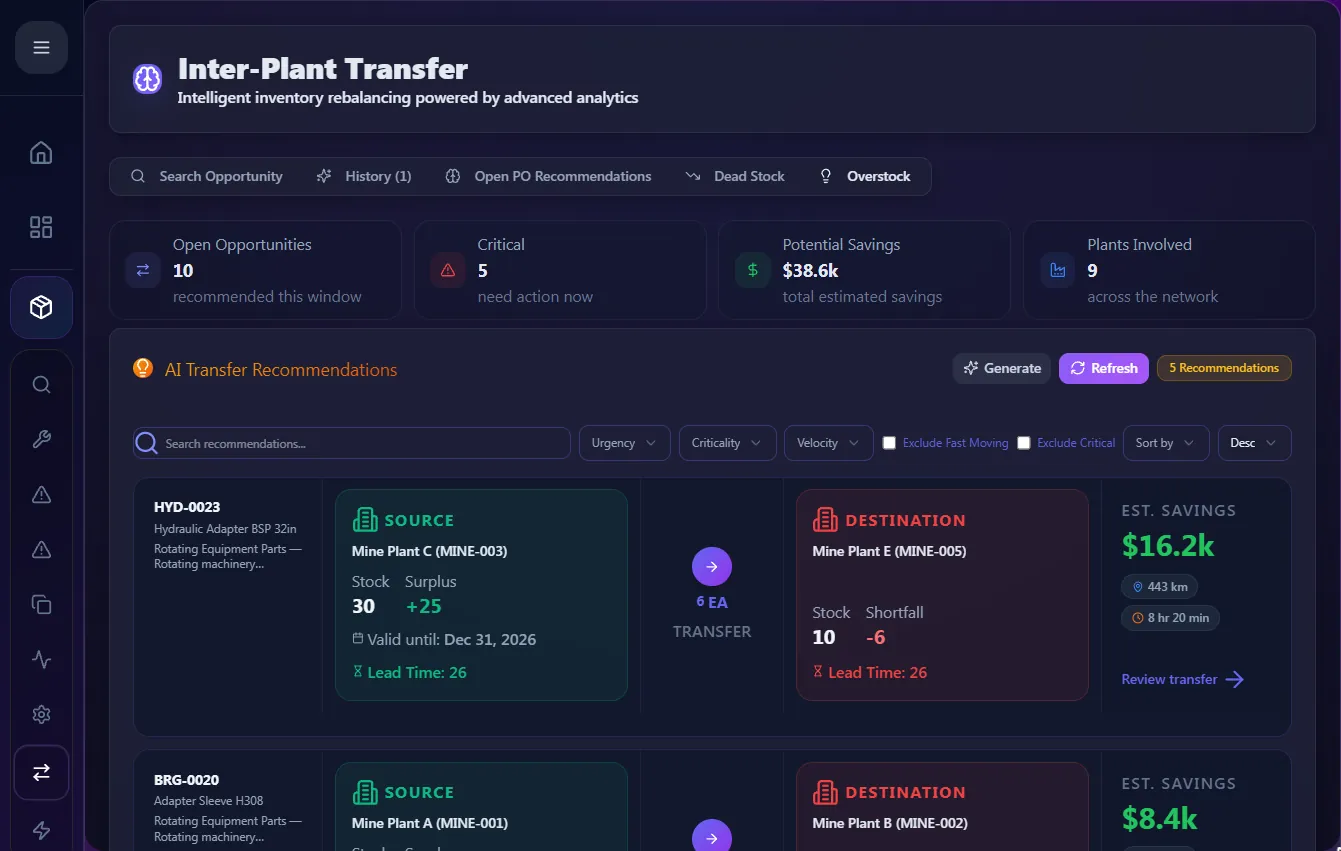
Get a free diagnosticMRO360 matches surplus at one plant with a shortfall at another and shows the savings, road distance and transit time before anyone raises an external PO. The decision stays with your planner.
Transfer recommendation
At one miner, Site A airfreighted a crusher bearing that sat unused in Site B's storeroom. Neither team could see the other's stock. That happened 14 times in a year.
Three screens do most of the work: the opportunities, the decision, and the value you get back from parts nobody needs.
Transfer cards show the source plant's surplus, the destination's shortfall, the quantity to move, estimated savings, distance and transit time.

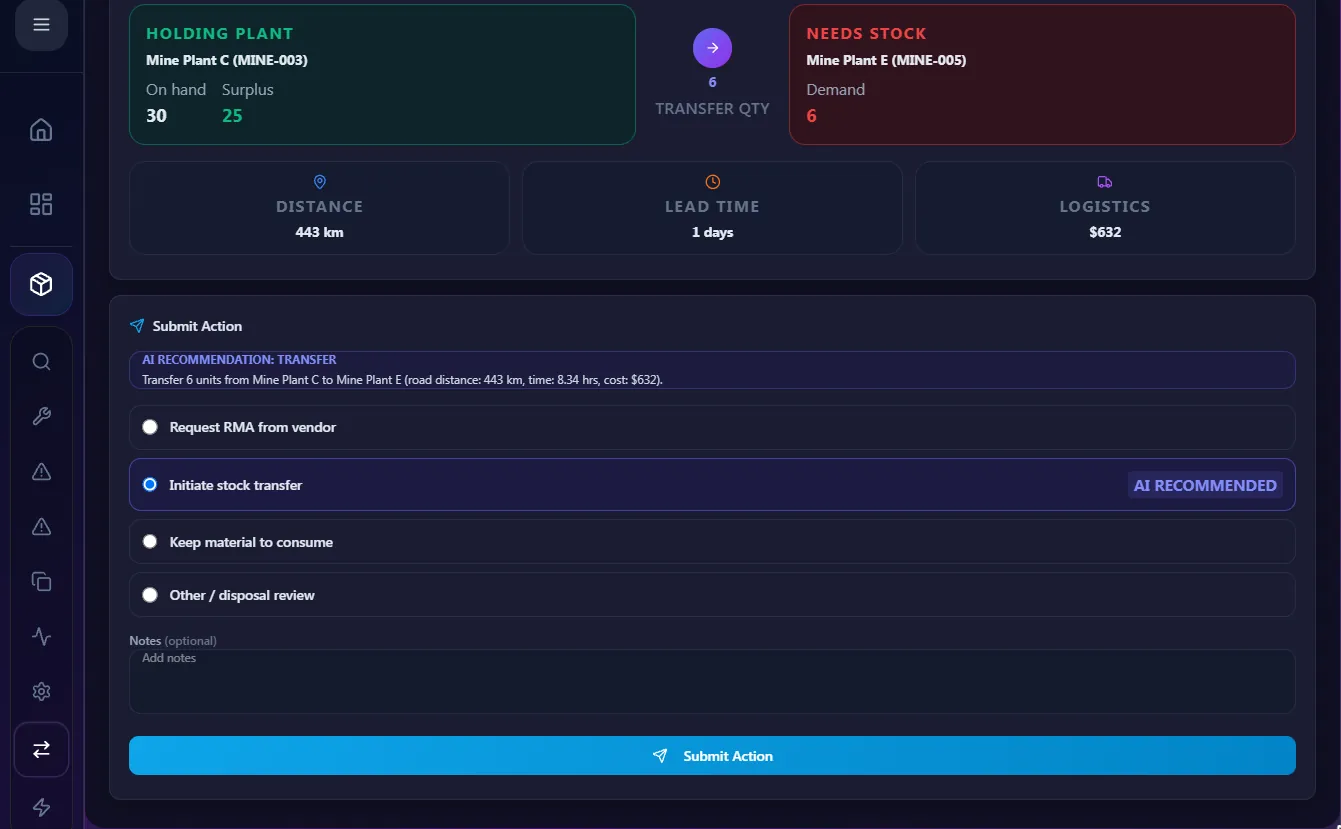
For each opportunity choose to transfer, request a vendor return, keep the material or send it for disposal review, with notes. Approved transfers become stock transport orders.

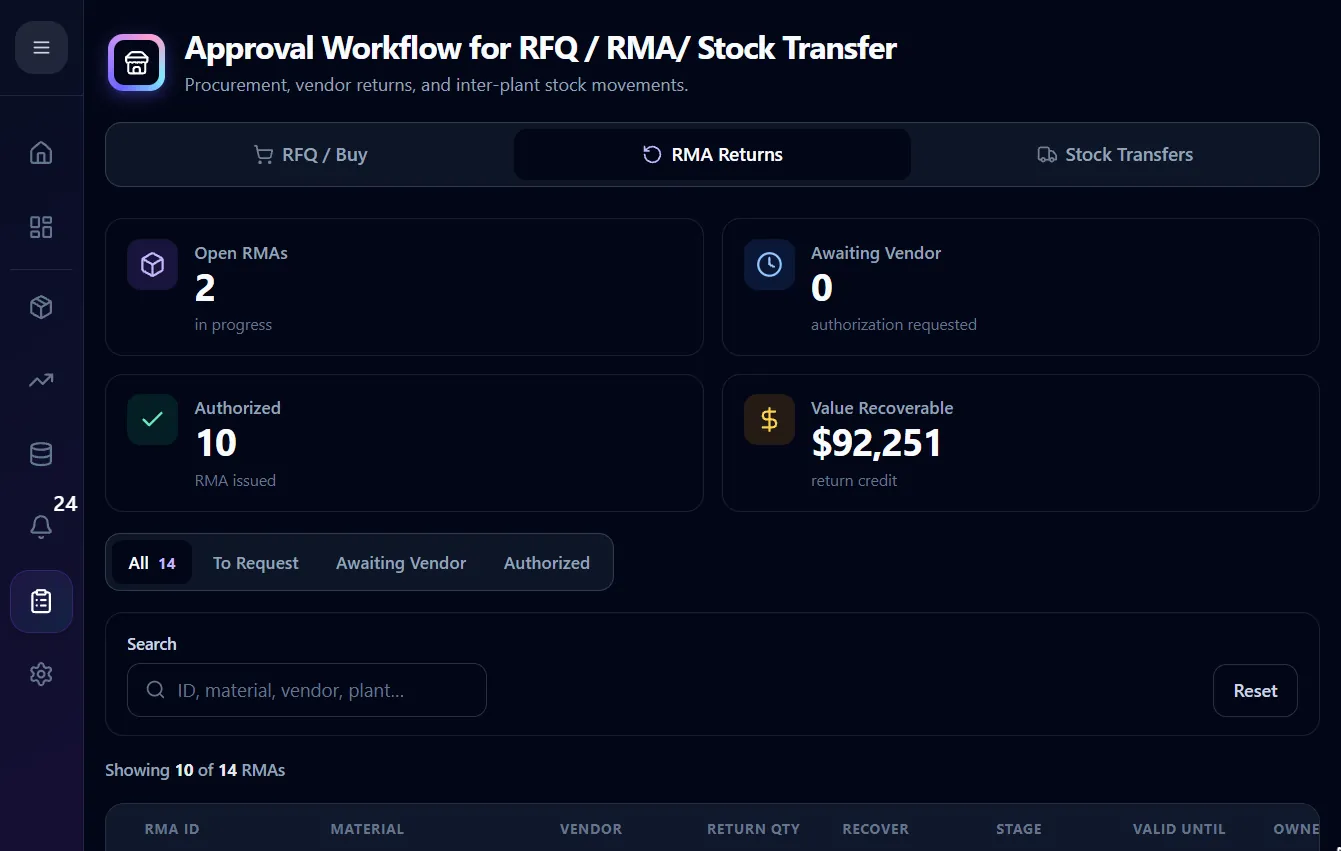
Dead stock and overstock are checked for vendor return eligibility, and returns are tracked from request to authorization with the value recoverable.

For every opportunity MRO360 shows the inventory position, return eligibility and logistics cost side by side. The planner picks one of four outcomes.
Every transfer and return is a planner decision. Stock transport orders and RMAs are created only after approval.
Stock Velocity tells this module which parts are idle. Work Orders Planner tells it which jobs are short. Transfers are the bridge between the two.
No. MRO360 reads each site's system, so transfers work across separate SAP instances or mixed ERP and CMMS estates.
Each recommendation weighs road distance, logistics cost, transit time and criticality urgency against the cost and lead time of a new purchase.
Yes. It checks RMA eligibility, vendor and return window, and tracks returns through authorization with the value recoverable.
Send one extract per plant. We match surplus to shortfall across all of them and value every transfer against buying new.
Free for multi-site operators. Findings within days of receiving the extracts.
A short call with an MRO specialist. We'll also email a secure link for your extract.
Oil and Gas organizations face huge unwanted costs in the form of losses, penalties and compensation due to industrial accidents, taking a sizable chunk of their revenues. One of the important reasons for failures and accidents is the breakdown of key industrial infrastructure arising from ineffective management of the material base and inefficiencies in the MRO supply chain that are highly critical for the production and maintenance cycles.
More and more organizations are now looking to establish Master Data Management (MDM) implementations in order to manage their assets through informed decision-making based on reliable data and ensure optimal industrial safety across the enterprise.
About the company:
This US based company is a global leader in providing essential mechanical components for both land and offshore drilling rigs, complete drilling and well servicing rigs, as well as a comprehensive range of tubular inspection, internal coatings, drill string equipment, lifting and handling gear, and downhole drilling tools. It also offers supply chain services through distribution centers strategically located near major drilling and production sites worldwide. With over 800 manufacturing, sales, and service centers globally and annual revenues exceeding $12 billion, the company delivers customer-focused solutions tailored to meet the energy industry’s quality, productivity, and environmental needs.
The company faced significant challenges with their master data.
• Lack of consistency and standards for the master data
• Incorrect, incomplete, unclassified and outdated attribute fields of master
data High volumes of data in multiple languages
• Multiple ERP and other legacy instances across the company
• Poorly structured material descriptions
• Lack of data governance and collaboration across cross-functional divisions and locations
Solution: Material Master Data Harmonization & Ongoing Maintenance
The company implemented Verdantis Material Harmonize to cleanse and enrich its historical material master data. Using AI-powered tools and the Verdantis Content Repository, the solution classified, standardized, and eliminated duplicate materials.
Once the data was harmonized, Verdantis Material Integrity was deployed for ongoing data governance. It ensured continuous data accuracy through real-time validation, AI-driven classification, and duplication prevention, maintaining high data quality across enterprise systems.
Key Actions Taken:
Results Achieved:
By integrating Material Harmonize & Material Integrity, the company achieved a scalable, AI-powered Master Data Management framework, ensuring long-term data consistency, efficiency, and compliance.