

Manufacturing leaders face a difficult decision: how much capital should be allocated to maintenance, repair and operations (MRO) spare parts to protect production without accumulating unnecessary inventory?
Excess stock ties up working capital, increases carrying costs and creates obsolescence risks. Insufficient stock can delay maintenance, extend equipment downtime and trigger expensive emergency purchases.
MRO spares inventory optimization addresses this challenge by aligning inventory levels with equipment criticality, demand patterns, supplier lead times and operational requirements. Rather than applying blanket stock reductions, manufacturers need a structured approach to determine which parts to retain, which to reduce and where existing inventory can be used more effectively.
For manufacturing leaders, effective MRO inventory optimization connects operational reliability with financial performance.
Why Spare Parts Inventory Optimization Requires a Different Approach
Unlike finished goods, maintenance spare parts often have intermittent and unpredictable demand. A component may remain unused for years but become essential during an unexpected equipment failure.
Spare parts inventory optimization therefore requires manufacturers to consider more than historical consumption and purchase value. Four factors should guide stocking decisions:
| Factor | Key consideration |
| Equipment criticality | What are the consequences of a part being unavailable? |
| Supplier lead time | How quickly can the component be replenished? |
| Demand variability | Is consumption regular, intermittent or maintenance-driven? |
| Financial exposure | How much capital is tied up, and what does it cost to retain the stock? |
A low-consumption component may justify protective stock if it supports critical equipment and has a long replacement lead time. Conversely, a frequently used component may require less local inventory if reliable replenishment and approved alternatives are available.
The objective is to establish stocking policies that reflect these differences rather than applying identical rules across the entire inventory portfolio.
MRO Inventory Management vs. Inventory Optimization
MRO inventory management covers the operational processes required to receive, store, issue, track and replenish maintenance materials. Inventory optimization examines whether the quantities, locations and replenishment policies themselves are appropriate.
| Dimension | MRO inventory management | MRO inventory optimization |
| Primary objective | Control inventory and maintain availability | Balance inventory cost, availability and risk |
| Main activities | Stock tracking, issuing and replenishment | Criticality assessment, demand analysis and policy review |
| Financial focus | Inventory control and valuation | Working capital and carrying-cost reduction |
| Key question | What inventory do we have? | What inventory should we hold, and where? |
Accurate inventory records do not guarantee efficient stocking decisions. A manufacturer can maintain reliable stock balances while continuing to replenish obsolete materials or hold excessive quantities.
Effective MRO inventory management and optimization must therefore work together. The first establishes control; the second improves the decisions that determine what the organization holds.
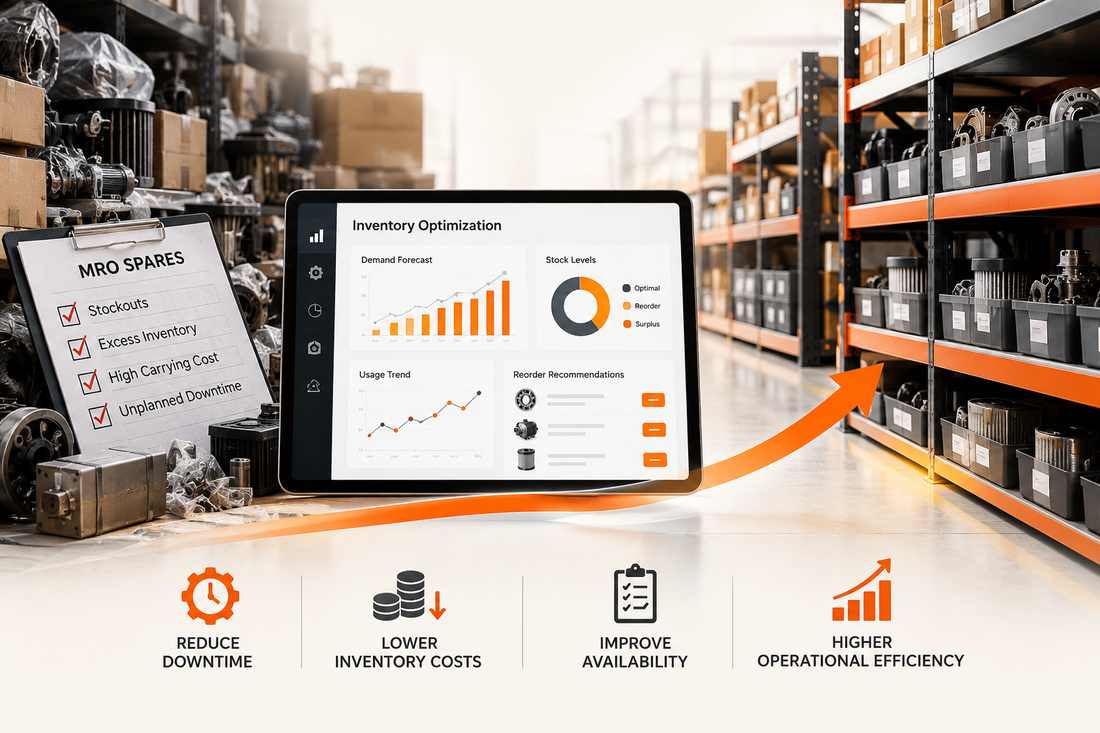
Four Inventory Decisions Manufacturing Leaders Must Make
1. Critical Spare Parts Management: What Should Be Retained?
Critical spare parts management identifies components whose unavailability could create significant production, safety or financial consequences.
Manufacturers should evaluate the equipment supported by each part, failure consequences, supplier lead times, approved substitutes and maintenance requirements.
Asset criticality and spare parts criticality are related but distinct. A critical machine may contain components with very different replacement options and stocking requirements.
For example, a readily available seal for a production-critical pump may require a different stocking policy from a proprietary motor component with a lengthy replacement lead time. The latter may justify stronger inventory protection despite its lower historical consumption.
Stocking decisions should document why the part is required, the level of protection needed and the conditions that would trigger a review.
2. Reduce Excess and Obsolete MRO Inventory
Manufacturers accumulate inventory through equipment modifications, changing maintenance requirements, duplicate material records and purchasing decisions made without visibility into existing stock.
A structured review should identify:
- Materials associated with decommissioned or modified equipment.
- Stock quantities that exceed current operational requirements.
- Duplicate material records that obscure actual inventory.
- Slow-moving items whose original stocking assumptions are no longer valid.
Low movement alone does not mean a part is unnecessary. Some components are held specifically for rare but consequential failures.
The objective is to distinguish genuinely excess inventory from stock that protects production continuity.
3. Improve Inventory Distribution Across Plants
Multi-site manufacturers may purchase a component at one plant while equivalent stock remains unused at another. Independent purchasing practices and inconsistent material descriptions can make these opportunities difficult to identify.
Before placing another order, planners should check whether suitable inventory is available elsewhere in the network.
Technical specifications, compatibility, condition and transfer lead times must be validated before stock is redeployed. Similar descriptions alone do not establish that two parts are interchangeable.
When suitable stock can be transferred within the required timeframe, inter-plant redistribution can reduce unnecessary purchases and improve inventory utilization.
4. Reassess Replenishment Policies
Reducing inventory without changing the underlying replenishment rules can produce temporary savings followed by renewed accumulation.
Manufacturers should review whether reorder points, safety stock and replenishment quantities reflect current demand, supplier lead times and equipment requirements.
A basic reorder point can be expressed as:
Reorder point = Expected demand during lead time + Safety stock
Expected demand during lead time estimates consumption while replenishment is pending. Safety stock provides a buffer against uncertainty in demand and supply.
These parameters should reflect the part’s operational importance and supply conditions. They should also be reviewed when suppliers, equipment configurations or maintenance requirements change.
How to Reduce MRO Inventory Costs Without Increasing Production Risk
A credible MRO inventory cost reduction programme must distinguish working capital release from recurring savings.
Suppose a manufacturer holds ₹10 crore in MRO inventory and identifies ₹1 crore of stock that can potentially be removed after operational validation. The ₹1 crore represents a potential working capital release, not an annual saving of the same amount.
If the organization’s validated annual carrying-cost rate is 20%, eliminating that inventory could generate an indicative annual carrying-cost benefit of ₹20 lakh, provided the associated costs are genuinely avoidable and no additional costs offset the benefit.
This example is illustrative. Actual savings depend on the inventory that can be removed, the costs included in the carrying-cost calculation and implementation expenses.
Manufacturers should evaluate four measures:
| Measure | What it establishes |
| Working capital released | Value of inventory removed or redeployed |
| Carrying-cost reduction | Recurring costs that can actually be avoided |
| Emergency procurement spend | Potential savings from fewer urgent purchases |
| Critical parts availability | Whether inventory changes preserve maintenance readiness |
Avoid counting the same benefit twice. Inventory value released and carrying costs avoided are different financial measures.
Manufacturers should also monitor stockouts, emergency purchases and critical-part availability after implementation. A reduction programme that releases capital but increases unplanned downtime may undermine its business case.
A Practical Framework for MRO Inventory Planning
MRO inventory planning should be a continuous process rather than an annual exercise in adjusting stock levels.
Step 1: Establish a reliable baseline. Consolidate inventory values, movement history, supplier lead times, stocking parameters and equipment relationships. Identify duplicate records and missing information.
Step 2: Prioritize inventory reviews. Focus on financially significant holdings, potential obsolescence, policy exceptions and parts with substantial operational consequences.
Step 3: Develop stocking recommendations. Determine which parts to retain, reduce, redistribute or manage under revised replenishment policies. Record the evidence supporting each decision.
Step 4: Validate changes across functions. Maintenance teams should assess operational risk, procurement should review supply conditions, and finance should validate the financial assumptions.
Step 5: Monitor the results. Track inventory value, critical-part availability, stockouts and emergency purchasing. Review exceptions and revise policies when operating conditions change.
This framework establishes accountability for both financial performance and production reliability.
How MRO Inventory Optimization Software Supports Better Decisions
For manufacturers managing large inventories across multiple plants, spreadsheets and static ERP reorder settings may not provide sufficient visibility into demand patterns, criticality and network-wide stock availability.
MRO inventory optimization software can help analyze inventory data, identify inefficient stocking policies and support more consistent replenishment decisions. Similarly, spare parts inventory optimization software can help planners evaluate stocking requirements and identify potential inventory imbalances across locations.
When evaluating MRO inventory planning software, manufacturers should assess its ability to work with existing data, account for operational constraints, support cross-site visibility and integrate with established ERP and EAM systems.
Manufacturing inventory optimization software should support informed decisions rather than rely on blanket reduction targets. Data quality, operational validation and clear governance remain essential to achieving reliable outcomes.
Verdantis MRO360 addresses MRO inventory challenges through inventory intelligence, spare parts criticality, demand forecasting and replenishment planning.
Its manufacturing case study, The 42% No One Had Measured, illustrates how examining multi-site spare parts inventory can reveal dormant holdings and opportunities for inventory rationalization. The findings are specific to that engagement and should not be treated as a universal savings benchmark.
Manufacturers can explore Verdantis MRO360 inventory intelligence to understand how its capabilities may support their inventory optimization objectives.
Inventory Optimization for Manufacturing Requires Defensible Decisions
Inventory optimization for manufacturing should not be measured solely by the amount of stock removed from warehouses. Its real value lies in reducing unnecessary capital commitments while preserving the parts availability required for reliable production.
Manufacturers need to determine what to retain, what to reduce, where to position inventory and which stocking policies need to change. These decisions should reflect equipment criticality, supplier conditions, maintenance requirements and financial objectives.
For organizations evaluating how to optimize spare parts inventory, an evidence-based review of existing holdings is the practical starting point. Identifying excess stock, duplicate records, cross-site availability and outdated stocking policies can reveal opportunities without imposing indiscriminate reductions.
Where inventory complexity exceeds the capacity of manual analysis, manufacturing inventory optimization software can support more consistent decisions. Verdantis MRO360 provides capabilities in inventory intelligence, criticality assessment, demand forecasting and replenishment planning to support this process.
The objective is straightforward: release working capital where it is unnecessary, preserve inventory where it protects operations, and maintain stocking policies that reflect changing manufacturing requirements.
Frequently Asked Questions
1. What is MRO spares inventory optimization?
MRO spares inventory optimization determines which maintenance spare parts a manufacturer should stock, in what quantities and at which locations. It balances inventory costs, working capital, supplier lead times, demand variability and the operational consequences of stockouts.
2. How can manufacturers reduce MRO inventory carrying costs?
Manufacturers can reduce MRO inventory carrying costs by reviewing excess and obsolete stock, correcting duplicate material records, reassessing stocking policies and redistributing suitable inventory across plants. Reductions should be validated against equipment requirements and supply constraints.
3. How do you determine optimal stock levels for critical spare parts?
Stock levels depend on equipment criticality, expected demand during replenishment lead time, demand variability, supplier reliability and replacement options. These factors should inform safety stock and reorder policies, which must be reviewed as operational conditions change.
4. What is the difference between MRO inventory management and inventory optimization?
MRO inventory management controls stock records, material movements and replenishment. Inventory optimization evaluates whether stocking quantities, locations and replenishment policies are appropriate for the organization’s financial objectives and operational risks.
5. How does MRO inventory planning software help prevent stockouts? MRO inventory planning software analyzes inventory balances, demand patterns, supplier lead times and maintenance requirements to identify shortages and support replenishment decisions. Depending on its capabilities, it can also evaluate criticality and identify suitable stock available at other locations. Its effectiveness depends on data quality and integration with existing systems.

