Key Takeaways
- An MRO inventory assessment analyzes your actual ERP data instead of industry averages.
- Start with one ERP extract: send a standard material master and movements extract.
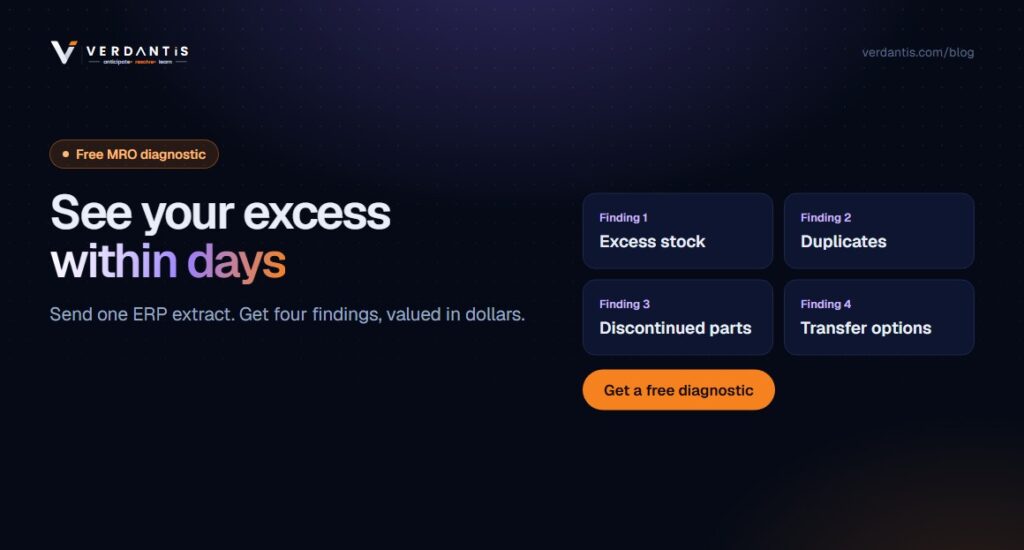
- Within days you get your excess, duplicates, discontinued parts and transfer opportunities, each valued in dollars.
- Verdantis runs it free: an MRO specialist will set up a secure upload and walk you through the findings.
- No system access, no obligation, no slideware: your numbers.
Read the full article below to learn more.






What You Get
Four findings, each valued in dollars, from your own data:
From your material master + movements extract
01
Excess
Your excess inventory, valued in dollars.
02
Duplicates
Your duplicate parts, valued in dollars.
03
Discontinued
Your discontinued parts, valued in dollars.
04
Transfers
Your transfer opportunities, valued in dollars.
Why Do Companies Run an MRO Inventory Assessment?
Usually one of three triggers
Finance is asking
Why does storeroom value keep climbing?
A critical stockout just happened
A stockout on a critical spare just caused expensive downtime.
An initiative is being scoped
An optimization initiative needs a fact base instead of assumptions.
In all three cases the assessment does the same job: it replaces the internal argument about whether there’s a problem with a quantified answer about how big it is and where it sits. Most plants that run one discover 20–40% of inventory value is excess, obsolete, or duplicated (the benchmarks behind that range are in our MRO inventory reduction playbook), but the number that changes the conversation is yours.
Start your free MRO inventory assessment
An MRO specialist will set up a secure upload and walk you through the findings.
Request a free diagnosticWhat Data Do We Need to Provide?
One standard material master and movements extract: no system access, no transport, no changes to how your ERP runs. An MRO specialist will set up a secure upload and walk you through the findings.
Works with SAP ECC and S/4HANA, Oracle, Maximo, Ellipse, and mixed multi-site landscapes. Incomplete data isn’t a blocker: messy descriptions are the norm, and exposing what they hide is half the assessment’s value.
How Long Does It Take, and How Much of Our Time?
Within days, and your side of the effort is one standard ERP extract:
One ERP extract, findings within days
Secure upload
An MRO specialist will set up a secure upload.
Start with one ERP extract
Send a standard material master and movements extract.
Findings within days
Your excess, duplicates, discontinued parts and transfer opportunities, each valued in dollars.
Walk-through
An MRO specialist will walk you through the findings.
What Does It Cost, and Why Is It Free?
It’s free, with no obligation, and the reason is straightforward commercial logic rather than charity: MRO360’s AI does the analysis work that used to take a consulting team months, so the assessment costs us little, and companies that see their own excess and duplicates valued in dollars tend to want the platform that fixes them continuously.
If the findings don't justify action, you keep them and we part as friends.
Either way, you walk away with a fact base that would cost six figures from a consulting firm.
Is Our Data Safe?
Yes, and the handling is designed for enterprise procurement review:
Designed for enterprise procurement review
01
NDA first
Mutual, before any data moves.
02
Read-only
Extract-based, no connection to your live systems, nothing written back.
03
Isolated and encrypted
Your data is processed in a logically isolated environment, encrypted in transit and at rest.
04
Deleted on request
If you don't proceed, we delete your extracts; you keep the findings.
05
Security artifacts on request
SOC 2-type documentation available for your infosec review up front, not after signature.
Who in Our Organization Should Sponsor This?
Whoever owns the pain, and the assessment is built to arm all three of the usual sponsors:
One assessment, three usual sponsors
Supply chain / materials
Excess and duplicates, valued in dollars
Finance keeps asking for them.
Maintenance & reliability
Discontinued parts and transfer opportunities
Found in the same analysis, from the same extract.
Finance
Every finding valued in dollars
Excess, duplicates, discontinued parts and transfer opportunities, on your own data.
If you’re building the internal case for any of these audiences, our reduction playbook covers the business-case math, and this assessment produces the plant-specific numbers to plug into it.
How Is This Different From Hiring a Consulting Firm to Study Our Inventory?
Three ways:
Three ways it differs from a consulting inventory study
| Consulting inventory study | Verdantis assessment | |
|---|---|---|
| Speed and cost | Three to six months and a six-figure fee | Findings within days, free, from one ERP extract, because AI does the matching, classification and policy analysis that consultants staff with analysts |
| Depth | Most studies work around dirty data rather than through it, which caps what they can find | The AI finds duplicates and equivalents across your material master as part of the analysis |
| What happens next | The report is the deliverable | A live analysis that becomes the running optimization if you proceed: nothing gets re-done, and the dollar values convert directly into tracked, ERP-verified reductions |
Evaluating platforms more broadly? The buyer’s guide covers the seven questions to ask anyone, including us.
What Happens After the Assessment?
Three honest outcomes
01
Execute internally
The findings are yours, and the write-off and redeployment actions don't require us.
02
Run a paid pilot
One plant, full optimization with recommendations flowing to planners, savings measured against the assessment baseline.
03
Proceed to multi-plant deployment
Using the assessment as the business case, typically when the findings are large enough that sequencing plant-by-plant would cost more in delay than it saves in risk.
The assessment is designed to make whichever path you choose defensible to your CFO.
We’re Mid-Budget-Cycle, Mid-S/4 Migration, or Just Reorganized. Should We Wait?
The assessment is precisely what you do while you can’t yet commit to a program: it’s free, the findings arrive within days, and it produces the number that determines whether next cycle’s budget should include this at all.
Mid-migration is actually the strongest timing: knowing your excess and duplicates before you migrate makes an ECC-to-S/4HANA move measurably cheaper, as we cover in our SAP spare parts optimization guide. The only bad timing is after the write-off audit or the next critical-spare stockout, when the same numbers arrive as bad news instead of a plan.
Start with one ERP extract
Send a standard material master and movements extract. Within days you get your excess, duplicates, discontinued parts and transfer opportunities, each valued in dollars. An MRO specialist will set up a secure upload and walk you through the findings. Prefer to talk it through first? Book 30 minutes with our team.
Frequently Asked Questions
What is an MRO inventory assessment?
What data do we need to provide for the assessment?
How long does the assessment take, and how much of our time?
Why is the MRO inventory assessment free?
Is our data safe during the assessment?
What happens after the assessment?
Related reading: How to Reduce MRO Inventory Without Stockouts · Spare Parts Criticality Analysis · MRO Inventory Optimization Software: Buyer’s Guide