Key Takeaways
- Ask every vendor for total first-year cost: license, implementation, integration and services, not the license line alone.
- Pricing models differ (per plant, per SKU band, per inventory value); normalize quotes to cost per plant per year to compare.
- The payback math runs on carrying cost and working-capital release, and it's usually decisive within year one.
- The expensive option is not the software. It's another year of the storeroom as-is.
- Pilots should be priced and scoped to convert into deployment, not run as standalone consulting.
Read the full article below to learn more.
Quick answer: Enterprise MRO inventory optimization platforms are priced by plants, SKU volume, or inventory value under management. Implementation ranges from bundled (modern cloud platforms) to services-led engagements (legacy suites). Against a carrying cost of 15-25% per year on MRO holdings, a platform that removes 15-30% of a $20M inventory pays back its first-year cost several times over.






What Pricing Models Do MRO Optimization Vendors Use?
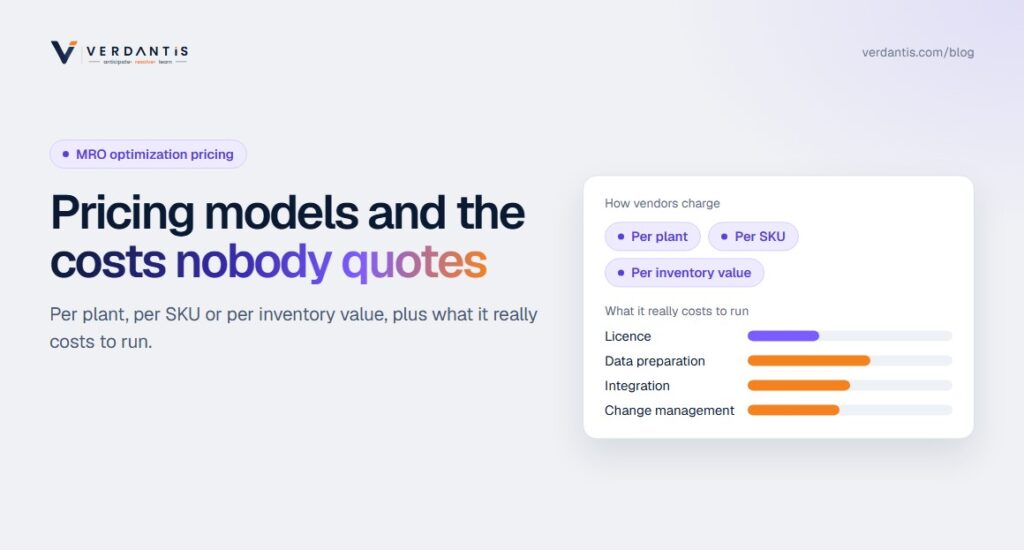
Three dominate the category:
Three pricing models dominate the category
Model 1
Per plant / site
A platform fee plus a per-site amount. Predictable for multi-plant rollouts, and the easiest model to budget as you scale.
Model 2
Per SKU volume
Banded by active material count. Fair for data-heavy scopes, but ask what happens when rationalization reduces your SKU count: the price shouldn't punish the cleanup.
Model 3
Per inventory value under management
A percentage-of-value logic that aligns vendor incentive with your holdings, though it can get expensive at mining/heavy-industry scale.
Most enterprise quotes blend a platform fee with one of these scaling axes. Whichever model you’re quoted, normalize to cost per plant per year and compare vendors on that number plus first-year services. It strips out the packaging differences.
What Goes Into a Realistic First-Year Budget?
Ask every vendor for total first-year cost: license, implementation, integration and services, not the license line alone. Two structural warnings apply whichever vendor you evaluate:
Two structural warnings
Warning 1
Services-led implementations
Legacy analytics suites often carry services-led implementations that exceed the license. Always ask for total cost of the first 12 months in writing.
Warning 2
“Free pilot” offers
From services-heavy vendors, these usually convert into paid discovery phases. A genuine software pilot runs on standard extracts in weeks, priced to credit against deployment.
What Hidden Costs Should We Budget For?
The quote covers the platform; these four live on your side of the table:
Four costs that live on your side of the table
01
IT time for extracts / integration
Usually small (days) for extract-based starts; larger if you mandate live interfaces on day one.
02
SME time
A materials/storeroom lead, 2-4 hours per week through the first validation quarter: the single most important investment in the program.
03
Change management
Planner training and the governance agreement on who approves policy changes. Cheap in money, decisive in outcomes.
04
Write-off execution
Disposing of the obsolete stock the platform finds has its own accounting timing. Agree it with finance up front so identified savings become realized ones.
Note what’s not on the list for modern platforms: hardware and database licenses.
How Do We Justify the Cost to Finance?
Run the CFO math on three lines your finance team already tracks:
The CFO math: three lines finance already tracks
Line 1
Carrying cost avoided
MRO holdings × 15-25% annual carrying cost × the 15-30% reduction the program targets.
$450K-$1.5Mper year in avoided carry, on $20M inventory
Line 2
Working capital released
The one-time balance-sheet release of the excess itself.
$3M-$6Mone-time, on that same $20M holding
Line 3
Downtime avoided
Parts-driven downtime hours × cost per hour, from fixing the under-protected criticals the same analysis finds.
Your hours × your ratefrom the criticals the analysis finds
Our ROI and business case guide includes the full model structure to present internally.
Want to see how this applies to your network?
Share your plant count, SKU volume, and ERP landscape and an MRO specialist will walk you through scope, the hidden costs on your side and the payback math on your figures.
Is a Pilot Worth Paying For, or Should We Demand It Free?
That’s the wrong question. The right one is what the pilot proves and what it converts into.
A well-structured pilot
01
Runs on a real extract
From your worst plant.
02
Returns evidence within 2–6 weeks
Evidenced duplicates, excess value, and under-protected criticals.
03
Is spot-checkable
By your own planners, on a random SKU sample.
04
Credits its cost against deployment
If you proceed.
Whether that’s free, paid, or credited matters far less than whether success criteria were agreed in writing before data changed hands.
A free pilot with vague criteria costs more than a paid one with sharp criteria: you pay in quarters, not dollars.
What’s Included With MRO360?
Straightforwardly: we’ll put a total first-year number in writing during evaluation.
What's included
MRO360, straightforwardly
- A platform fee plus per-plant scaling
- Standard SAP/Oracle/Maximo integration in scope
- Pilot costs credited against deployment
- A total first-year number (license, implementation, everything) in writing during evaluation
Where we're honest about fit
Below ~$3M MRO value, fix the process first
- Very small single-site holdings (under ~$3M MRO value) often can't justify any enterprise platform's cost
- Below that line, the carrying-cost math favors process fixes over software
What Does Doing Nothing Cost?
It’s the comparison every budget discussion should include. A $20M MRO inventory with typical 25% excess, standing still for one more year, means $750K-$1.25M in carrying cost on stock you don’t need, continued expedites and emergency freight on the criticals that aren’t protected, and an obsolescence pile quietly growing toward a write-off cliff.
The platform decision sits next to a seven-figure status quo. That asymmetry, not vendor features, is what gets these programs funded.
Run the payback math on your own figures
Tell us your plant count, ERP, and rough inventory value, and an MRO specialist will walk through scope and the first-year payback math on your figures.
Book a demo →Frequently Asked Questions
How is MRO inventory optimization software priced?
What pricing models do MRO optimization vendors use?
What hidden costs should we budget for beyond the license?
How do you justify MRO optimization software cost to finance?
Should an MRO optimization pilot be free or paid?
When is MRO inventory optimization software not worth the cost?
Related reading: MRO Inventory Optimization ROI: The Business Case · MRO Optimization Software Buyer’s Guide · MRO Optimization Alternatives