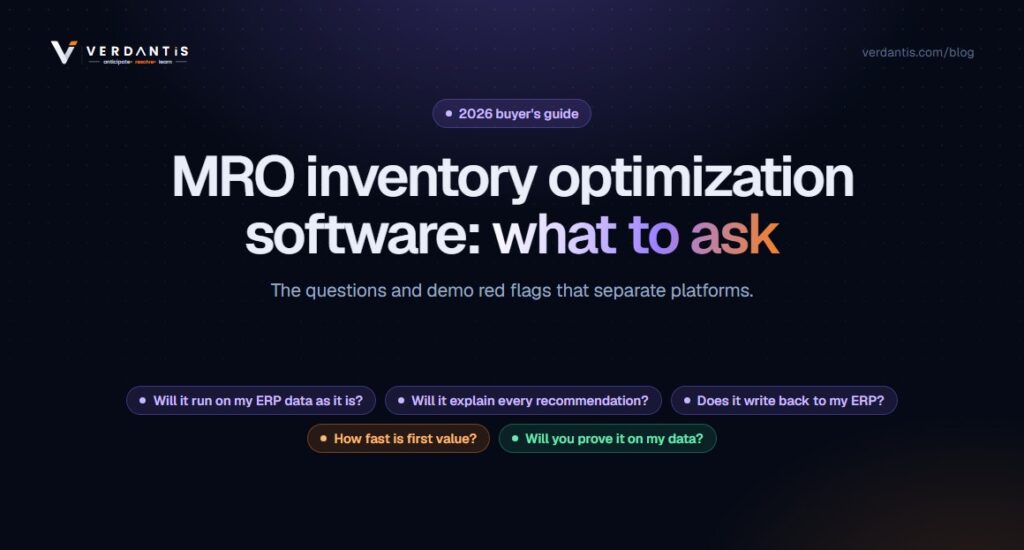
Quick answer: MRO inventory optimization software uses AI to score part criticality, find excess and obsolete stock, and continuously recommend the right stocking levels, typically cutting inventory 15–30% while improving parts availability. The deciding factors between vendors are how well it works on your real ERP data, ERP integration depth, explainability of AI recommendations, and time-to-first-value.
Key Takeaways
- Optimization software is dynamic and explainable; ERP min/max is static and blind to criticality.
- Demand a pilot on your own ERP extract: a vendor that needs months of data preparation first is a project killer.
- Credible ROI: 15–30% inventory reduction and 20–40% fewer part-driven downtime events over 12 months.
- A real POC needs only standard ERP extracts and runs in 2–6 weeks on your data.
- Watch for demo red flags: canned data, black-box scores, and services-heavy implementation plans.
Read the full article below to learn more.
If you’re comparing platforms like Verusen, IBM Maximo (Oniqua), HxGN EAM, or MRO360, this FAQ covers the questions that actually separate vendors in an evaluation.




What Does MRO Inventory Optimization Software Actually Do?
Four things, in sequence:
Four things, in sequence
Builds one view of every spare part
Reads materials, stock and history from your ERP and puts the spares of every plant in one searchable, scored view.
Segments inventory
By criticality, demand pattern, lead time, and value.
Recommends stocking policies
Min/max, reorder points, and safety stock per SKU, continuously updated as consumption and lead times change.
Executes
Pushes approved changes back to your ERP and tracks realized savings against a baseline.
If a vendor only does step 3, be careful: recommendations without a plant-wide view and criticality behind them produce confident, wrong answers, and recommendations that never reach the ERP never become savings.
How Is This Different from the Min/Max Settings in My ERP?
ERP min/max (SAP MRP types, Oracle min-max planning) is static. Optimization software is dynamic. ERPs also can’t detect duplicates across plants or infer criticality; they only execute the numbers they’re given.
ERP min/max (SAP MRP types, Oracle min-max planning)
Static
- Someone sets the numbers once, and they stay until someone remembers to change them
- Can't detect duplicates across plants
- Can't infer criticality
- Only executes the numbers it's given
Optimization software
Dynamic
- Recalculates policies as demand, lead times, criticality, and installed base change
- Explains why each change is recommended
The practical difference shows up at scale: no planning team can manually review 40,000 SKUs a quarter, so without an engine doing it continuously, policies decay to whatever was typed in years ago.
What Does Excess MRO Inventory Cost While You Wait?
The evaluation math that matters is cost against carrying cost.
The evaluation math: cost against carrying cost
$20M
MRO inventory
20%
annual carrying cost
$4M
per year, just existing
A platform that removes 20% of that inventory pays for itself several times over in year one.
Any vendor should be willing to build this model with your numbers before you sign.
What ROI Should I Expect, and How Fast?
Credible benchmarks from enterprise deployments:
Credible benchmarks from enterprise deployments
Inventory
15–30%
Inventory reduction over 12 months.
Downtime
20–40%
Fewer stockout-driven downtime events on critical equipment.
Time to value
6–8 weeks
To first validated recommendations with a modern cloud platform.
Be skeptical of vendors promising 50%+ reductions or savings in week two. Also ask how savings are measured: “identified savings” (what the algorithm found) and realized, ERP-verified savings (what actually left the balance sheet) are very different numbers, and only the second one survives a CFO review.
What Are the 7 Questions to Ask Every Vendor?
Ask every vendor the same seven questions:
The 7 questions to ask every vendor
| # | Question | What to listen for |
|---|---|---|
| 1 | Will you run on our ERP extract exactly as it is today? | A pilot on your real data, or a months-long data-preparation project before anything happens? |
| 2 | How does the AI explain its recommendations? | Black-box scores get rejected by planners; explainable recommendations get adopted. |
| 3 | What does ERP integration look like? | Read-only start, certified SAP/Oracle connectors, controlled write-back for approved changes. |
| 4 | How do you determine part criticality? | Asset linkage and failure impact, not just consumption frequency. |
| 5 | What's the time to first validated recommendation? | Weeks, not quarters. |
| 6 | Who owns the data and models after deployment? | Your data, your policies, exportable on exit. |
| 7 | What's the total first-year cost including implementation and services? | Total first-year cost, not license alone. |
Score each vendor's answers in writing. Vague responses to questions 1, 2, and 7 predict painful deployments with remarkable accuracy.
Do I Need to Prepare My Data Before Implementing?
No, and vendors who require a data project first are shifting their hardest problem onto you. MRO360 runs on the ERP data you already have: it reads materials, stock and history from SAP, Oracle or Maximo, and surfaces excess, obsolete and duplicate parts as findings for your team. Your ERP stays the system of record, and nothing changes there without your approval.
The question to ask isn't “is our data good enough?” It's “show me what your platform does with data exactly as bad as ours.”
Should We Build This In-House Instead of Buying?
Most enterprises with a data science team consider it, and the first analysis is genuinely buildable. What in-house builds consistently fail to deliver is the operating system around it:
Genuinely buildable
The first analysis
- A competent analyst can produce a one-time excess report from ERP extracts
What in-house builds consistently fail to deliver
The operating system around it
- Continuous re-optimization as lead times and demand shift
- Duplicate detection at material-master scale
- Criticality models linked to asset hierarchies
- Planner-facing explanations
- ERP write-back
- Savings tracking that survives audit
That's multi-year product engineering, not an analytics project.
The pragmatic test: if your build plan doesn’t include maintaining intermittent-demand models and a planner UI for the next five years, you’re planning a report, not a capability.
What Data Does a Vendor Need for a Pilot or POC?
Standard extracts your IT team can produce in days, with no SAP transport and no system changes:
Standard extracts, no SAP transport, no system changes
01
Material master
Numbers, descriptions, plant, MRP settings, valuation.
02
Consumption / issue history
24–36 months.
03
Open POs and purchase history
For lead times and pricing.
04
Equipment master and BOMs
Where available, for criticality linkage.
05
Current stock on hand
By location.
A serious vendor runs a 2–6 week POC on this data and comes back with your duplicates, your excess value, and your under-protected critical numbers you can independently verify. If a vendor wants a paid multi-month discovery phase before showing results on your data, that tells you how the whole relationship will go.
What Are the Red Flags to Watch for in Vendor Demos?
Six warning signs:
Red flags in vendor demos
01
Canned demo data only
If they won't run on a sample of your extract, the product likely can't handle real plant data.
02
Black-box scores
“Our AI rates this part 87” with no visible reasoning means planner adoption will fail.
03
No write-back story
Recommendations that live in a dashboard and never reach the ERP become shelf-ware.
04
Services-heavy implementation plans
A six-month project team requirement is a consulting engagement wearing a software badge.
05
Savings claims with no measurement methodology
Ask exactly how “realized savings” will be calculated and baselined.
06
One-ERP tunnel vision
If your landscape is mixed (SAP + Maximo, multiple instances), verify multi-source support live, not on a roadmap slide.
How Does MRO360 Compare to Verusen and IBM Maximo?
At a high level:
At a high level
| MRO360 | Verusen | IBM Maximo (Oniqua) | |
|---|---|---|---|
| Runs on your ERP data as it is | Yes | Partial | Limited — assumes Maximo data |
| Works across SAP/Oracle/Maximo | Yes | Yes | Maximo-centric |
| Explainable, planner-approved recommendations | Yes | Score-based | Rules-based |
| Time to first value | 6-8 weeks | Quarter+ | Multi-quarter program |
| Execution layer (write-back + tracked savings) | Yes | Recommendations-focused | Within Maximo suite |
See the full teardowns on our MRO360 vs Verusen and MRO360 vs IBM Maximo comparison pages.
What Does Implementation Actually Require from My Team?
Plan for:
What to plan for
IT
One ERP data extract or read-only connection
A few hours.
Materials / storeroom
2–4 hours per week during validation
A materials/storeroom SME.
Maintenance / reliability
Sanity-check criticality on top assets
A maintenance or reliability lead.
Governance-wise, agree upfront who approves policy changes and how write-back is controlled. That decision, not technology, is what determines rollout speed across plants.
How Should We Structure Pilot Success Criteria Before We Start?
Agree the scorecard with the vendor in writing before data is handed over: pilots without pre-agreed criteria always “succeed” in the vendor’s readout. A defensible scorecard has four parts:
A defensible scorecard has four parts
01
Data outcomes
Excess, obsolete and duplicate value found on your own data and verified by your planners.
02
Financial outcomes
Excess and obsolete value identified, independently spot-checked by your planners on a random sample of 50–100 SKUs.
03
Risk outcomes
Under-protected critical spares identified, validated by maintenance, since these are savings from avoided downtime, not just inventory cuts.
04
Adoption test
Put the recommendations in front of two working planners and measure how many they accept, adjust, or reject, and whether the explanations were good enough to decide quickly.
The spot-check on a random sample is the step most buyers skip and the one that most reliably separates real platforms from good demos.
What Will Our IT and Security Team Ask Cloud MRO Vendors?
Expect four questions in every enterprise review, and collect the answers during evaluation rather than after signature:
Four questions in every enterprise review
01
Access model
Read-only integration to start; write-back only for approved changes via standard, logged interfaces, no direct database access.
02
Tenancy and residency
For multi-tenant SaaS, how is your data isolated, in which cloud regions can it reside, and is it fully exportable on exit?
03
Security artifacts
SOC 2 (or equivalent) report, recent penetration test summary, encryption in transit and at rest.
04
AI governance
What data trains the models, is your data used to train other customers' models, and how are recommendations logged for audit?
A vendor that answers these fluently has been through enterprise procurement before. Hesitation here predicts a painful security review later; factor it into the shortlist.
Shortlisting vendors?
Bring us your worst plant's data. MRO360 will run a no-obligation excess and criticality analysis on a real extract so you evaluate on your numbers, not our slides.
Request an assessment →Book a demoFrequently Asked Questions
What does MRO inventory optimization software actually do?
How is it different from the min/max settings in my ERP?
What ROI should I expect, and how fast?
Do I need to prepare my data before implementing?
What data does a vendor need for a pilot or POC?
Related reading: MRO Inventory Reduction Playbook · SAP Spare Parts Optimization · MRO360 vs Verusen · MRO360 vs IBM Maximo