Key Takeaways
- Verusen's core strength is AI-driven material harmonization and trust-based inventory recommendations; the common evaluation concerns are recommendation explainability and depth of the execution loop back into the ERP.
- If duplicate, free-text material data is your root problem, shortlist platforms that run on that data as it is and surface duplicates as findings, instead of needing a data project first.
- If you live inside IBM Maximo, evaluate IBM's own MRO IO before anything else; if you're SAP-centric, weight native SAP PM/MM operation heavily.
- Demand-planning specialists win on forecasting science but typically assume cleaner data than MRO storerooms have.
- Running every finalist on the same extract of your worst plant's data is the only comparison that predicts deployment reality.
Read the full article below to learn more.
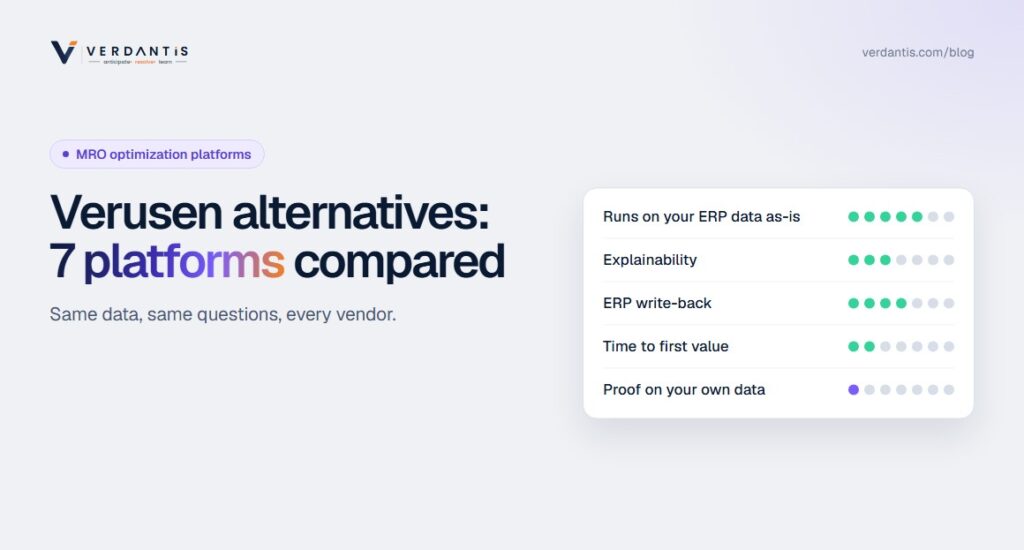
Quick answer: The strongest Verusen alternatives in 2026 are MRO360 (AI-native criticality, replenishment and transfers, with explained, approved recommendations and fast time-to-value), IBM Maximo Inventory Optimization (the Oniqua-heritage analytics engine, strongest inside IBM estates), and specialist planning platforms like Smart Software and ToolsGroup (deep intermittent-demand science). The right choice depends on four factors: how dirty your material data is, which ERP/EAM landscape you run, how much explainability your planners need, and how fast you need validated results.






Why Do Teams Evaluating Verusen Look at Alternatives?
Verusen is a credible, well-funded platform and belongs on MRO optimization shortlists. Three patterns send evaluators looking further, based on what buyers tell us in evaluations:
What buyers tell us in evaluations: they want…
01
Auditable recommendation logic
Recommendation logic their planners can audit line-by-line rather than trust scores.
02
An execution loop that closes
The optimization loop to execute approved policy changes written back to the ERP, with savings tracked against a baseline.
03
Proof on their own data, fast
Proof on their own data inside weeks rather than a longer program.
None of these are universal experiences; they’re the evaluation criteria that separate the field, which is why the comparison below is organized around them.
The 7 Platforms Compared
The 7 platforms compared
| Platform | Best for | Data approach | Explainability | Time to first value |
|---|---|---|---|---|
| MRO360 (Verdantis) | Enterprises with messy multi-plant data on SAP/Oracle/Maximo wanting analysis, optimization and ERP write-back in one platform | Runs on your ERP data as it is; duplicates and equivalents surfaced | Every recommendation carries visible reasoning | 6-8 weeks |
| Verusen | Multi-site harmonization and inventory visibility programs | AI harmonization is core | Trust-score based | Quarter+ |
| IBM Maximo Inventory Optimization | IBM Maximo estates; Oniqua-heritage statistical rigor | Limited: assumes governed data | Rules/statistics based | Multi-quarter program |
| Smart Software (Smart IP&O) | Intermittent-demand forecasting science; planning-team led initiatives | Not core | Statistical, planner-oriented | Quarter+ |
| ToolsGroup (SO99+) | Service-parts and distribution networks; probabilistic planning depth | Not core | Model-based | Quarter+ |
| SPARETECH | Parts data and duplicate identification, European OEM catalog depth | Data platform is the product | Data-matching focused | Weeks (data scope) |
| Xtivity | Managed-service MRO optimization for teams wanting outcomes without running software | Service-delivered | Analyst-mediated | Program-based |
Three honest notes on reading this table
01
“Best for” matters more than feature counts
A Maximo shop evaluating IBM's own module is rational, and a company whose only problem is duplicate part data may find a data-scope tool sufficient.
02
The data column is the one most evaluations underweight
Optimization math on fragmented demand history produces confident, wrong answers regardless of vendor.
03
Every “time to first value” figure assumes prompt extracts
It assumes your IT can produce standard extracts promptly; that's usually the binding constraint, not the platform.
How Should We Run the Actual Evaluation?
Use the same discipline for every finalist:
Use the same discipline for every finalist
Same data, every vendor.
One extract from your worst plant (material master, 24–36 months of consumption, open POs, equipment/BOMs). Vendors demo brilliantly on their own data; the ranking that matters comes from yours.
Score explainability with real planners.
Put each platform's recommendations in front of two working planners and count what they can confidently approve. Adoption is where these programs live or die.
Demand the execution story.
Where do approved changes go, through what interface, with what audit trail, and how are realized (not identified) savings measured?
Pre-agree success criteria in writing.
Duplicate rate evidenced, excess value spot-checked on a random SKU sample, under-protected criticals validated by maintenance.
Our buyer’s guide carries the full seven-question vendor scorecard and pilot framework.
Where Does MRO360 Genuinely Differ?
Since this is our page, here is the specific case, verifiable in an evaluation:
Our case, verifiable in an evaluation
Where MRO360 genuinely differs
- Criticality comes from the equipment each part protects, so critical spares are protected, not cut, and it runs on the ERP data you already have, live in 8–12 weeks
- Every recommendation ships with its reasoning (demand pattern, lead time, criticality, asset link), which is what makes planner adoption and audit sign-off fast
- The loop closes: approved policies write back to SAP, Oracle, or Maximo through standard interfaces with savings tracked against a frozen baseline
Being honest
Where competitors are stronger
- IBM inside all-IBM estates
- The forecasting specialists on pure planning-science depth for already-clean data
- Verusen where multi-site visibility and harmonization is the primary goal
Bring the same extract to all of us and let the outputs argue.
Shortcut the bake-off
MRO360 will run your extract through the same analysis we'd deploy with, no obligation, usually inside two weeks.
Frequently Asked in Evaluations
Is IBM Maximo Inventory Optimization only for Maximo users?
Can't our ERP or EAM do this natively?
Do any of these require clean data first?
Related reading: MRO Inventory Optimization Software Buyer’s Guide · MRO360 vs IBM Maximo · SAP Spare Parts Optimization Guide