Key Takeaways
- SAP MRP executes replenishment; it has no engine to optimize intermittent, failure-driven spare-parts demand.
- 10–25% duplication in MRO material masters is typical in enterprise SAP landscapes, and it corrupts every downstream number.
- You don't need S/4HANA to fix this; optimization actually makes an ECC-to-S/4 migration cheaper.
- Deployment starts read-only: no transports, no process change, planners keep working in SAP.
- Typical results: 15–30% inventory reduction in a year, with an auditable rationale behind every stocking policy.
Read the full article below to learn more.
Quick answer: SAP MM handles MRO transactions well but was never designed to optimize spare parts. The fix is not replacing SAP; it's adding an AI optimization layer that reads SAP data, recommends better policies, and writes approved changes back through standard interfaces.
SAP MM handles MRO transactions well, but MRP types like VB rely on static, manually set reorder points, there’s no criticality-based logic, and duplicate material masters silently distort every calculation.
Most large manufacturers we work with run maintenance and materials on SAP ECC or S/4HANA. This FAQ covers what SAP-shop maintenance and supply chain leaders ask when the storeroom keeps growing despite “having it all in SAP.”






Can’t SAP MRP Already Optimize My Spare Parts?
SAP MRP executes replenishment; it doesn't optimize it.
With MRP type VB (manual reorder point), the reorder point and maximum are whatever a planner typed in: often at plant commissioning, often padded after a bad stockout, rarely revisited. VM (automatic reorder point) exists but uses forecast models built for production materials with steady demand, which spare parts don’t have. MRO demand is intermittent, lumpy, and driven by failures, not schedules.
The result in most SAP environments: thousands of materials on stale VB settings, safety stock as folklore, and no one able to say which of 40,000 SKUs actually protect production.
Why Do Duplicate Material Masters Matter So Much in SAP?
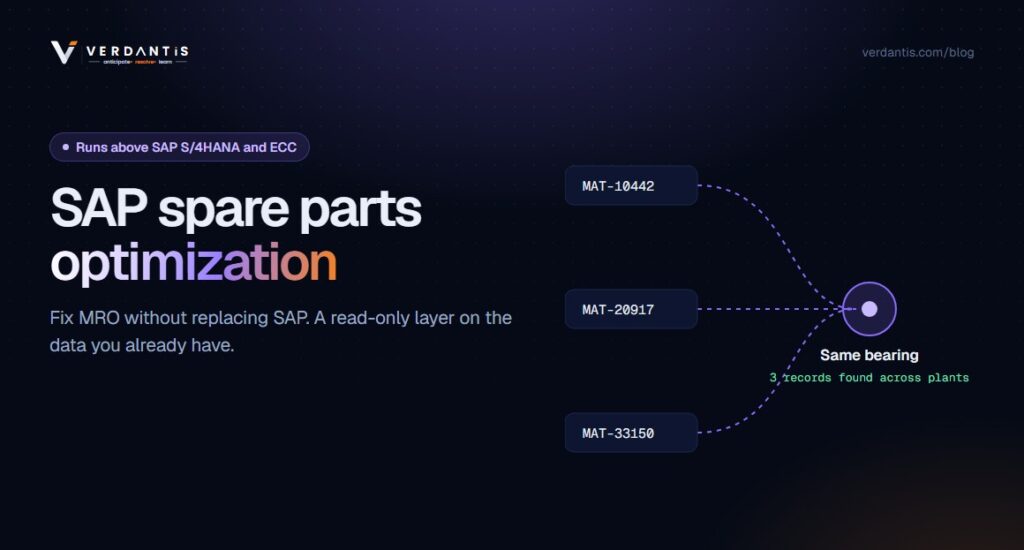
Because they fragment demand history. When “6205-2RS BEARING,” “BRG BALL 6205,” and “BEARING, 6205, SKF” are three material numbers across three plants, each shows one-third of true consumption:
One bearing, three material numbers, three plants
6205-2RS BEARING⅓ of consumptionBRG BALL 6205⅓ of consumptionBEARING, 6205, SKF⅓ of consumptionWhat SAP sees
- Each looks like a slow mover
- Each carries its own safety stock
- Cross-plant stock sharing becomes impossible
Any optimization run on top of that data is optimizing fiction.
In enterprise SAP landscapes, 10–25% duplication in MRO material masters is common. Any optimization run on top of that data is optimizing fiction, which is why serious platforms find duplicates and fragmented history across plants as part of the analysis, instead of waiting on a separate data project you must finish first.
Which SAP Data Does an Optimization Layer Actually Use?
Standard extracts or a read-only connection covering five areas:
Standard extracts or a read-only connection covering
MM
Material master
MARA/MARC-level data: material numbers, descriptions, plant assignments, MRP type, reorder point, safety stock, valuation class.
MM
Consumption history
Goods issues and reservations (typically 24–36 months) from material documents.
MM
Purchasing
Open POs, purchase history, info records: the source of real lead times and prices.
PM
Plant maintenance
Equipment master, functional locations, and material-to-equipment BOM links where maintained: the backbone of criticality scoring.
MM
Stock
On-hand by plant and storage location.
Your BASIS or data team can produce these as flat extracts in days, or expose them via standard interfaces. Nothing here requires a transport, an enhancement, or a change to how SAP runs.
Do I Need to Migrate to S/4HANA to Fix This?
No. S/4HANA improves the platform but does not add spare parts specific optimization:
S/4HANA improves the platform
What you get
- Better MRP runs
- Fiori apps
- Embedded analytics
Outside standard scope
What it does not add
- Criticality scoring
- Intermittent demand modeling
- Duplicate detection
- Multi-plant pooling
The gap you have in ECC persists in S/4.
How Does Spare Parts Optimization Help an ECC-to-S/4HANA Migration?
Three concrete ways, which is why several of our customers run optimization through their migration rather than waiting for it.
Three concrete ways optimization helps the migration
01
You migrate less junk
Knowing your excess, obsolete and duplicate parts before you migrate means fewer objects to convert, test, and govern in the new system. Data volume is a direct driver of migration cost.
02
You don't migrate dead stock decisions
Rationalizing inventory before cutover means the S/4 system starts with defensible policies instead of inheriting a decade of padded VB settings.
03
The optimization layer is migration-proof
It sits outside SAP and connects through standard data, so it works identically against ECC today and S/4 after cutover: continuity through the riskiest IT program most companies will run this decade.
What About SAP IBP, or Building This In-House on BW/Datasphere?
SAP IBP is built for finished-goods and production supply chains; its statistical models assume demand patterns MRO doesn’t have, and it has no concept of asset criticality or BOM-to-equipment linkage.
In-house (BW, Datasphere, Excel, analytics team): teams build a one-time analysis that’s accurate for a quarter, then decays. The hard part isn’t the first calculation; it’s continuously re-optimizing tens of thousands of SKUs as lead times, consumption, and the installed base change, and getting planners to trust and apply the output. That’s a product, not a report.
We Run Multiple SAP Instances and Plants. Does That Break the Model?
It’s actually where the value concentrates. Multi-instance and multi-plant SAP landscapes are where duplication and stranded stock hide best: each instance has its own material numbering, so the same OEM part exists under unrelated numbers with no cross-visibility.
An optimization layer above the instances gives you one view of every spare and a network view SAP itself can’t produce: which slow-moving criticals can be pooled regionally, where one plant’s excess covers another’s open requisition, and which parts are duplicated across instances.
Plants keep their local stock and local SAP; the platform sits across them.
How Does the Integration Work Without Disrupting SAP?
A modern deployment runs in four steps.
A modern deployment looks like this
Read-only extract or connection
To the MM/PM data above. No changes to SAP.
Duplicates and equivalents found
Across plants and instances, listed for your team with the value at stake.
Recommendations
For min/max, safety stock, and stock rationalization, each with an explanation a planner can audit (demand pattern, lead time, criticality, asset link).
Controlled write-back
Of approved changes to SAP via standard interfaces, so SAP remains the system of record and your change-control process stays intact.
Your planners keep working in SAP transactions they already know. The optimization layer just makes the numbers in SAP right and keeps them right.
What Will Our IT and Security Team Ask, and What Are the Answers?
Four questions come up in every evaluation.
The four questions SAP shops raise in every evaluation
| Question | The answer |
|---|---|
| Access model | Read-only to start; write-back only for approved changes through standard, logged interfaces. No direct database access, no transports. |
| Data residency and tenancy | Confirm cloud region options and tenant isolation for a multi-tenant SaaS platform; your data should be logically isolated and exportable. |
| Security posture | Ask for the vendor's security artifacts (SOC 2 or equivalent, penetration test summaries, encryption in transit and at rest) during evaluation, not after signature. |
| Performance impact | Extract-based integration has zero impact on the productive SAP system; scheduled extracts run like any other interface job. |
A vendor fluent in these answers has deployed against real SAP landscapes. Hesitation here is a proxy for deployment risk.
What Results Do SAP Customers Actually See?
What enterprise SAP environments typically see
15–30%
MRO inventory reduction within a year
10–25%
Duplicate rate found and valued across plants
Fewer stockouts
On critical spares, because criticals get protected, not cut
Plus a defensible, auditable basis for every stocking policy.
Just as important for SAP shops: a defensible, auditable basis for every stocking policy, which is what internal audit and finance have been asking the storeroom for. And because the recommendations carry their reasoning, planner adoption survives the people changes that kill spreadsheet-based programs.
Does This Connect to SAP PM Work Orders and Reservations, or Just MM?
The PM side is where the criticality intelligence comes from. Goods issues tell you what was consumed; work orders and reservations tell you why: which equipment failed, whether the work was planned or breakdown, and which parts were reserved but unavailable. That linkage powers three things MM data alone can’t:
Three things MM data alone can't do
Criticality scoring grounded in failure impact
Parts consumed on breakdown orders against production-critical functional locations rank differently from the same part used on planned work.
True stockout detection
Reservations that couldn't be fulfilled from stock are your real service-level failures, even when no one logged a complaint.
BOM gap analysis
Critical equipment with no maintained material BOM is invisible risk; the platform flags critical equipment with no parts list behind it.
Plants with thin PM data aren’t excluded: optimization starts on consumption patterns and improves asset linkage maturity.
What Happens to Our SAP Planners’ Roles?
They move up the value chain rather than out of it. Today a planner’s week is consumed by expediting shortages and answering, “why do we have so much of X?”: reactive work created by stale policies. With an optimization layer, the planner’s job becomes reviewing exception-based recommendations (each with visible reasoning), approving or adjusting them, and managing supplier lead-time performance: the judgment work it was always supposed to be.
Practically, plan for 2–4 hours per planner per week during the first-quarter validation phase, dropping to routine exception review afterwards. Adoption fails only when recommendations arrive as unexplained numbers; it sticks when planners can see the demand pattern, lead time, and criticality behind each one.
Explainability belongs on your vendor scorecard, not the nice-to-have list.
Running MRO on SAP?
MRO360 deploys against ECC and S/4HANA with a read-only start (no SAP transports, no process disruption) and shows your excess, duplicates, and under-protected criticals in the first weeks.
Frequently Asked Questions
Can SAP MRP optimize spare parts?
Why do duplicate material masters distort SAP spare parts data?
Do I need to migrate to S/4HANA to optimize spare parts?
Which SAP data does a spare parts optimization layer use?
How does an optimization layer integrate with SAP without disruption?
What results do SAP customers see from spare parts optimization?
Related reading: MRO360 · MRO Inventory Reduction Playbook · MRO Inventory Optimization Software: Buyer’s Guide