

A maintenance team can schedule an equipment overhaul weeks in advance, allocate technicians and prepare the work orders, yet still delay the job because a required spare part is unavailable. The maintenance plan may be sound, but the inventory plan has failed to support it.
This disconnect is common in asset-intensive manufacturing. Maintenance teams plan around equipment requirements, while inventory teams often rely on historical consumption, fixed reorder points and separate procurement schedules.
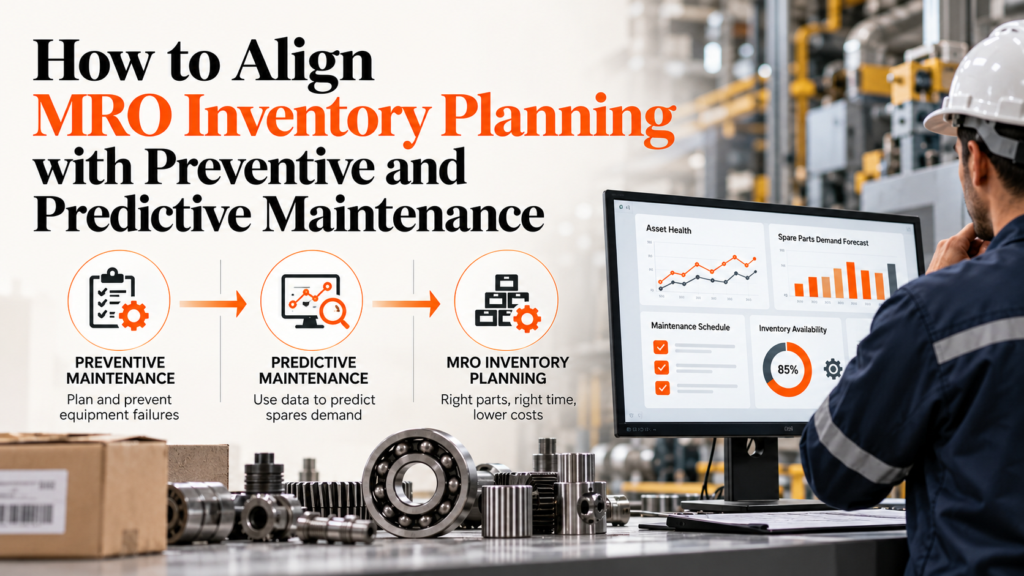
MRO inventory planning with preventive and predictive maintenance provides and effective outcome. Preventive maintenance provides visibility into scheduled work. Predictive maintenance can provide additional signals about developing equipment problems. Together, these inputs help manufacturers anticipate spare parts requirements before they become urgent purchasing requests.
For organizations managing complex equipment and multiple plants, aligning maintenance and spare parts inventory management can reduce avoidable stockouts, improve maintenance readiness and make better use of working capital.
Preventive Maintenance: Planning Spare Parts Around Scheduled Work
Preventive maintenance involves performing maintenance activities at predetermined intervals or according to established usage-based schedules. Inspections, lubrication, filter replacements and planned component changes are common examples.
Because these activities are scheduled, they create an opportunity to plan material requirements in advance.
Preventive maintenance spare parts planning
Preventive maintenance spare parts planning begins with the maintenance schedule and the parts required to execute each work order.
A practical process connects:
- Planned maintenance dates and work orders.
- Equipment bills of materials and approved spare parts.
- Required quantities and existing inventory.
- Open purchase orders and supplier lead times.
- Parts already reserved for other maintenance activities.
Consider a plant preparing for a scheduled compressor overhaul in six weeks. The maintenance plan identifies the required seals, bearings and replacement components. Inventory planners can compare those requirements against available stock and incoming deliveries, then initiate procurement where necessary.
This approach is more reliable than waiting for consumption to occur before adjusting replenishment quantities.
However, preventive maintenance does not eliminate uncertainty. Planned work may be rescheduled, component condition may differ from expectations, and additional defects may be discovered during inspection. Inventory policies must account for these possibilities without treating every planned requirement as an inflexible demand signal.
Predictive Maintenance: Preparing for Demand Before Failure
Predictive maintenance uses equipment condition and performance information to assess deterioration and identify potential failures. Depending on the equipment and monitoring system, signals may include vibration trends, temperature changes, lubricant analysis or other condition indicators.
These signals can provide useful context for inventory planning, but they must be interpreted carefully. An abnormal vibration reading, for example, does not automatically establish that a particular component will fail on a specific date.
Predictive maintenance inventory planning
Predictive maintenance inventory planning connects relevant equipment-health signals with the spare parts potentially required for inspection, repair or replacement.
The process may involve linking condition alerts to equipment records, reviewing previous failure modes, identifying affected components and assessing whether suitable inventory is available.
When a developing problem creates a credible maintenance risk, planners can investigate replenishment options before the equipment requires an unplanned intervention.
The value lies in creating more preparation time, not in assuming that every predicted failure will occur.
This distinction matters when deciding whether to procure a component immediately, monitor the condition further or use an existing stock buffer. The decision should consider the confidence of the maintenance signal, the consequence of failure, the component’s lead time and the availability of alternatives.
How predictive maintenance improves MRO inventory planning
Predictive maintenance can improve MRO inventory planning by introducing condition-based information that historical consumption alone may not reveal.
For example, a component may have low recorded consumption because replacements are infrequent. If condition monitoring identifies deterioration in a critical asset, that information may justify reviewing the component’s availability before the next planned maintenance window.
The planning team can then assess the likely requirement, current inventory, procurement lead time and operational consequences of a shortage.
The signal should not automatically trigger a purchase. It should prompt a decision based on the evidence available and the risk associated with waiting.
Preventive vs. Predictive Maintenance Inventory Planning
Preventive and predictive maintenance provide different kinds of information. Effective inventory planning uses both where appropriate rather than treating them as competing approaches.
| Planning consideration | Preventive maintenance | Predictive maintenance |
| Primary input | Scheduled maintenance intervals and work orders | Equipment condition and developing failure signals |
| Demand visibility | Often known in advance | Depends on the condition signal and its reliability |
| Inventory implication | Plan known requirements before scheduled work | Review potential requirements before an expected intervention |
| Main uncertainty | Schedule changes and additional findings | Signal interpretation, failure timing and diagnostic accuracy |
| Planning priority | Confirm parts availability for scheduled work | Assess risk and prepare for plausible future demand |
A preventive schedule can establish a baseline for expected parts consumption. Predictive information can help identify where additional review or protection may be warranted.
Corrective maintenance remains another source of demand. Unexpected failures can occur even when preventive schedules and condition-monitoring systems are in place. Inventory planning must therefore consider planned, condition-indicated and unplanned requirements.
Spare Parts Demand Forecasting Using Maintenance Data
Spare parts demand forecasting using maintenance data connects inventory history with the operational events that generate demand.
Historical consumption alone can be misleading. A part with low annual usage may support equipment that requires a replacement during a major overhaul. Another component may experience increased demand because a particular failure mode is recurring across several assets.
A more useful forecasting process combines relevant information from maintenance and supply chain systems.
- Maintenance schedules and work orders help identify known requirements and expected timing.
- Equipment failure history and root-cause records provide context for recurring problems and potential corrective demand.
- Operating hours and condition information, where available, can help explain changes in wear or failure exposure.
- Inventory balances, reservations and supplier lead times establish whether the forecasted requirements can be met.
These inputs should be assessed together, while keeping scheduled requirements distinct from less certain corrective demand.
Verdantis’s MRO360 maintenance demand forecasting capabilities are designed to combine historical consumption with equipment maintenance history, root-cause information, operating hours and work orders. The approach separates preventive and corrective demand to support part-level forecasting.
The quality of any forecast depends on the completeness of the available records and the suitability of the model. Manufacturers should compare forecasted requirements with actual outcomes and investigate material deviations.
MRO Inventory Optimization: Turning Maintenance Signals into Stocking Decisions
Better demand information is only useful when it informs inventory policy.
MRO inventory optimization connects expected demand with criticality, supplier lead times, current stock and the consequences of a stockout. This helps manufacturers decide whether a forecasted requirement calls for replenishment, a stock transfer, a policy adjustment or further review.
Three decisions are particularly important.
- Criticality-based stocking: Parts supporting equipment with severe failure consequences may require greater protection than components that are readily replaceable or available from reliable suppliers.
- Spare parts reorder point optimization: Reorder points should reflect expected demand during replenishment lead time and an appropriate safety buffer. Scheduled maintenance requirements and credible changes in failure exposure may justify reviewing existing thresholds.
- Cross-site inventory coordination: Before raising a new purchase order, planners should establish whether another plant has a technically compatible part available within the required timeframe.
These decisions should remain subject to operational validation. A maintenance alert or forecast should not automatically override approved inventory policies without considering the consequences.
The Role of MRO Inventory Planning Software
For manufacturers with complex maintenance operations, spreadsheets and disconnected systems can make it difficult to reconcile work orders, inventory balances and future material requirements.
MRO inventory planning software can help consolidate relevant information, forecast demand and identify potential shortages before maintenance begins.
When evaluating maintenance inventory management software, manufacturers should assess whether it can:
- Connect maintenance work orders with relevant spare parts.
- Incorporate historical consumption and maintenance-related data.
- Identify requirements that may exceed available inventory.
- Support reorder point and safety stock reviews.
- Provide visibility into stock across multiple plants.
- Integrate with existing ERP, EAM and CMMS environments.
Verdantis MRO360 provides inventory intelligence, spare parts criticality, maintenance demand forecasting and replenishment planning capabilities designed to work alongside existing enterprise systems.
Manufacturers should establish which maintenance signals and integrations are available in their own environment before assuming that every condition-monitoring input can be consumed automatically.
Align Inventory Decisions with Maintenance Reality
Preventive maintenance gives manufacturers a schedule around which spare parts requirements can be planned. Predictive maintenance can provide additional information about developing equipment problems. Connecting both to MRO inventory planning helps teams prepare for maintenance demand rather than relying exclusively on historical consumption.
Effective MRO inventory optimization requires more than forecasting. It combines maintenance information with criticality, lead times, inventory availability and clear approval processes.
For manufacturers looking to improve spare parts inventory management, the practical starting point is to connect planned work orders with material requirements and identify where condition-based signals could improve readiness.
Verdantis MRO360 supports this process through maintenance demand forecasting, inventory intelligence and replenishment planning. The objective is to make parts availability a planned component of maintenance execution, rather than a problem discovered when the equipment is ready for repair.
Frequently Asked Questions
1. How does preventive maintenance affect MRO inventory planning?
Preventive maintenance creates scheduled requirements for spare parts and consumables. Connecting maintenance schedules and work orders with inventory data helps planners check availability, account for supplier lead times and procure required materials before the work begins.
2. How does predictive maintenance improve spare parts planning?
Predictive maintenance can provide condition-based signals that help identify potential component requirements before failure. When combined with failure history, criticality, inventory levels and lead times, these signals help planners assess whether additional stock or earlier replenishment is justified.
3. What is the difference between preventive and predictive maintenance inventory planning?
Preventive maintenance inventory planning is driven primarily by scheduled maintenance activities. Predictive maintenance inventory planning incorporates equipment condition and developing failure signals to assess potential future requirements. Both approaches can support a combined inventory plan.
4. How can manufacturers forecast spare parts demand using maintenance data?
Manufacturers can combine historical material consumption with work orders, maintenance schedules, equipment failure records, root-cause information and operating hours. These inputs help distinguish planned requirements from less predictable corrective demand, subject to data quality and model suitability.
5. How does MRO inventory planning software help prevent stockouts?
MRO inventory planning software can compare expected spare parts requirements with available inventory, incoming orders and supplier lead times. It can flag potential shortages and support replenishment decisions, helping planners act before maintenance work is delayed.

