Work Order Management: Planning and Scheduling

A complete operational guide to work order management for asset-intensive industries: work order types, the lifecycle, the planning vs scheduling line, the sourced cost of failure, and the orchestration capabilities of a mature EAM and MRO environment.

Table of Contents

Work order management is the discipline that turns a maintenance requirement into completed, documented work. Its operational core is planning and scheduling: preparing each work order with the right scope, parts, crew, and time window before a technician ever picks up a tool.

In asset-intensive industries the gap between a planned operation and a reactive one is measured in millions of dollars. This guide covers work order management end to end: what a work order is and the types you will run, the work order management process and lifecycle, who owns each stage, how planning and scheduling divide, the sourced cost of getting it wrong, and the capabilities that separate a basic work order management system from an AI-native orchestration layer.

Foundations of Work Order Management

What it is

Work order management is the end-to-end process of creating, approving, planning, scheduling, executing, and closing the work orders that maintain physical assets. A work order itself is the system record that authorizes, scopes, and tracks a single unit of maintenance work. Done well, work order management is the bridge between a maintenance need (a failure, an inspection finding, a preventive task) and the physical work on the floor, with a complete audit trail at the end.

Planning establishes the content of the job. Scheduling establishes when it runs against finite capacity. A work order management system, whether a CMMS, an EAM, or an ERP maintenance module, exists to hold that record and coordinate the handoffs, but the quality of the outcome is set by the discipline applied at each stage, not by the software alone.

Who manages it

Five roles own different parts of this process. Their KPIs differ, and a healthy operation keeps the roles distinct rather than collapsing them into one overloaded planner.

Maintenance Planner

Owns the "what" and "how." Scopes future jobs, builds the work package, defines steps, parts, tools, and SOPs. Works one to four weeks ahead, removing barriers before execution.

Scheduler

Owns the "when" and "who." Levels the planned backlog against crew capacity and shift structures, negotiates equipment downtime windows, and finalizes the daily and weekly schedule.

Reliability Engineer

Owns "why it fails and what matters." Defines failure modes, asset criticality, and the predictive strategy. Drives defect elimination and root cause analysis, feeding better jobs back into planning.

Storeroom / MRO Manager

Owns material readiness. Maintains inventory accuracy, BOM data, and reservations, and assembles kits. A planned job is only executable if the storeroom can guarantee the parts.

Maintenance Supervisor

Owns daily execution. Leads the crew, manages schedule break-ins safely, and returns completion feedback and actuals that calibrate the next planning cycle.

Operations / Production

Owns the asset window. Controls when equipment can be released for maintenance, the constraint that scheduling must reconcile against maintenance demand.

Relevant industries

The discipline matters most where assets are capital-intensive, failure is expensive, and safety or environmental exposure is high.

Oil & GasContinuous process units where an unplanned trip carries safety, flaring, and restart consequences measured per hour in six figures.
ChemicalsReaction-critical equipment with strict isolation and permit regimes; off-spec product and batch loss compound downtime cost.
Mining & MetalsRemote sites, heavy rotating equipment, and long lead-time parts make any unplanned stoppage a throughput crisis.
UtilitiesPower and water assets with regulatory availability mandates and limited, tightly negotiated outage windows.
Heavy ManufacturingHigh-volume lines where a single failure cascades across the plant and idles entire crews and downstream stages.
PharmaceuticalsValidated equipment where an unplanned stoppage can invalidate a batch and trigger costly re-validation and documentation.

Types of work orders

Work order management has to handle several work order types, and the type drives how much planning lead time the job gets and where it sits in the schedule. Most CMMS and EAM systems classify work orders into the categories below.

Work order typeTriggerTypical use case
CorrectiveRaised after a fault or failure is reportedBreakdown repairs, restoring a degraded asset to service
PreventiveTime or usage-based scheduleRoutine inspections, lubrication, filter and seal replacement
Predictive / condition-basedSensor, prognostic, or inspection signalActing on a developing failure mode before breakdown
EmergencyUrgent safety or operational riskCritical failures that break into and displace the schedule
Inspection / complianceRegulatory or audit requirementSafety checks, statutory inspections, calibration records
Installation / projectNew equipment or modificationCommissioning, upgrades, multi-craft turnaround scope

The planned categories (preventive, predictive, and most inspection work) are where mature operations want the majority of their effort, because planned work is cheaper, safer, and schedulable. Emergency and unplanned corrective work is the load that disciplined work order management is trying to shrink.

A real-world anchor

Worked example: centrifugal slurry pump, mineral processing plant

Consider a centrifugal slurry pump feeding a grinding circuit in a mining facility. The pumped slurry is abrasive, so the impeller, throatbush, shaft sleeve, mechanical seal, and bearings wear on a predictable curve. If the pump sits on a single train with no installed spare, its asset criticality is high: when it stops, the mill stops.

Planning this rebuild means defining the full job: the BOM line items with exact part numbers (impeller, liners, seal kit, bearing set), the step-by-step SOP, the torque specifications for the casing and gland bolting, the lifting plan for the heavy casing, and the isolation protocol for both the slurry line and the motor.

Scheduling it means fitting the work into a negotiated mill downtime window, sequencing riggers, mechanical fitters, and electricians so each craft arrives when its predecessor finishes, and confirming the storeroom has staged every part beforehand. The same logic governs a reciprocating compressor in a refinery, where valve kits, piston rings, packing, confined-space permits, and hot-work permits define the package and a turnaround defines the window.

Architectural requirement

Planning and scheduling are distinct functions owned by distinct roles. The work package is built by the planner and made executable by the storeroom; the scheduler commits it against the asset window controlled by operations. Asset criticality, set by reliability, decides what gets that window first.

The Functional Line: Planning vs Scheduling

The most common process error in maintenance is treating planning and scheduling as one activity. They answer different questions, run on different horizons, and fail in different ways.

DimensionPlanning, the "what" and "how"Scheduling, the "when" and "who"
Core questionWhat work is required and how is it performed safely?When does it run and which crew executes it?
Primary activitiesJob scoping, step-by-step SOPs, tool and material lists, safety isolation protocolsCalendar assignment, crew and shift leveling, downtime-window negotiation, daily and weekly finalization
Time horizonOne to four weeks ahead of executionDaily and weekly, against current capacity
Key outputA 100 percent complete, executable work packageA committed, resource-leveled schedule
Failure modeIncomplete scope; missing parts or permits surface at the toolOver- or under-committed crews; low schedule compliance

The dependency is one-directional. Scheduling cannot rescue a poorly planned job; it can only commit a placeholder to a slot. If the planner omits a part or the wrong craft is specified, the scheduler optimizes against false constraints and the failure surfaces during execution, at the most expensive possible moment.

Architectural requirement

Plan first, schedule second, never in reverse. Planning defines a complete, resource-specified work package; scheduling commits it against capacity and the asset window. Quality flows downstream, so a defect in planning becomes an execution failure that scheduling cannot correct.

Current Operational Challenges in EAM and MRO

Problems with manual and legacy work order management

Many plants still run work order management on paper, spreadsheets, email threads, or a legacy module bolted onto an ERP. These manual processes share a predictable set of failures: work orders that are never properly closed, no reliable history of parts consumed or time spent, slow distribution of jobs to technicians, and no objective way to prioritize competing requests. The record exists, but it is incomplete, so every downstream decision is made on partial information.

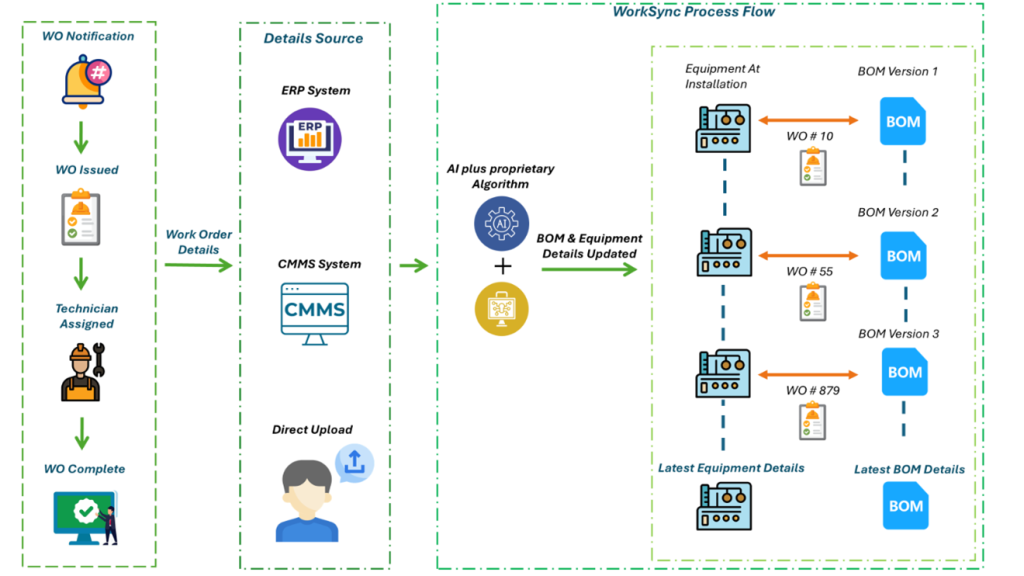
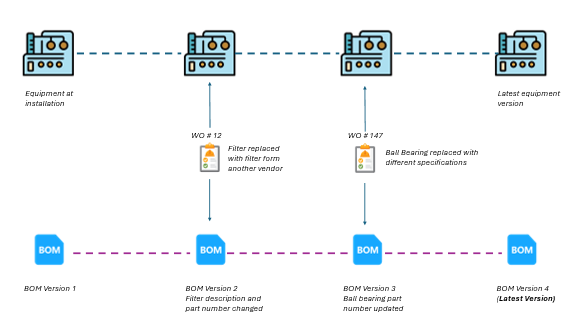
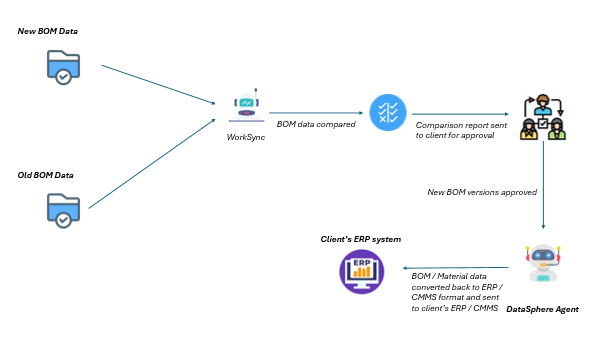
Maintenance modules inside SAP, other ERPs, and most CMMS platforms solve the system-of-record problem: they centralize work order creation, assignment, and tracking. What they rarely solve is data quality and cross-silo coordination. Work order management in SAP, for example, is only as good as the material master, asset hierarchy, and BOM data feeding it, and those are exactly the records that drift over time. The result is a digitized but still unreliable process, which is why a dedicated work order software solution and a clean data layer sit on top of, not instead of, the system of record.

The silo problem

Work order planning and scheduling spans three organizations that historically run on separate systems and separate data definitions: maintenance execution, operations and production scheduling, and the warehouse and MRO procurement function.

Each silo optimizes locally. Maintenance wants the asset now; operations protects production throughput; the storeroom manages stock against a budget. Without a shared data layer, the handoffs between them rely on email, spreadsheets, and phone calls, and every handoff is a point where information is lost or distorted.

The most damaging break sits between maintenance and the storeroom. A planner reserves a part by material number; the storeroom fulfills against that number. When the same physical part exists under duplicate records, the reservation can point to a record showing zero on hand while identical stock sits under another number. The job stalls on a part the plant already owns.

The reactive culture

The second challenge is cultural. In a reactive operation, emergencies set the schedule. Planners spend their time expediting parts and chasing breakdowns rather than preparing future work, which guarantees the next emergency.

This is measurable. Leading organizations target at least 85 percent planned work and under 15 percent reactive, yet many departments operate near a 50-50 split, which industry analysts treat as a clear signal that firefighting is in control. (Sockeye, 2025)

Architectural requirement

The core failure is structural and cultural: siloed systems break the maintenance-operations-storeroom handoff, and a reactive culture spends planning capacity on firefighting. Both are solved only by a shared, accurate data layer that lets planned work displace emergencies.

End-to-End Components and Workflow Linkages

What a 100 percent complete work package contains

A work package is "complete" only when a technician can execute it without leaving the job to find anything. That standard is exacting.

  • Sequenced job steps and a step-by-step standard operating procedure
  • Safety permits and isolation requirements (lockout-tagout, confined space, hot work)
  • Rigid material line items, each with an exact part number and quantity, reserved against stock
  • Specialized tools and equipment, including lifting and rigging plans for heavy components
  • Engineering data: torque specifications, clearances, calibration values, and reference drawings
  • Labor estimate by craft, with required certifications identified

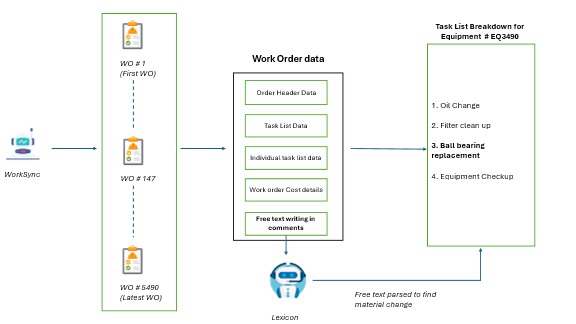
Every one of these elements is a query against master data. The material lines resolve against the material master; the parts-to-asset relationship resolves against the asset BOM; the craft and certification requirements resolve against the labor master. An incomplete or dirty record at any point produces an incomplete package.

The work order management process and lifecycle

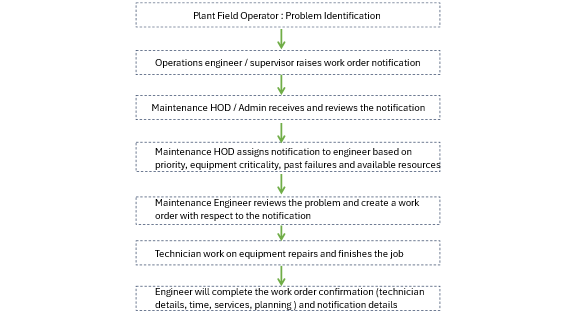
The work order management process runs as a closed loop. A need is identified, the work order is approved, then planned, then scheduled, then executed, then closed out, and the actuals captured at close-out feed back into the next planning cycle. Drawing the process as a lifecycle (rather than a straight line) is what keeps estimates, BOMs, and PM frequencies improving over time instead of going stale.

The work order lifecycle and feedback loop
1Identify 2Approve 3Plan 4Schedule 5Execute 6Close-out Feedback loop: actuals and findings recalibrate future planning
Close-out is not the end. Captured actuals (real durations, parts consumed, findings) feed back into planning, which is how estimates and BOMs improve over successive cycles.
Architectural requirement

A complete work package is a set of resolved master data queries: parts, BOM linkages, permits, engineering specs, and certified labor. The lifecycle is a closed loop, and the close-out feedback step is what makes planning estimates and BOMs more accurate over time.

The High Cost of Planning and Scheduling Failure

Root causes

  • Inaccurate stock counts and duplicate part records that hide available inventory
  • Unexpected emergency breakdowns that break into and displace the planned schedule
  • Uncoordinated operations teams that will not release equipment in the agreed window
  • Incomplete work packages that send technicians hunting for parts, tools, or permits mid-job

Downstream impacts

These causes produce a predictable chain: low schedule compliance, a growing maintenance backlog, and stockout delays that extend outages. Each emergency consumes the planning capacity that would have prevented the next one, so the operation entrenches deeper into a reactive state.

Infographic 1: the Wrench Time force multiplier
Unplanned shift Wrench time 25 to 35% ~2.5h tool time Transit Part hunting Missing tools / wait Planned shift Wrench time 50 to 60%+ 5+ hours tool time Transit Admin 0h4h8h shift Planning roughly doubles productive tool time by removing transit, part hunting, and missing-tool delays
Proportions reflect published wrench-time bands, not a single measured site. World-class wrench time runs 55 to 65 percent against a typical 25 to 35 percent. (Reliable Plant) (FTMaintenance)

The numbers

The financial case for disciplined planning is well documented. Three benchmark sets matter.

Wrench time, the share of a paid shift spent physically performing maintenance, typically sits at 25 to 35 percent in most organizations and reaches 55 to 65 percent in world-class operations, with mature planning and scheduling identified as the primary lever. (Reliable Plant)

Schedule compliance, the share of scheduled work completed as scheduled, carries a common target of 85 percent or higher, while world-class maintenance benchmarks place it above 90 percent. (Reliable Plant)

Unplanned downtime cost varies sharply by sector. Drawing on the Siemens True Cost of Downtime data and Aberdeen research: general discrete manufacturing runs roughly $10,000 to $50,000 per hour, heavy industry such as steel and mining around $187,500 per hour, oil and gas around $500,000 per hour, and automotive past $2 million per hour, with a cross-sector average near $260,000 per hour. (Siemens / Aberdeen, via ReliaMag, 2024) For Fortune Global 500 companies the aggregate reaches roughly $1.5 trillion a year, about 11 percent of revenue. (Siemens TCOD, 2024)

Where the money leaks

The bottom-line drain shows up in three lines. Technician overtime, when reactive work pushes jobs outside normal shifts. Expedited freight, including emergency air-freight premiums for parts that should have been staged. And lost production yield, the largest line in process industries, where every idle hour is unrecoverable throughput.

Architectural requirement

Planning failure is quantifiable: wrench time collapses toward 25 percent, schedule compliance falls below target, and unplanned downtime bills at $10,000 to over $2,000,000 per hour by sector. The recoverable losses are overtime, expedited freight, and lost yield, all of which disciplined planning directly reduces.

The System Solution: Bridging the Gap

Dedicated EAM and MRO software exists to close these failure modes by replacing the manual handoffs between silos with a single coordinated data flow. When teams evaluate a work order management system, the criteria that actually predict success are less about feature checklists and more about data: how the platform handles the material master and BOM, how it reserves and kits parts, how it scores criticality, and how cleanly it sits over an existing SAP or ERP system of record rather than forcing a rip-and-replace.

"At its core, standard work order scheduling software is a logistical engine. It bridges the gap between Planning (what needs to be done and with what parts) and Execution (doing the physical work). Its primary job is to eliminate spreadsheets, whiteboards, and frantic phone calls."

That is the baseline. The engine consolidates the labor, material, and asset-window data that previously lived in separate systems, applies the scheduling rules, and pushes a single coordinated schedule to the crew. It removes the manual reconciliation that the silo structure forces, and with it the errors that reconciliation introduces.

The ceiling, however, is much higher than scheduling logistics. The next section deconstructs the capabilities that turn a digitized scheduler into an AI-native orchestration layer.

See where your data layer breaks

Map your planning-to-execution gaps against a governed EAM and MRO baseline, then see where an intelligence layer closes them above the systems you already run.

Book a non-obligatory consultation call with our delivery team to address master data management challenges

Verdantis is proud to be the trusted partner of leading organizations across the globe.

From Fortune 500 companies to industry pioneers, our clients have trusted our MDM solutions

Advanced Pillars of Modern Work Order Orchestration

Pillar 1: autonomous triggering of work orders

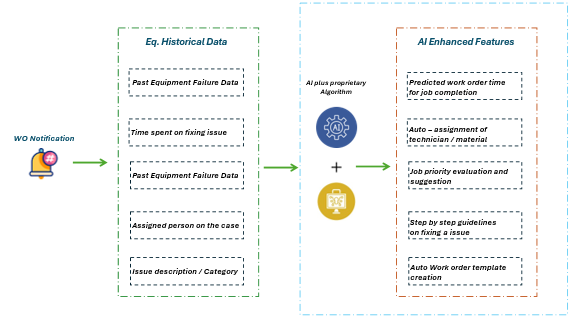
Mature predictive maintenance moves beyond single-sensor threshold alerts. An AI-native predictive layer ingests high-frequency sensor streams and runs pattern failure analysis, correlating multiple signals over time to recognize a developing failure mode before any single value breaches a limit.

On detecting that pattern, the system autonomously queries the EAM to pull the asset's historical records, closed work order logs, and component hierarchy. This context turns a raw anomaly into a precise diagnosis: not just "vibration rising" but "outboard bearing degradation consistent with prior failures on this equipment class."

The prognostic step estimates Remaining Useful Life and, from it, the lead time available to act. The system then instantiates a complete work order, populated with the predicted failure mode, the affected component, and the likely required parts, without manual data entry. This capability depends absolutely on a clean asset register: when functional locations are corrupted or asset names are unstructured free text, pattern recognition cannot associate the signal with the correct asset, and the trigger either fails or cross-contaminates another asset's profile.

Pillar 2: advanced inventory kitting

Kitting pre-packages and stages every specific part, specialized tool, and safety document for a job into a physical, tagged kit in the storeroom before the job reaches the master schedule. It is the single most effective countermeasure to the parts-run bottleneck that destroys wrench time.

The digital trigger depends on absolute BOM completeness and standardized part descriptions. The kitting engine reads each BOM line, reserves it against on-hand stock, and where stock is short raises an automated Material Request routed to a qualified supplier from the vendor master. A duplicate material record breaks this: the engine reads a false zero, buys a part already on the shelf under another number, and inflates working capital against a data defect. Reliable kitting is therefore a master data problem first and a logistics problem second.

Infographic 2: the EAM data pipeline for scheduling
HRMS / Time & Attendance Labor availability, shifts Warehouse / Storeroom Kitting, BOM, stock, reservations Operations Asset downtime windows Scheduling Engine CONSTRAINT SOLVER Execution Team Mobile EAM, daily schedule
The engine sits in the middle, reconciling labor (HRMS), materials and kitting (warehouse), and asset windows (operations) into one schedule for the execution team. The integrity of every input is a master data dependency.

Pillar 3: algorithmic workforce management

The scheduling engine assigns tasks by solving a constrained allocation problem, and it fetches each constraint from a specific system of record.

  • Labor availability and shifts are fetched from the HRMS or Time and Attendance module, establishing who is on shift and for how long.
  • Craft types and standard hours are fetched from the EAM Labor Master, establishing skill categories and expected task durations.
  • Safety and certifications are fetched from corporate Compliance and Training databases, so that only a currently certified high-voltage electrician is assigned to an arc-flash task. A certification mismatch is a hard constraint the engine cannot override.

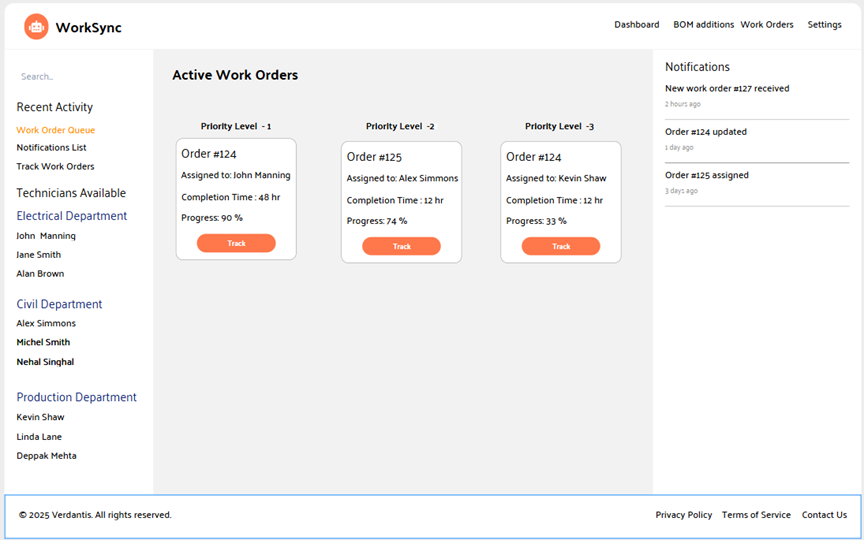
With these inputs the engine produces a feasible allocation in which no technician is double-booked and no compliance rule is violated, and it re-solves dynamically when an emergency work order breaks into the queue, pushing revised assignments to mobile nodes in the field.

Pillar 4: criticality scoring

Prioritization replaces "loudest-voice" scheduling with a calculation. The engine cross-references the Asset Criticality Ranking (the safety, environmental, and financial risk the equipment carries) with Task Urgency (how soon the specific work must occur) to produce an objective execution priority score.

Infographic 3: the criticality matrix
Asset criticality → Task urgency → Schedule Expedite Urgent Executefirst Backlog Schedule Expedite Urgent Defer Backlog Schedule Expedite Defer Defer Backlog Schedule Execution priority = Asset criticality cross-referenced with task urgency
The combined score is objective and reproducible. A high-urgency task on a low-criticality asset and a low-urgency task on a high-criticality asset land in different cells, rather than competing on escalation volume.

The calculation is only as sound as the criticality model behind it. Scores must be computed per asset and per part against real operating context. The common assumption that every part on a critical asset is itself critical is false: criticality varies by part within an asset and by plant for the same part. Defensible parts criticality depends on clean asset-to-part linkages derived from accurate asset BOMs. A structured asset criticality assessment keeps that ranking repeatable rather than a one-time alignment exercise.

Pillar 5: tactical splitting of work orders

A multi-week plant turnaround cannot be managed as a single work order. It must be decomposed into a parent-child architecture: a parent that holds overall scope and cost, and child operations that are individually schedulable.

This structure enables multi-craft sequential routing. The engine routes dependent phases across distinct labor pools while enforcing order, for example Craft 1 scaffolding, then Craft 2 mechanical overhaul, then Craft 3 non-destructive testing, scheduling each phase against its own pool's capacity and rolling cumulative cost up to the parent. It also protects resource agility: if one phase slips, the engine reschedules the dependent children without losing the cost history or the sequence logic.

Architectural requirement

The orchestration layer adds autonomous triggering, automated kitting, algorithmic workforce allocation sourced from HRMS, the labor master and compliance systems, objective criticality scoring, and parent-child decomposition. Every one of these functions degrades or fails when the underlying asset, material, and labor master data is not clean.

Maturity Comparison

ParameterReactive MaintenanceStandard Digitized SchedulingAutonomous AI-native EAM
Data inputsOperator reports, breakdown calls, paper and spreadsheet logsStatic PM calendars, manual work order entry, periodic ERP stock snapshotsHigh-frequency sensor streams, MTBF and RUL models, live governed master data, supplier history
Trigger sourceAsset failure after the eventTime or usage-based PM rules plus manual requestsCondition and prognostic prediction before failure, autonomous instantiation
Labor optimization levelNone; allocation is firefightingManual leveling against shift calendarsMulti-constraint algorithmic allocation across craft, certification, capacity, and safety
Material accuracy dependencyLow; parts sourced ad hoc at failureModerate; depends on ERP stock accuracyAbsolute; kitting and reservation fail without clean, deduplicated BOM and material master

The Numbers That Anchor the Case

Why planning maturity is a financial decision

25-35%
Typical wrench time, against 55-65% world-class
85%+
Schedule compliance target; 90%+ world-class
$260K/hr
Cross-sector average cost of unplanned downtime
$2M+/hr
Automotive; oil & gas near $500K, heavy industry near $187.5K

Sources: Reliable Plant and FTMaintenance (wrench time, schedule compliance); Siemens True Cost of Downtime 2024 and Aberdeen Research (downtime cost). Figures are industry benchmarks; verify against your own production rate and cost structure before citing externally.

The Foundation Beneath Every Pillar

Each advanced capability above terminates at the same dependency. Autonomous triggering needs a clean asset register. Kitting needs complete BOMs and deduplicated material masters. Criticality scoring needs accurate asset-to-part linkages. The orchestration layer is a set of functions over master data, and the functions are only as correct as the data.

This is why the sequencing matters. A scheduling optimizer deployed over fragmented material masters and broken asset hierarchies will not deliver its modeled return; it will surface the data defects faster and at higher cost. The defensible path is to remediate the data first through automated cleansing and classification, sustain it through continuous governance, and then deploy the orchestration capability onto a foundation that can support it. An MRO intelligence layer that scores criticality, confirms parts availability, and exposes phantom inventory above your existing EAM is the practical first step, because it delivers value on the data you have while making the case for the data you need.

Final imperative

Advanced scheduling is downstream of master data quality. Benchmark your structural data health (asset, material, supplier) before procuring orchestration capability, then deploy on a governed foundation. Optimization on dirty data surfaces defects faster, not value.

Work Order Management FAQ

Common questions on what work order management is, how planning and scheduling differ, and where AI changes the process.

What is work order management in maintenance?

It is the end-to-end process of creating, approving, planning, scheduling, executing, and closing the work orders that keep physical assets running. It covers both the system record (the work order itself) and the discipline that prepares each job and commits it to a crew and a time window.

Planning answers what work is required and how it is performed safely: scope, steps, parts, tools, permits, and labor. Scheduling answers when it runs and who executes it, leveling the planned work against crew capacity and the asset downtime window. Plan first, schedule second, never in reverse.

Work orders that are never properly closed, no reliable history of parts or time, slow distribution of jobs to technicians, and no objective prioritization. The record stays incomplete, so planning, scheduling, and reporting all run on partial information and the operation drifts toward reactive firefighting.

Higher wrench time, better schedule compliance, fewer stockout delays, lower overtime and expedited freight, and a clean maintenance history that improves future planning. In asset-intensive sectors the largest gain is avoided unplanned downtime, which can run from tens of thousands to over two million dollars per hour depending on the industry.

An AI-native layer can autonomously trigger a work order from a predicted failure, pre-stage the right parts through kitting, allocate certified labor against real constraints, and prioritize by objective criticality rather than escalation volume. Every one of these capabilities depends on clean asset, material, and BOM data underneath it.

Keep planning and scheduling as distinct roles, hold a defined standard for a complete work package, target at least 85 percent planned work, schedule against a negotiated asset window, capture actuals at close-out, and remediate the underlying master data before deploying optimization on top of it.

About the Author

Picture of Kalpesh Shah

Kalpesh Shah

Kalpesh has been leading Program Management at Verdantis for the last 11 years. He carries with himself deep service and product expertise across Materials and Supplier data and has been responsible for cutting-edge delivery solutions throughout the organization

Related Posts

Download The File

Your data is 100% protected with us via our non-disclosure agreement.

Your data is secure and used solely for intended purposes. We prioritize your privacy and protect your information.