How a leading Latin American consumer-goods manufacturer built a modular business case for MRO optimization, letting leadership choose the scope rather than accept an all-or-nothing proposal.
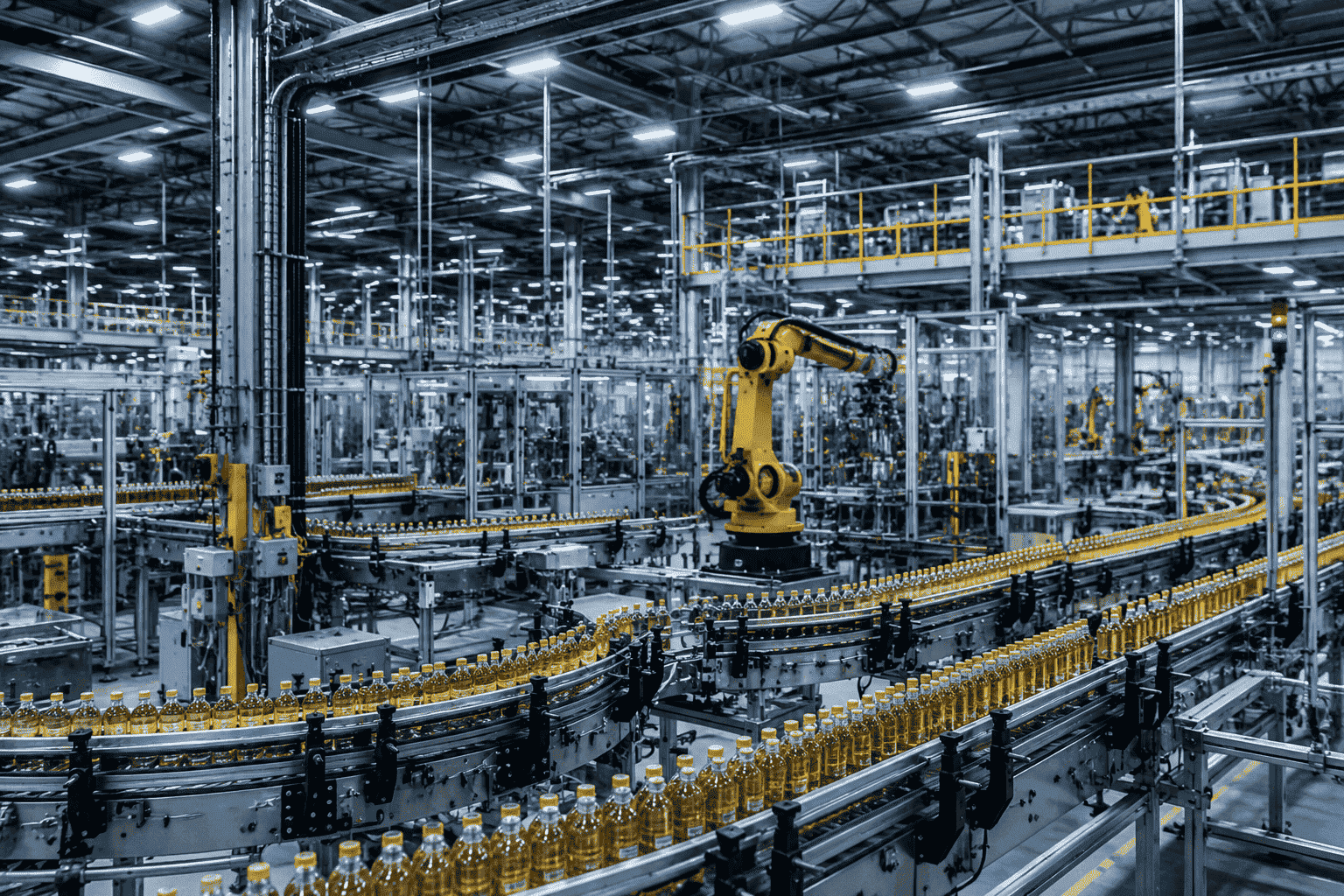
A leading Latin American consumer-goods manufacturer, a household name in its categories, operating a network of plants across its region, all on a single ERP instance, with tens of thousands of MRO SKUs and a large maintenance-planning community. Its products move at retail speed, which means its filling, packaging, and processing lines have to move at retail speed too.
Rather than an all-or-nothing proposal, the business case was built as two scenarios on the same estate, differing only in module coverage, so leadership could see precisely what each increment of scope buys. Because every site already ran the same ERP instance, the network-level modules could work from day one: surplus at one plant visible and transferable to every other plant, with the buy-versus-transfer decision costed for logistics, no integration programme required first.
Customer figures in this case study are expressed as ratios to protect confidentiality. The downtime figure is a published industry benchmark, not a customer-specific number. The underlying case was built from operating figures the customer provided.
High-volume consumer-goods manufacturing concentrates the MRO problem into two connected numbers: the capital tied up in spare parts across the network, and the thousands of unplanned incidents a year that interrupt the lines. On a consumer-goods line, the inventory question and the uptime question are the same question, and both were being managed site by site.
The download covers both scenarios module by module, the arithmetic behind the increment, and why the uptime prize was left out of the headline case entirely.
Get the full story behind the transformation.
Your details are used only to route this conversation. See our Privacy Policy .
Both scenarios cleared the bar on their own; the arithmetic of the increment between them made the decision.
| Metric | Result |
|---|---|
| Payback | Under 6 months, either scenario |
| Return on increment | ~4.5× the incremental cost of the two added modules |
| Three-year net benefit | Lifted by roughly 70% from Scenario 1 to Scenario 2 |
| Carrying-cost saving | ~22% per year on capital released |
| Purchases avoided | ~1% of annual MRO spend, against 5–15% published benchmarks |
| Downtime cost | ~$39,000 per hour, published industry benchmark, not a customer figure |
Avoided downtime was deliberately excluded from the headline case and positioned as upside, to be quantified against the customer's own downtime records rather than claimed in advance.
Accountable for line uptime across a network where a missing spare stops output, not just costs money.
Closing the gap between site-by-site stocking rules and network-wide visibility on a shared ERP.
Evaluating a modular business case with a costed increment, not an all-or-nothing proposal.
Running a single ERP instance across the network, with no integration programme required to add scope.
If your plants share an ERP but not their spare parts, the same scenario-based case can be built on your figures, in days.
Oil and Gas organizations face huge unwanted costs in the form of losses, penalties and compensation due to industrial accidents, taking a sizable chunk of their revenues. One of the important reasons for failures and accidents is the breakdown of key industrial infrastructure arising from ineffective management of the material base and inefficiencies in the MRO supply chain that are highly critical for the production and maintenance cycles.
More and more organizations are now looking to establish Master Data Management (MDM) implementations in order to manage their assets through informed decision-making based on reliable data and ensure optimal industrial safety across the enterprise.
About the company:
This US based company is a global leader in providing essential mechanical components for both land and offshore drilling rigs, complete drilling and well servicing rigs, as well as a comprehensive range of tubular inspection, internal coatings, drill string equipment, lifting and handling gear, and downhole drilling tools. It also offers supply chain services through distribution centers strategically located near major drilling and production sites worldwide. With over 800 manufacturing, sales, and service centers globally and annual revenues exceeding $12 billion, the company delivers customer-focused solutions tailored to meet the energy industry’s quality, productivity, and environmental needs.
The company faced significant challenges with their master data.
• Lack of consistency and standards for the master data
• Incorrect, incomplete, unclassified and outdated attribute fields of master
data High volumes of data in multiple languages
• Multiple ERP and other legacy instances across the company
• Poorly structured material descriptions
• Lack of data governance and collaboration across cross-functional divisions and locations
Solution: Material Master Data Harmonization & Ongoing Maintenance
The company implemented Verdantis Material Harmonize to cleanse and enrich its historical material master data. Using AI-powered tools and the Verdantis Content Repository, the solution classified, standardized, and eliminated duplicate materials.
Once the data was harmonized, Verdantis Material Integrity was deployed for ongoing data governance. It ensured continuous data accuracy through real-time validation, AI-driven classification, and duplication prevention, maintaining high data quality across enterprise systems.
Key Actions Taken:
Results Achieved:
By integrating Material Harmonize & Material Integrity, the company achieved a scalable, AI-powered Master Data Management framework, ensuring long-term data consistency, efficiency, and compliance.