

Principales conclusiones
- Criticidad de los activos establece la importancia relativa de cada activo físico evaluando las consecuencias de su fallo para la seguridad, el medio ambiente, las operaciones y las finanzas, lo que proporciona a los equipos de mantenimiento y fiabilidad una base de datos para establecer prioridades.
- Una evaluación estructurada de la criticidad de los activos (ACA) consta de cinco etapas -inventario de activos, definición de criterios, puntuación multifactorial, clasificación por niveles y revisión continua- que dan lugar a un registro ordenado que impulsa estrategias de mantenimiento más inteligentes, decisiones de inversión de capital y gestión de riesgos a lo largo de todo el ciclo de vida de los activos.
- Éxito de los programas de criticidad requieren datos maestros de activos limpios, colaboración interfuncional, integración con sistemas GMAO y ERP, y revisiones periódicas de gobernanza, y el enfoque de Verdantis ofrece todo esto de extremo a extremo: desde la armonización de datos impulsada por IA y la puntuación de criticidad hasta la integración perfecta con SAP, Maximo y EAM.
Lea el artículo completo a continuación para saber más.
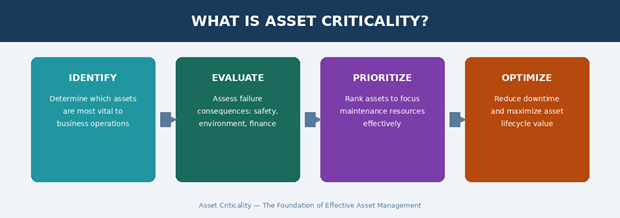
La criticidad de los activos es un proceso sistemático para clasificar los activos físicos, los equipos, la maquinaria, las infraestructuras y los sistemas, en función de las consecuencias que tendría su fallo para la seguridad, la producción, el medio ambiente, el cumplimiento normativo y los costes.
No todos los activos tienen la misma importancia. La avería de un sensor en un compresor de aire de una empresa de servicios públicos tiene consecuencias empresariales muy diferentes a las de la avería de una bomba de refrigeración en un reactor de proceso o de una válvula en un gasoducto.
El análisis de la criticidad de los activos obliga a todas las organizaciones a responder a una pregunta fundamental:
"¿Qué pasaría si este activo fallara y qué repercusiones tendría ese fallo en la empresa?"
En los sectores con un uso intensivo de activos, las funciones de mantenimiento, reparación y operaciones (MRO) se ven obligadas a buscar constantemente un equilibrio entre costes, riesgos y fiabilidad. Una de las ineficiencias más recurrentes en Gestión de datos MRO Los programas se deben a una cuestión muy sencilla:
No todos los activos se gestionan en función de su verdadera importancia.
Esto da lugar a un exceso de mantenimiento de los equipos no críticos, a un mantenimiento insuficiente de los activos de alto riesgo y a estrategias ineficaces en materia de piezas de recambio. Es aquí donde la Evaluación de la Criticidad de los Activos (ACA) cobra un carácter esencial.
Al evaluar sistemáticamente la importancia de cada activo, las organizaciones pueden priorizar los recursos, mejorar las estrategias de mantenimiento e impulsar resultados empresariales cuantificables.






Industrias que dependen de la criticidad de los activos
Los marcos de criticidad de los activos se utilizan en todos los sectores con gran intensidad de capital en los que los fallos de los equipos tienen importantes consecuencias operativas, financieras o de seguridad.
Personas clave implicadas
La criticidad de los activos es una disciplina interfuncional. Requiere conocimientos operativos, perspicacia financiera, experiencia en seguridad y conocimientos de datos: ninguna persona tiene la visión completa.
Personas clave implicadas
La criticidad de los activos es una disciplina interfuncional. Requiere conocimientos operativos, perspicacia financiera, experiencia en seguridad y conocimientos de datos: ninguna persona tiene la visión completa.
Una evaluación eficaz de la criticidad requiere un taller multidisciplinar estructurado. Los sesgos hacia la seguridad o la producción de forma aislada conducen a clasificaciones sistemáticamente incorrectas.
Ninguna persona ve el panorama completo, las seis deben estar en la mesa, con un facilitador neutral que gestione la resolución de conflictos y la calibración.
¿Qué es la evaluación de la criticidad de los activos?
La evaluación de la criticidad de los activos (ACA) es una metodología estructurada para clasificar los activos en función de las consecuencias que tendría su fallo.
En lugar de tratar todos los equipos por igual, ACA ayuda a las organizaciones a identificar qué activos tienen mayor impacto en aspectos clave como:
- Seguridad
- Impacto medioambiental
- Pérdida de producción
- Coste de mantenimiento
- Cumplimiento de la normativa
El resultado suele ser una clasificación por niveles —por ejemplo, Nivel 1, Nivel 2, Nivel 3, o Crítico, Semicrítico, No crítico— que permite tomar decisiones de forma específica.
El resultado de una evaluación de la criticidad de los activos es un registro ordenado por importancia, que suele clasificarse en los siguientes niveles: Crítico (A / Nivel 1), Semicrítico (B / Nivel 2)y No crítico (C / Nivel 3), lo que a su vez determina las decisiones relativas a la estrategia de mantenimiento, la asignación de capital, el almacenamiento de piezas de recambio, la frecuencia de las inspecciones y la inversión en mitigación de riesgos.
La evaluación de la criticidad de los activos no es una tarea que se realice una sola vez. Se trata de un programa en constante evolución que debe reevaluarse cuando cambian las configuraciones de la planta, cuando surgen nuevos requisitos normativos o cuando varían los perfiles de riesgo operativo.
ISO 55000, la norma internacional para la gestión de activos, recomienda explícitamente la evaluación de la criticidad como base para la toma de decisiones sobre el ciclo de vida.
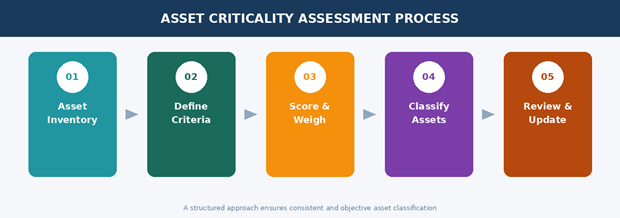
Asegúrate de que todos los activos sujetos a mantenimiento estén registrados en tu sistema con datos precisos y completos. Una mala calidad de los datos, los duplicados y la falta de detalles dan lugar a resultados poco fiables en cuanto a la criticidad.
Establezca factores de evaluación como la seguridad, el impacto medioambiental, la pérdida de producción, el coste y la redundancia. Asigne ponderaciones en función de las prioridades de la empresa.
Evalúa los activos según una escala coherente (por ejemplo, del 1 al 5). Combina las puntuaciones con las ponderaciones para calcular una puntuación global de criticidad.
Agrupa los activos en categorías como «Crítico», «Alto», «Medio» o «Bajo» para orientar las decisiones relativas al mantenimiento, los repuestos y las inversiones.
Actualiza periódicamente las puntuaciones de criticidad en función de los cambios en las operaciones, el estado de los activos o las prioridades empresariales.
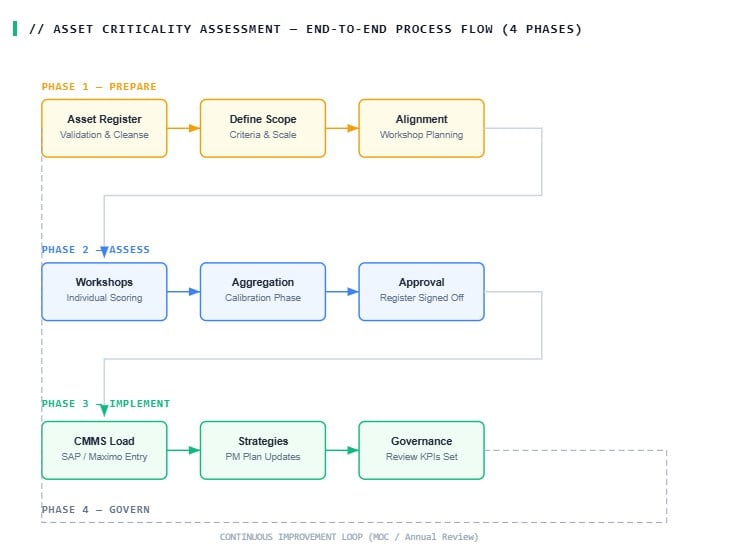
Proceso y flujo de la evaluación
Una evaluación de la criticidad de los activos bien estructurada sigue un proceso definido y repetible. A continuación se presenta el flujo completo, desde la puesta en marcha hasta la integración en el CMMS y la gestión continua.
Matriz de estrategias de mantenimiento basadas en la criticidad
| Nivel de criticidad | Rango de puntuación | Enfoque de mantenimiento | Frecuencia de inspección | Política de piezas de recambio |
|---|---|---|---|---|
| Nivel A - Crítico | 4.0 - 5.0 | Análisis predictivo y basado en el estado, además de análisis RCM. Tolerancia cero ante fallos imprevistos. | Monitorización continua / en tiempo real | Repuestos de capital in situ, existencias en consignación |
| Nivel B: Semicrítico | 2.5 - 3.9 | Mantenimiento preventivo con intervalos definidos. Alcance de inspección mejorado. | Mensual / trimestral | Stock en almacén con punto de pedido |
| Nivel C - No crítico | 0 - 2.4 | Mantenimiento preventivo «hasta el fallo» o basado en plazos básicos. Gastos generales de inspección mínimos. | Anual / bajo ciertas condiciones | Pedidos a la carta / Aprovisionamiento JIT |
¿Qué es la clasificación de criticidad de los activos?
La clasificación de la importancia de los activos es el proceso que consiste en asignar una puntuación de importancia a cada activo y utilizarla para elaborar una lista por orden de prioridad.
Si bien una evaluación define los criterios, la clasificación es el proceso en el que dichos criterios se aplican a todo el parque de activos para determinar cuáles son los más importantes. Sin una clasificación clara, decisiones como la planificación del mantenimiento, el almacenamiento de repuestos y la priorización de los trabajos pendientes se vuelven incoherentes y reactivas.
Cálculo de la criticidad de los activos
La criticidad de un activo se calcula mediante un modelo de puntuación basado en el riesgo que combina la probabilidad de que un activo falle con el impacto de dicho fallo. La fórmula más utilizada es:
Paso 1: Asignar la probabilidad de fallo (PoF)
La PoF suele puntuarse en una escala del 1 al 5 en función de:
- Historial de fallos (MTBF)
- Antigüedad y estado del activo
- Entorno operativo
- Eficacia del mantenimiento
Ejemplo de escala: 1 = fallo poco frecuente · 3 = fallo ocasional · 5 = fallo frecuente
Paso 2: Calcular las consecuencias de un fallo (CoF)
En lugar de ser un único valor, el CoF suele calcularse a partir de varias áreas de impacto:
Dónde: S = Repercusiones en materia de seguridad, P = Pérdida de producción, C = Repercusión en los costes, E = Impacto medioambiental. Cada parámetro se puntúa del 1 al 5.
Ejemplo 1. Bomba de refinería Bomba de refinería
| Factor | Puntuación |
|---|---|
| Seguridad (S) | 4 |
| Producción (P) | 5 |
| Coste (C) | 4 |
| Medio ambiente (E) | 3 |
CoF = (4 + 5 + 4 + 3) / 4 = 4,0
Si PoF = 3: Nivel de criticidad = 3 × 4 = 12, medio-alto
MRO Insight: Es necesario realizar un mantenimiento preventivo y un seguimiento del estado de las instalaciones.
Cálculo basado en el FMEA (nivel avanzado)
Para realizar un análisis más detallado, especialmente en ingeniería de fiabilidad, se utiliza el índice de prioridad de riesgo (RPN).
Ejemplo: Caja de engranajes en un sistema transportador
Gravedad = 9 (parada de la producción) · Frecuencia = 6 (fallos moderados) · Detección = 7 (difícil de detectar en una fase temprana)
RPN = 9 × 6 × 7 = 378, muy alto
Modelo de criticidad financiera
Ejemplo: Bomba de alimentación de caldera
Fallos al año = 3 · Coste por fallo = $50 000
Criticidad = $150.000 de riesgo anual
Interpretación final (correspondencia típica)
| Rango de puntuación | Criticidad | Estrategia MRO |
|---|---|---|
| 1-5 | Bajo | Run-to-failure |
| 6-12 | Medio | Mantenimiento preventivo |
| 13-20 | Alta | Mantenimiento predictivo |
| >20 | Extremo | Redundancia y supervisión continua |
En la práctica, las organizaciones combinan estos modelos para garantizar que la importancia de los activos refleje no solo el riesgo de fallo, sino también el impacto operativo y financiero, lo que permite una planificación precisa del mantenimiento, las reparaciones y las operaciones (MRO), así como la priorización de los recursos.
Metodología y criterios de puntuación
El método de puntuación ponderada semicuantitativa es el estándar del sector, utilizado en marcos como API 580, ISO 31000 y la Guía de mejores prácticas SMRP. He aquí cómo funciona en la práctica.
Categorías principales de consecuencias
| # | Categoría | Definición | Peso habitual | Escala |
|---|---|---|---|---|
| 1 | Seguridad | Riesgo de lesiones, muerte o daños al personal o al público en caso de fallo | 25-35% | 1-5 |
| 2 | Impacto medioambiental | Riesgo de vertido, contaminación, incumplimiento de la normativa o daño medioambiental duradero | 15-25% | 1-5 |
| 3 | Producción | Pérdida de ingresos, reducción del rendimiento o interrupción de servicios críticos sin desvío | 20-30% | 1-5 |
| 4 | Coste de mantenimiento | Coste directo de la reparación o sustitución, mano de obra, piezas y coste de oportunidad perdido | 10-15% | 1-5 |
| 5 | Normativa / Cumplimiento | Riesgo de multa reglamentaria, responsabilidad legal o infracción del permiso en caso de incumplimiento | 10-15% | 1-5 |
| 6 | Reputación / Cliente | Riesgo para la confianza pública, incumplimiento del acuerdo de nivel de servicio con el cliente o exposición a daños para la marca | 5-10% | 1-5 |
La fórmula de puntuación
Fórmula estándar para calcular la puntuación de criticidad ponderada
Puntuación de criticidad = Σ (Puntuación de categoríai × Pesoi)
Ejemplo: Compresor de inyección de gas, plataforma marítima
Seguridad [5 × 0,35] + Medio ambiente [4 × 0,20] + Producción [5 × 0,25] + Costes [3 × 0,10] + Normativa [4 × 0,10]
= 1.75 + 0.80 + 1.25 + 0.30 + 0.40 = 4.50 / 5.00, NIVEL CRÍTICO A
La matriz de riesgos 5×5
Cuando se combina la probabilidad de fallo con la criticidad, los activos se representan en una matriz de riesgo para orientar la frecuencia de las inspecciones y la selección de la estrategia de mantenimiento.
| Insignificante | Marginal | Moderado | Crítica | Catastrófico | |
|---|---|---|---|---|---|
| Raro | BAJA | BAJA | BAJA | MED | MED |
| Improbable | BAJA | BAJA | MED | MED | ALTO |
| Posible | BAJA | MED | MED | ALTO | ALTO |
| Probablemente | MED | MED | ALTO | ALTO | EXTREMO |
| Cierto | MED | ALTO | ALTO | EXTREMO | EXTREMO |
Análisis de la criticidad de los activos
El Análisis de Criticidad de los Activos (ACA) va más allá de la puntuación y la clasificación para ofrecer una inteligencia operativa más profunda. Examina de forma sistemática los datos de criticidad, tanto a nivel individual como en el conjunto de los activos, con el fin de identificar patrones, puntos críticos de fallo, oportunidades de optimización del mantenimiento y concentraciones de riesgo.
Un análisis eficaz transforma las puntuaciones de criticidad en bruto en información estratégica que sirve de base para los planes de gestión de activos, los presupuestos de capital y los registros de riesgos; es el motor analítico que vincula los resultados de la evaluación de la criticidad con las decisiones empresariales.
Consideraciones avanzadas sobre la criticidad de los activos
- Fallos ocultos: Algunos elementos, como las válvulas de seguridad o los sistemas de reserva, pueden fallar sin que se aprecien signos visibles, pero con graves consecuencias. Por lo general, se consideran de alta criticidad y requieren pruebas periódicas.
- Análisis de cuellos de botella: Incluso un activo de baja importancia puede llegar a ser crítico si supone una limitación en el proceso de producción.
- Criticidad dinámica: La importancia crítica de los activos no es fija, sino que varía en función de las condiciones de funcionamiento, el estado de los activos, las prioridades de producción y la disponibilidad de redundancia.
- Integración digital: La integración de ACA con CMMS, EAM y herramientas predictivas permite actualizaciones en tiempo real, priorización automatizada y decisiones de mantenimiento más basadas en datos.
Consulta la puntuación de tu propio registro de activos en tiempo real
Trae un ejemplo de tu registro de activos del CMMS o del EAM. Te mostraremos qué activos son realmente críticos, cuáles de los marcados como tales no lo son y en qué casos la calidad de tus datos podría distorsionar actualmente la puntuación de criticidad.
Tipos de criticidad de los activos
No existe un único marco universal de criticidad. Los distintos enfoques se adaptan a diferentes niveles de madurez organizativa, sectores y entornos normativos.
| Tipo | Descripción | Lo mejor para | Complejidad |
|---|---|---|---|
| Cualitativo / Por niveles BÁSICO |
Los activos se asignan a los niveles A/B/C o 1/2/3 según el criterio del taller. Criterios sencillos, sin puntuación numérica ponderada. Rapidez de ejecución. | Organizaciones que inician su proceso de evaluación de la criticidad, con una base de activos reducida (menos de 5.000 activos) | Bajo |
| Semicuantitativo (puntuación ponderada) ESTÁNDAR |
Múltiples categorías de consecuencias puntuadas numéricamente y ponderadas según las prioridades de la organización. Produce una puntuación numérica defendible y una clasificación por niveles. Alineado con los marcos API 580 y SMRP. | La mayoría de las empresas de petróleo y gas, servicios públicos, minería y del sector químico. Se integra perfectamente con SAP PM e IBM Maximo. | Medio |
| Basado en el riesgo (probabilidad × consecuencia) AVANZADO |
Combina la probabilidad de fallo —utilizando modelos de degradación, datos de inspección, antigüedad y estado— con las consecuencias en términos de criticidad para generar un Índice de Prioridad de Riesgo (RPN) y situar los activos en una matriz de riesgo. | Petróleo y gas, productos químicos, generación de energía, activos con un amplio historial de fiabilidad en el sistema CMMS | Alta |
| Centrado en la fiabilidad (RCM-Driven) EXPERTO |
La criticidad se integra en un análisis completo de RCM, y el Análisis de Modos de Fallo y Efectos (FMEA) se correlaciona con los fallos funcionales. Cada tarea de mantenimiento se justifica a partir de la lógica de la criticidad. Máxima fidelidad, mayor consumo de recursos. | Activos de gran valor y con escasa dotación de personal en los sectores de la energía, el ferrocarril y las industrias de procesos. Se suele aplicar a los 5% activos más críticos. | Muy alta |
| Condición de criticidad modificada ESTÁNDAR |
Clasificación estática de la criticidad de los activos ajustada dinámicamente en función de la puntuación del estado actual de los activos a partir de los resultados del mantenimiento predictivo, las calificaciones de las inspecciones o los datos de los sensores. Un activo de nivel B en mal estado puede elevarse temporalmente al nivel de urgencia A. | Organizaciones con programas CBM maduros e integración de IoT/sensores | Medio-Alto |
Enfoque Verdantis de la criticidad de los activos
Verdantis aporta un enfoque basado en la inteligencia artificial (IA) a la evaluación de la criticidad de los activos, partiendo de la base de que el principal obstáculo para una valoración precisa de la criticidad no es la metodología, sino la calidad de los datos y la gestión de la taxonomía, junto con gestión de datos maestros de activos.
La mayoría de los programas de criticidad de activos fracasan silenciosamente porque se construyen sobre registros de activos que están incompletos, son incoherentes o no se mantienen.
Verdantis inicia cada proyecto de gestión de la criticidad con una evaluación del estado de los datos de los activos, antes de proceder a la puntuación. El principio es el siguiente: no se puede puntuar con precisión lo que no se puede describir con precisión.
La diferencia de Verdantis
Mientras que muchos enfoques se centran en la metodología de puntuación, Verdantis se centra en la capa de datos subyacente.
Una bomba con una puntuación de 4,8 que, en realidad, es un duplicado de una bomba de servicio con una puntuación de 1,2 provoca una grave mala asignación de los recursos de mantenimiento. La integridad de los datos no es un requisito previo, sino el propio programa de criticidad.
Criticidad de los activos de Verdantis: metodología de 8 pasos
El proceso comienza con la extracción del registro de activos de los sistemas CMMS/EAM del cliente (SAP PM, Maximo, Oracle, Infor). Se evalúa la disponibilidad de cada activo analizando atributos clave como el tipo de equipo, la ubicación y el contexto operativo.
Las lagunas en los datos, como jerarquías que faltan, registros duplicados o atributos incompletos, se detectan de forma temprana para garantizar que solo se incluyan en la evaluación los activos fiables y que puedan ser objeto de puntuación.
Los activos se estandarizan utilizando marcos alineados con la industria (ISO 14224, ISO 55000), garantizando una clasificación de equipos y estructuras jerárquicas coherentes.
La información sobre el contexto operativo que falta se completa utilizando las referencias técnicas disponibles, como los esquemas P&ID, los datos de los fabricantes de equipos originales (OEM) y el historial de mantenimiento, lo que permite una evaluación de la criticidad más precisa y coherente.
Se configura un marco de puntuación a medida adaptado al entorno operativo del cliente. Esto incluye:
- Definición de categorías de consecuencias (seguridad, producción, costes, medio ambiente)
- Asignación de ponderaciones
- Establecimiento de baremos y umbrales de puntuación
Esto garantiza que el modelo refleje el riesgo operativo real y las prioridades empresariales.
Utilizando el marco configurado y los datos enriquecidos de los activos, se genera una puntuación inicial de criticidad en toda la base de activos.
La puntuación se basa en la clase de equipo, el contexto del proceso y el análisis del impacto de los fallos para generar un perfil de criticidad de referencia coherente y escalable.
Las puntuaciones de criticidad se revisan y se calibran prestando especial atención a los activos de gran impacto y a los casos extremos.
Este paso garantiza la coherencia en la puntuación, elimina las anomalías y ajusta los resultados al comportamiento real de la planta y a las dependencias operativas.
Las puntuaciones y los niveles de criticidad definitivos se integran en el sistema CMMS/EAM del cliente a nivel de equipo.
Esto convierte la criticidad en un parámetro operativo, directamente utilizable para la planificación del mantenimiento, la priorización y la elaboración de informes.
Los niveles de criticidad se asignan a estrategias de mantenimiento:
- Nivel crítico alto → Mantenimiento predictivo / basado en el estado
- Medio → Mantenimiento preventivo
- Bajo → Funcionamiento hasta el fallo
Este paso garantiza que la evaluación se traduzca en medidas prácticas de mantenimiento, reparación y revisión (MRO) y en una optimización de los esfuerzos de mantenimiento.
Un enfoque de gobernanza estructurado garantiza que la importancia de los aspectos críticos se mantenga a lo largo del tiempo. Esto incluye:
- Actualizaciones periódicas basadas en el estado y el rendimiento de los activos
- Incorporación de nuevos activos y cambios operativos
- Propiedad definida para mantener la precisión
Esto garantiza que la criticidad de los activos siga siendo dinámica y se ajuste a las necesidades operativas en tiempo real.
Qué ofrece el módulo de criticidad de activos de MRO360
La metodología de 8 pasos descrita anteriormente es la forma en que Verdantis pone en marcha el programa. Esto es lo que hace el propio software una vez que está en funcionamiento: ahí radica la diferencia entre un ejercicio de criticidad y un sistema de criticidad.
Las categorías de consecuencias, las ponderaciones y los umbrales de puntuación se configuran en función de su entorno operativo, y no vienen predefinidos en una plantilla genérica.
Las puntuaciones y los niveles de criticidad se registran directamente en SAP PM, Maximo, Oracle o Infor a nivel de equipo, por lo que se trata de un campo operativo y no de una exportación a una hoja de cálculo.
Las nuevas instalaciones de activos, los eventos de MOC, el desmantelamiento y los datos de seguimiento del estado marcan automáticamente los activos para su reevaluación, en lugar de esperar a la próxima revisión programada.
Cada registro de activos se evalúa en cuanto a su integridad y fiabilidad antes de incorporarse al modelo de criticidad, de modo que los datos de baja calidad no distorsionen el registro de forma inadvertida.
Los niveles de criticidad se corresponden directamente con las asignaciones de estrategias de mantenimiento —predictivo, preventivo o «funcionamiento hasta el fallo»— sin que el planificador tenga que consultar manualmente una matriz.
Las puntuaciones se transmiten automáticamente desde el sistema y la ubicación funcional hacia abajo, pasando por los niveles de activos, equipos y piezas de repuesto, lo que garantiza la coherencia de toda la jerarquía ante cualquier cambio en cualquiera de los niveles.
Señales de alerta a la hora de elegir un software de evaluación de la criticidad de los activos
Esto indica que una "herramienta de criticidad" es una calculadora de puntuación, no un sistema operativo de gestión de activos.
Si las categorías de consecuencias y las ponderaciones no se pueden adaptar a su entorno operativo y normativo, la puntuación no reflejará el riesgo real.
Si los niveles solo aparecen en el panel de control del proveedor, los planificadores nunca los ven realmente en el momento de crear la orden de trabajo.
Un registro que no se actualiza tras los eventos del MOC, el desmantelamiento o los cambios de estado se desvía de la realidad en el plazo de un año.
Calcular sobre la base de registros de activos no validados y plagados de duplicados da lugar a cifras que parecen fiables, pero que, en realidad, son erróneas.
Si la herramienta no permite aplicar las puntuaciones del sistema y la ubicación funcional de forma escalonada hasta las piezas de repuesto, habrá que puntuar cada nivel de forma manual y por separado.
Un proyecto de consultoría que da como resultado una hoja de cálculo única no es software, sino un informe que empieza a quedar obsoleto el mismo día en que se entrega.
Implementación real
Caso práctico destacado
Petróleo y gas · Refinería
Cómo subsanar la brecha entre el MRP de SAP y la criticidad en el sector del refinado
El registro de activos SAP de una refinería incluía indicadores de criticidad que no se habían revalidado desde la puesta en marcha inicial, por lo que llevaban años desfasados con respecto al contexto operativo real, el estado de los activos y las consecuencias de un fallo. Al contrastar el modelo de criticidad a nivel de activos con la realidad actual, se puso de manifiesto qué etiquetas de "crítico" estaban desactualizadas y qué equipos, que presentaban un riesgo realmente elevado, nunca habían sido señalados como tales.
Lee el caso práctico completo →Retos y problemas comunes
A pesar de su aparente simplicidad, los programas de criticidad de activos fracasan o se estancan de forma rutinaria, a menudo por razones estructurales y organizativas, no técnicas.
Problemas relacionados con la calidad de los datos
La calidad de la puntuación de criticidad depende directamente de la calidad de los datos del activo subyacente. La falta de atributos del equipo, la ausencia de funciones del proceso, la falta de contexto operativo y la ausencia de un historial de modos de fallo hacen que la puntuación se base en corazonadas en lugar de en pruebas objetivas.
- Los registros de activos duplicados distorsionan las poblaciones de puntuación
- La falta de una jerarquía de ubicaciones funcionales bloquea la propagación de consecuencias
- No existe vinculación entre el registro de activos y los esquemas P&ID de los procesos
- Los datos de la GMAO nunca se validan tras la migración o puesta en marcha del ERP
- La taxonomía incoherente de sustantivos y modificadores hace imposible la puntuación a nivel de clase.
Subjetividad y sesgo en la puntuación
Cuando la criticidad es evaluada por un único ingeniero sin un marco definido, refleja la experiencia personal y el sesgo de la memoria. Distintos ingenieros puntúan activos idénticos de forma diferente. Los cuasi accidentes recientes inflan las puntuaciones de seguridad; la familiaridad con un activo puede sesgar las puntuaciones a la baja.
Compartimentos estancos en la organización
Los departamentos de seguridad, mantenimiento, operaciones y cadena de suministro rara vez se ponen de acuerdo sobre qué significa "crítico". Un equipo de salud, seguridad y medio ambiente (HSE) podría calificar un depósito como «crítico» debido a la exposición ambiental, mientras que el departamento de operaciones lo calificaría como «no crítico» porque cuenta con redundancia total. Sin un marco de puntuación común y una gobernanza interfuncional, estos conflictos siguen sin resolverse.
Pensamiento en un momento concreto
Muchas organizaciones llevan a cabo un ejercicio de evaluación de la criticidad una sola vez, lo incorporan al CMMS y nunca lo revisan. Las plantas evolucionan, se instalan nuevos equipos, los perfiles de producción cambian y la normativa se vuelve más estricta. Un registro de criticidad estático se vuelve cada vez más inexacto.
- No se ha definido un desencadenante formal para la reevaluación tras los eventos MOC
- El registro de criticidad se va desviando del maestro de activos del CMMS con el paso del tiempo
- Los activos fuera de servicio conservan en el sistema sus antiguos índices de criticidad
- No hay un responsable de la gobernanza que imponga una cadencia de revisión
Soluciona el problema con los datos antes de que hunda tu programa
La mayoría de los programas de evaluación de la criticidad de los activos fracasan en el ámbito de los datos, no en la metodología. Comenzamos cada proyecto con una evaluación gratuita del estado de los datos de los activos para que sepas con qué estás trabajando antes de que comience la puntuación.
El caso empresarial de la gestión de la criticidad de los activos
Se calcula que los tiempos de inactividad imprevistos cuestan a las empresas industriales unos 1.400 millones de euros al año en todo el mundo. Los programas de criticidad de activos son una de las inversiones con mayor ROI que una empresa puede hacer para reducir esa cifra.
Sin un marco de priorización, los equipos de mantenimiento tratan todos los activos con la misma urgencia, desperdiciando recursos en equipos de escasa importancia, mientras que los activos verdaderamente críticos no reciben el mantenimiento necesario.
El efecto Pareto se cumple de forma sistemática en todos los sectores: aproximadamente entre el 5 y el 10% de los activos representan entre el 70 y el 80% del tiempo total de inactividad y del riesgo de seguridad.
El caso empresarial de la gestión de la criticidad de los activos
Se calcula que los tiempos de inactividad imprevistos cuestan a las empresas industriales unos 1.400 millones de euros al año en todo el mundo. Los programas de criticidad de activos son una de las inversiones con mayor ROI que una empresa puede hacer para reducir esa cifra.
Dónde se concentran los costes y el tiempo de inactividad
FUENTE: MEJORES PRÁCTICAS DEL PDRM
Sin un marco de priorización, los equipos de mantenimiento tratan todos los activos con la misma urgencia, desperdiciando recursos en equipos de escasa importancia, mientras que los activos verdaderamente críticos no reciben el mantenimiento adecuado. El efecto Pareto mencionado anteriormente se aplica de forma sistemática en todos los sectores.
Activo vs. Equipo vs. Piezas de repuesto vs. Ubicación funcional Criticidad
Estos términos se suelen utilizar indistintamente, lo cual es incorrecto. Cada uno de ellos representa un nivel distinto de la jerarquía de activos, se evalúa según criterios diferentes, es responsabilidad de equipos distintos y se utiliza para tomar decisiones diferentes.
Criticidad de los activos
La clasificación más amplia. Evalúa un activo físico —un equipo o sistema concreto— en función de las consecuencias que tendría su fallo en los ámbitos de la seguridad, el medio ambiente, la producción, los costes y la normativa. Es la clasificación principal de la que se derivan todas las demás.
Criticidad de los equipos
Una subclasificación dentro de la criticidad de los activos que se centra específicamente en el equipo físico en sí, su estado, antigüedad, facilidad de mantenimiento y solidez de diseño. Se utiliza a menudo en los programas de RCM para diferenciar entre tipos de activos idénticos en función del contexto operativo y el historial de fallos.
Criticidad de las piezas de recambio
Clasificación de las piezas de recambio MRO y los materiales, en función de las consecuencias que tendría su indisponibilidad en el momento de un fallo del activo. Hereda la criticidad del activo principal, pero se evalúa además en función del plazo de suministro, la sustituibilidad y la ventana de impacto de las consecuencias del fallo. Consulta nuestra guía específica sobre gestión de la criticidad de las piezas de recambio.
Criticidad de la ubicación funcional
Clasifica un puesto dentro de la jerarquía de la planta, una ubicación funcional o una unidad operativa, en lugar de un equipo concreto. Se utiliza en plantas grandes y complejas para establecer prioridades a la hora de determinar qué unidades de proceso o áreas reciben mayor atención en cuanto a recursos y presupuesto de mantenimiento.
Criticidad del sistema/proceso
Evalúa el grado de criticidad de un sistema en su conjunto —por ejemplo, un sistema de agua de refrigeración, de detección de incendios y gases o de aceite lubricante— en lugar de componentes individuales. Se utiliza en sectores donde la seguridad es fundamental y en la industria de procesos, en los que la normativa —como las normas PSSR, PED o los requisitos SIL— exige un análisis de fallos a nivel de sistema.
Cascada de jerarquía de criticidad: del sistema a la pieza de recambio
| Parámetro | Tipo 01: Activo | Tipo 02: Equipamiento | Tipo 03: Piezas de recambio | Tipo 04: Localización funcional. | Tipo 05: Sistema / Proceso |
|---|---|---|---|---|---|
| Nivel jerárquico | Equipo / Nivel de etiqueta | Etiqueta del equipo / Número de serie Nivel | Material / Nivel de código de existencias (lista de materiales) | Nivel de planta / unidad / sistema / subsistema | Sistema / Proceso Nivel de función |
| Anotado por | Taller multidisciplinar (HSE, Operaciones, Mantenimiento) | Mantenimiento / Ingeniería de fiabilidad | Gestión de materiales + Mantenimiento | Gestión de activos + Planificación de la producción | Ingeniería de procesos y seguridad + Operaciones |
| Salida | Clasificación en los niveles A/B/C + puntuación numérica | Criticidad ajustada en función del estado y los fallos | Política de existencias (in situ / almacén / a la carta) | Clasificación de las unidades críticas | Criticidad del sistema para HAZOP / SIL |
| Unidades | Estrategia de mantenimiento, planes de inspección, frecuencia de PM | Alcance de la inspección, planificación de la revisión | Niveles de inventario, existencias de seguridad | Planificación del cierre, asignación de recursos | Caso de seguridad, determinación SIL |
| Almacenado en | GMAO / EAM maestro de equipos (SAP PM, Maximo) | Órdenes de trabajo y registros de inspección de GMAO | ERP / SGA (SAP MM, Oracle INV) | Ubicación técnica de GMAO (SAP FL) | Sistemas de seguridad / Registro P&ID |
| Revisión Trigger | Eventos MOC, nuevos activos, ciclo de revisión anual | Actualizaciones posteriores al fallo | Cambios en los plazos de entrega, ruptura de existencias | Cambios en el proceso o la producción | Revalidación HAZOP, auditorías |
| Ejemplo | Bomba centrífuga P-1001 = Nivel A: Crítico (puntuación 4,6) | P-1001 usado frente a P-1002 nuevo | Impulsor → Repuesto de recambio | Unidad de compresión de alimentación crítica | Sistema ESD = SIL 2 |
Contexto del mercado
| Dimensión | Activo | Equipamiento | Piezas de recambio | Loc. funcional | Sistema |
|---|---|---|---|---|---|
| Pregunta principal | ¿Qué consecuencias tendría el fallo de este activo? | ¿Qué probabilidades hay de que falle esta unidad en concreto, dado su estado? | ¿Qué ocurre si esta pieza no está disponible en caso de avería? | ¿Qué área de la planta es más crítica para la continuidad de la producción? | ¿Qué consecuencias tendría el fallo de este sistema para la seguridad y el proceso? |
| Unidad de puntuación | Etiqueta del equipo (p. ej., P-1001) | Serie / instancia del equipo | Código de material/stock (p. ej., 10042211) | Ubicación funcional SAP / Unidad operativa | Sistema de proceso (p. ej., agua de refrigeración, ESD) |
| Criterios clave de puntuación | Seguridad, medio ambiente, producción, costes, normativa | Grado de condición, MTBF, complejidad de la reparación, antigüedad | Plazo de entrega, criticidad de los padres, posibilidad de sustitución, frecuencia de uso | Rendimiento del proceso, redundancia, impacto posterior | Clasificación SIL, gravedad del peligro, disponibilidad de salvaguardias |
| Producción primaria | Niveles A/B/C + puntuación numérica | Criticidad modificada (elevada o reducida) | Política de existencias: Capital / Almacén / A la carta | Clasificación de las prioridades de la unidad (presupuesto, alcance de la parada) | Nivel de integridad de la seguridad, categoría de mantenimiento |
| Propietario | Gestor de activos / mantenimiento | Ingeniero de fiabilidad | Responsable de Materiales / Inventario | Gestor de activos / Director de planta | Ingeniero de Seguridad de Procesos / SIL |
| Frecuencia de revisión | Anual + MOC activado | Ciclo posterior al fallo + inspección | Anual + plazo / desmantelamiento desencadenado | 3-5 años + un cambio importante en los procesos | Ciclo de revalidación de HAZOP (3-10 años) |
| Norma aplicable | ISO 55000, API 580, SMRP | ISO 14224, IEC 60300 | SMRP BP 2.1, GFMAM | ISO 55000, PAS 55 | IEC 61511, IEC 61508, PSSR |
Criticidad de los activos frente a riesgo de los activos
A menudo se confunden estos dos términos. Es fundamental distinguirlos correctamente:
Criticidad de los activos Es la consecuencia potencial de un fallo, es decir, la gravedad del impacto cuando el activo falla, independientemente de la probabilidad de que ese fallo se produzca. Es un parámetro estático y se basa en escenarios.
Riesgo de un activo = Criticidad × Probabilidad. Incorpora la probabilidad de fallo, la tasa de degradación y los datos de fiabilidad. El riesgo informa de las tácticas de mantenimiento; la criticidad informa de la estrategia de mantenimiento.
Criticidad a nivel de pieza de recambio
La criticidad de los activos es sólo la mitad de la ecuación. La criticidad de las piezas de repuesto determina qué componentes deben almacenarse in situ, cuáles pueden pedirse a demanda y cuáles representan un seguro estratégico contra pérdidas de producción catastróficas.
En las industrias intensivas en capital, los costes de mantenimiento de las existencias de piezas de recambio son, por término medio, los siguientes 20-30% del valor de las existencias al año.
Las organizaciones suelen tener en stock decenas de millones de dólares en piezas de recambio estancadas y en exceso para activos no críticos, mientras que, al mismo tiempo, se enfrentan a situaciones de falta de existencias de las piezas de recambio críticas que paralizan la producción. El análisis de la criticidad de las piezas de recambio aborda directamente este desequilibrio.
Enfoque Verdantis de la criticidad de las piezas de recambio
En Verdantis, la criticidad de las piezas de recambio es una extensión de la criticidad de los activos: hereda la puntuación del activo principal y añade los factores específicos relacionados con el almacenamiento de una pieza física, en lugar del mantenimiento de un equipo.
Cada pieza de recambio se puntúa utilizando un modelo de cinco factores:
- Importancia de los activos de la entidad matriz
- Puntuación del plazo de entrega del proveedor
- Sustitución de piezas / Disponibilidad en el mercado libre
- Historial de fallos / Frecuencia de consumo
- Consecuencia de la falta de disponibilidad
Las puntuaciones generan un Índice de criticidad de las piezas de repuesto (SPCI) que se asigna directamente a una política de almacenamiento: repuesto de capital in situ, existencias en almacén con punto de reorden o pedido según demanda.
La fiabilidad de esta puntuación depende de la calidad de los datos maestros en los que se basa, por lo que Depuración de datos MRO y vinculación entre el activo y la lista de materiales (BOM) de la parte B se tratan como requisitos previos, no como aspectos secundarios, y por qué las decisiones sobre seguros y repuestos, la racionalización de las existencias y la automatización de las políticas de almacenamiento se gestionan como parte de un mismo programa regulado, en lugar de como acciones puntuales.
Descubre la metodología completa, incluida la matriz ABC-VED, la lógica del margen de seguridad de los seguros, los factores desencadenantes de la gobernanza y los errores habituales en la implementación, en nuestra guía específica.
Leer el artículo sobre la criticidad de las piezas de recambio
Principio fundamental
La criticidad de las piezas de repuesto no es un ejercicio de racionalización puntual. Debe ser un programa de mantenimiento continuo, activado por nuevas instalaciones de activos, eventos de desmantelamiento, cambios en los plazos de entrega de los proveedores y ciclos de revisión anuales, todo ello gestionado a través de la misma plataforma MDM que el registro de criticidad de activos.
Conclusión
La criticidad de los activos constituye una infraestructura fundamental para el mantenimiento y la gestión de activos modernos. Las organizaciones que la desarrollan y la mantienen adecuadamente toman decisiones sistemáticamente más acertadas sobre dónde destinar los recursos de mantenimiento, cómo gestionar las existencias de piezas de recambio y dónde invertir capital.
El proceso de pasar de un conocimiento informal de los activos a un programa de criticidad regulado formalmente e integrado en un CMMS suele durar entre 3 y 9 meses, dependiendo del tamaño de la base de activos y del grado de madurez de la calidad de los datos. Los beneficios son sistemáticamente positivos en todos los sectores industriales: reducción de los tiempos de inactividad no planificados, menores costes totales de mantenimiento, optimización de la inversión en inventario, mayor cumplimiento normativo y un proceso de asignación de capital más justificado.
La evaluación de la criticidad de los activos es un pilar fundamental de una estrategia eficaz de mantenimiento, reparación y revisión (MRO). Si se aplica correctamente, transforma el mantenimiento de una función reactiva en una disciplina basada en el riesgo y orientada al valor.
Al concentrar los esfuerzos de ingeniería, los recursos de mantenimiento y la inversión en inventario donde más importan, las organizaciones pueden conseguir:
- Reducción de los tiempos de inactividad imprevistos
- Coste de mantenimiento optimizado
- Mejora de la fiabilidad de los activos
- Mejor control del riesgo
Verdantis colabora con organizaciones con un elevado volumen de activos para sentar estas bases, combinando su experiencia en la gestión de datos de mantenimiento, reparación y operaciones (MRO), la automatización basada en inteligencia artificial y una gran capacidad de integración, con el fin de convertir la criticidad de los activos en un programa operativo y dinámico, en lugar de un documento estático.