Live in 8–12 weeks, on the ERP you already run.
Book a demoNot sure where MRO360 fits? See what your own plants hold, from one ERP extract.
Get a free diagnosticFive mines, five SAP instances, one view of every spare.
Your dead stock, duplicates and transfer options, from one ERP extract.
Get a free diagnosticMRO360 is AI-native software for spare parts and maintenance. Its nine platform modules decide which parts matter, how much of each to hold, where to hold it, and when to buy, transfer, return or retire it. Work Order Planner & Scheduler turns every notification into a ready, scheduled job. Every recommendation is explained, approved by your team and written back to your ERP.
Nine modules in three stages, all in production. Each one hands its output to the next, so a change in one place flows through to stock, orders and transfers.
One searchable, scored view of every asset and spare part across your plants.
Which parts are obsolete, slow or exposed, what demand is coming, and the stock levels to match.
Work orders protected, and surplus moved to where it's needed before anyone buys.
How the modules work together on the problems planners deal with every week.
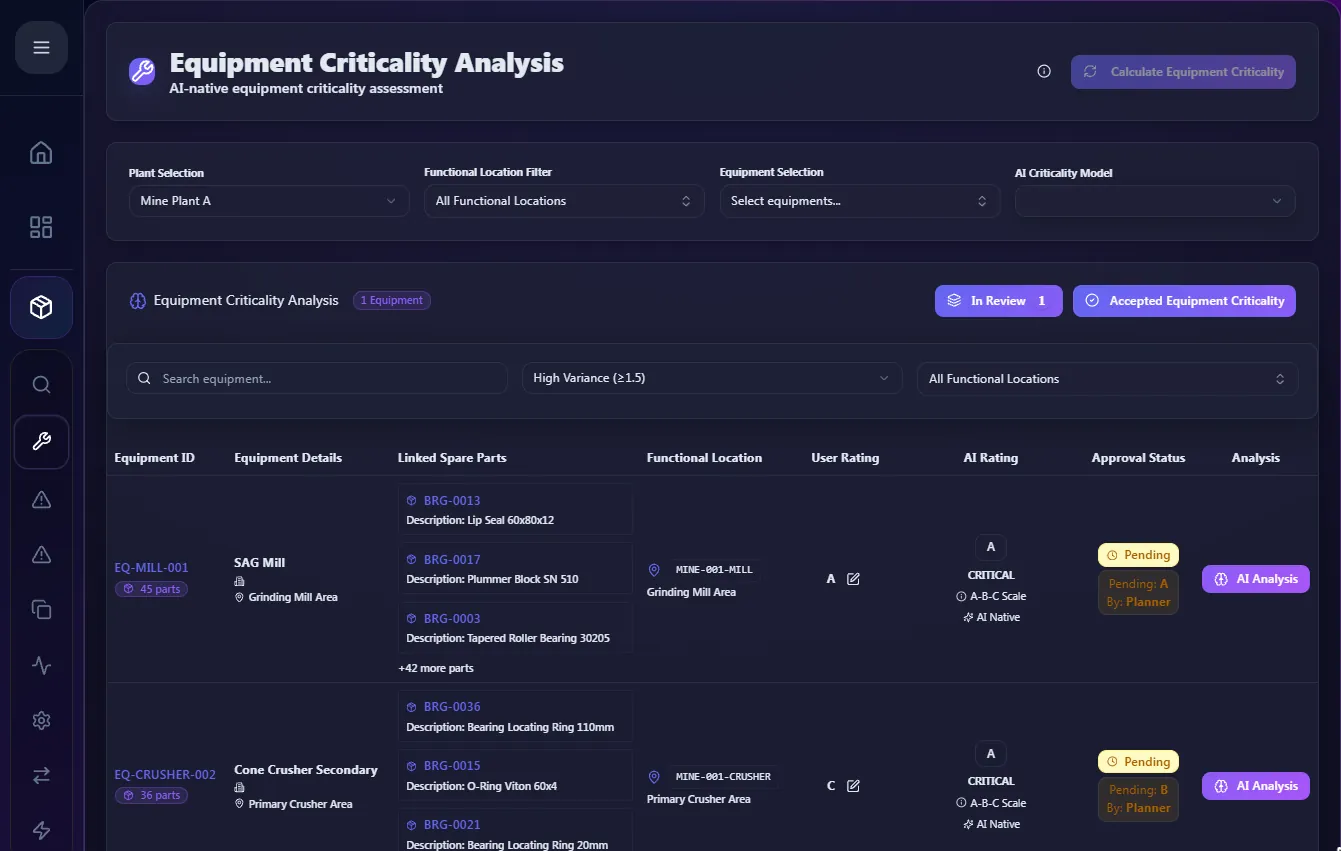
AI rates every asset and part with reasons. Planners disagree in the app with a note, approvers sign off, and the ERP gets the final rating.

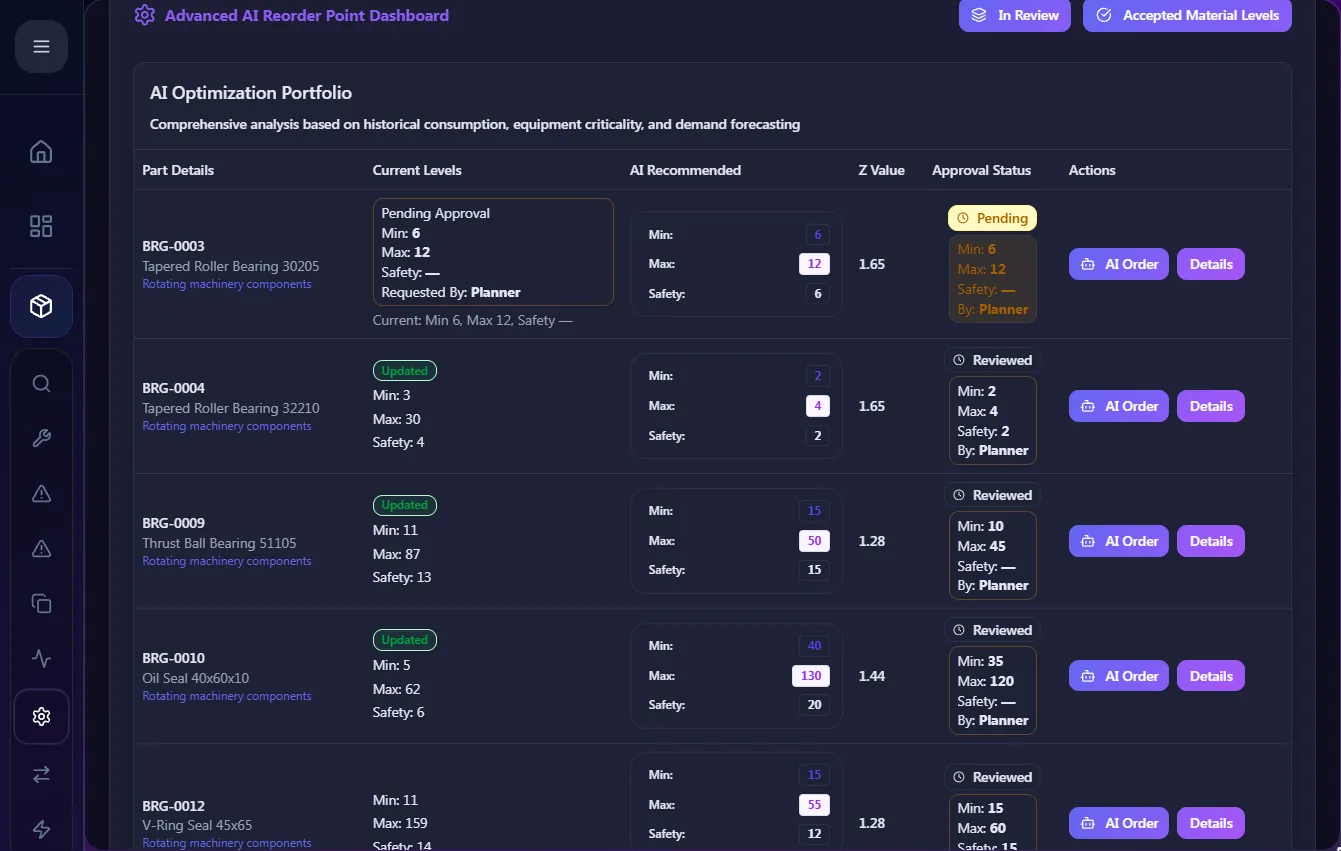
Velocity and forecast feed AI min, max and safety stock. Small reorders are placed by the agent; larger ones go to the RFQ desk and become purchase orders.

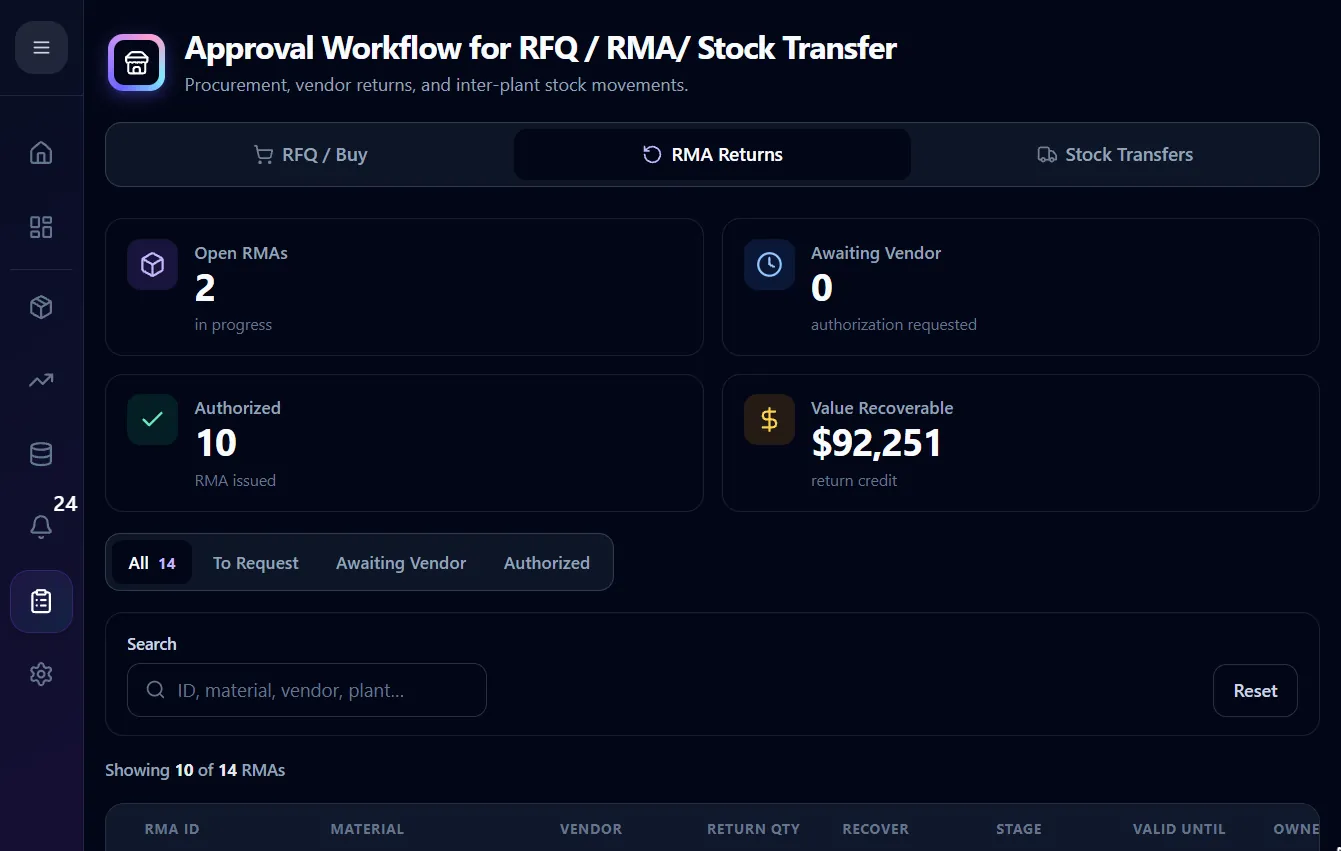
Dead and excess stock is matched to another plant's shortfall or a vendor return window, with savings, distance and transit time shown before anyone commits.

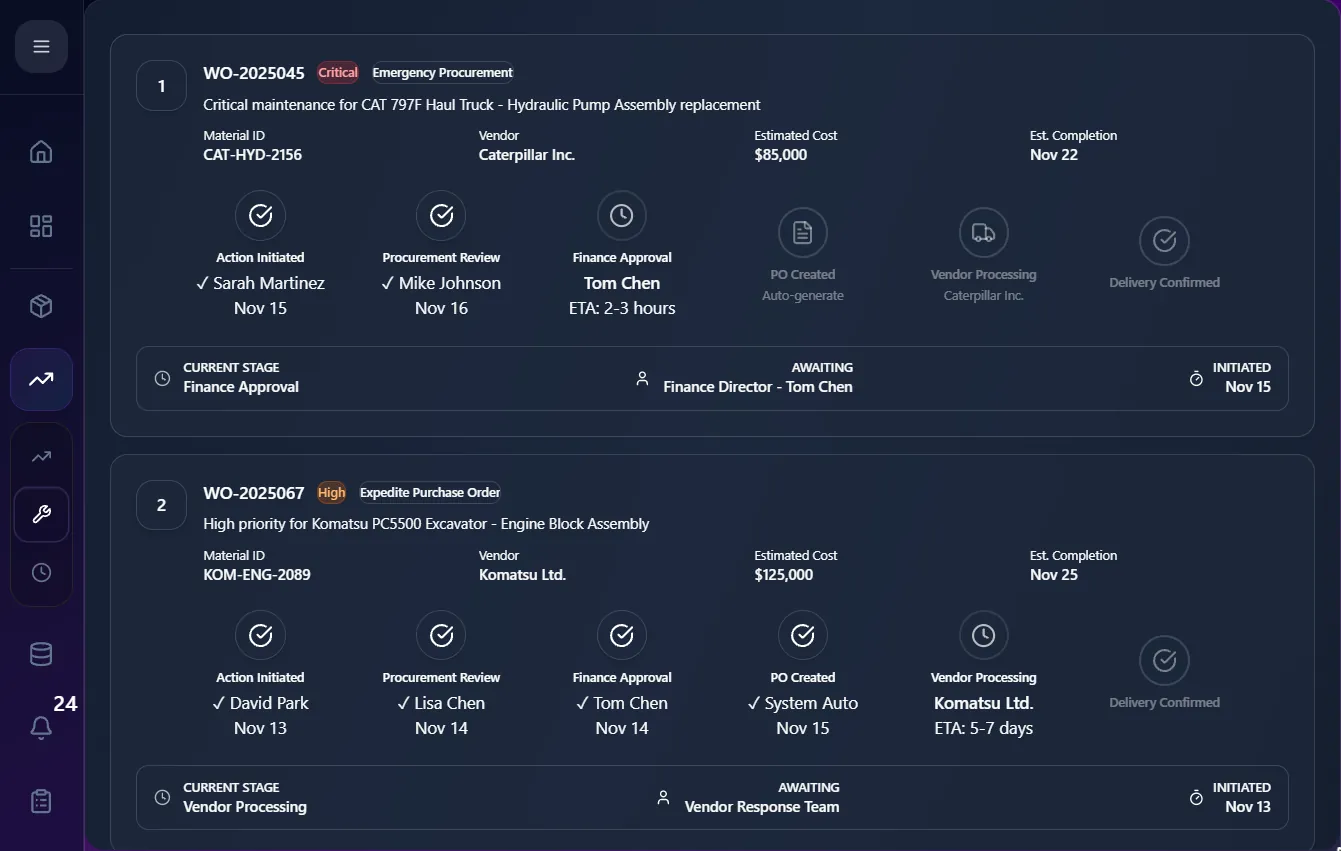
Work orders short of parts are flagged and tracked through procurement. Cancelled work orders get a line-by-line recommendation to cancel, return, transfer or keep.

Three stages, at the pace your team sets.
Deployed on your data and set to your criticality framework, sites and calendars. Validated with your planners before go-live.
Each override, correction and goods receipt feeds back into the models, so accuracy compounds over time.
Once agreed thresholds are met, agents act on defined routine decisions such as reorder updates, obsolescence flags and transfer proposals.
Dead, excess and duplicated stock found, valued and dispositioned, with reorder points corrected so it doesn't rebuild.
~$26M released at a five-site miner
Critical spares protected by criticality, and every part confirmed before the work order is released.
Zero critical parts missed at the first shutdown
Gaps found days or weeks ahead, and surplus at another site offered before any external PO.
43–47% less emergency spend in measured deployments
Shutdown work orders checked against live inventory weeks before mobilisation.
Parts availability confirmed six weeks before a 14-day SAG mill reline
Send one ERP extract. We run the first modules on it and walk you through what they find, in dollars.
An MRO specialist will set up a secure upload and walk you through the findings.
A short call with an MRO specialist. We'll also email a secure link for your extract.
Oil and Gas organizations face huge unwanted costs in the form of losses, penalties and compensation due to industrial accidents, taking a sizable chunk of their revenues. One of the important reasons for failures and accidents is the breakdown of key industrial infrastructure arising from ineffective management of the material base and inefficiencies in the MRO supply chain that are highly critical for the production and maintenance cycles.
More and more organizations are now looking to establish Master Data Management (MDM) implementations in order to manage their assets through informed decision-making based on reliable data and ensure optimal industrial safety across the enterprise.
About the company:
This US based company is a global leader in providing essential mechanical components for both land and offshore drilling rigs, complete drilling and well servicing rigs, as well as a comprehensive range of tubular inspection, internal coatings, drill string equipment, lifting and handling gear, and downhole drilling tools. It also offers supply chain services through distribution centers strategically located near major drilling and production sites worldwide. With over 800 manufacturing, sales, and service centers globally and annual revenues exceeding $12 billion, the company delivers customer-focused solutions tailored to meet the energy industry’s quality, productivity, and environmental needs.
The company faced significant challenges with their master data.
• Lack of consistency and standards for the master data
• Incorrect, incomplete, unclassified and outdated attribute fields of master
data High volumes of data in multiple languages
• Multiple ERP and other legacy instances across the company
• Poorly structured material descriptions
• Lack of data governance and collaboration across cross-functional divisions and locations
Solution: Material Master Data Harmonization & Ongoing Maintenance
The company implemented Verdantis Material Harmonize to cleanse and enrich its historical material master data. Using AI-powered tools and the Verdantis Content Repository, the solution classified, standardized, and eliminated duplicate materials.
Once the data was harmonized, Verdantis Material Integrity was deployed for ongoing data governance. It ensured continuous data accuracy through real-time validation, AI-driven classification, and duplication prevention, maintaining high data quality across enterprise systems.
Key Actions Taken:
Results Achieved:
By integrating Material Harmonize & Material Integrity, the company achieved a scalable, AI-powered Master Data Management framework, ensuring long-term data consistency, efficiency, and compliance.