











MDM in heavy industry isn’t the same discipline that a software company worries about. There’s no customer journey to personalize, no campaign attribution model to tune. In oil fields, mines, chemical plants and food processing facilities, the data that matters is materials, equipment, spare parts, suppliers, bill-of-materials hierarchies, and maintenance records.
When that data is wrong or inconsistent, the consequences show up as production stoppages, emergency procurement, duplicate inventory purchases, and regulatory exposure. Not bad analytics.
This article looks at how MDM adoption is playing out across asset-heavy industries, what the specific challenges are in each sector, and what numbers organizations are actually reporting when things go right.
It draws on published case studies, industry research, and operational data across Oil and Gas, Mining, Chemicals, Manufacturing, Food and Beverage, Energy and Building Materials.
Numbers Behind the MRO Data Problem Before MDM
There’s a common misconception that data quality is primarily a technology problem. In asset-heavy operations, it’s mostly an accumulation problem. Every plant acquisition adds a new ERP instance with its own naming conventions. Every new maintenance management system gets populated by a different crew with different standards.
Over ten years, you end up with a material catalog where the same industrial pump appears under nineteen different descriptions and nobody’s bothered to consolidate them because the production floor is always more urgent than a data cleanup project.
The financial reality of that neglect is stark. Gartner estimates the average cost of poor data quality at $12.9 million per organization annually. For large industrials, it’s almost certainly higher.
Unplanned downtime alone costs Fortune Global 500 companies close to $1.5 trillion per year, and while not all of that is attributable to data issues, the link between inaccurate spare parts records and delayed maintenance response is well-documented and real.
- Gartner estimates that poor data quality costs the average organization $12.9 million per year. In large industrial companies with complex multi-site operations, that figure is typically significantly higher.
- NetSuite reports that unplanned downtime costs Fortune Global 500 manufacturers $1.5 trillion annually, a significant portion of which is linked directly to maintenance data failures, wrong part orders, and equipment record inaccuracy.
- According to Verdantis research across 1,900 operations leaders, between 5 and 7% of all MRO purchases are duplicates caused by poor material master accuracy. For an organization spending $750M annually on MRO, that’s $37.5M to $52.5M in avoidable spend every year.
- McKinsey found that 80% of organizations report at least some divisions operating in data silos, each running separate systems with no shared data standards. In asset-heavy companies with multiple plants or acquired entities, this percentage is typically higher.
- Boston Consulting Group found that MRO spending ranges from 0.5 to 4.5% of revenues across heavy industries, with heavy manufacturing at the top end. Poor catalog data is the primary driver of overspending in this category.
- BCG also found that 20% of MRO spending is distributed across more than 1,600 suppliers, driving 45% of transaction volume but minimal spend consolidation. Long-tail supplier fragmentation is almost always a symptom of poor master data, not poor procurement strategy.
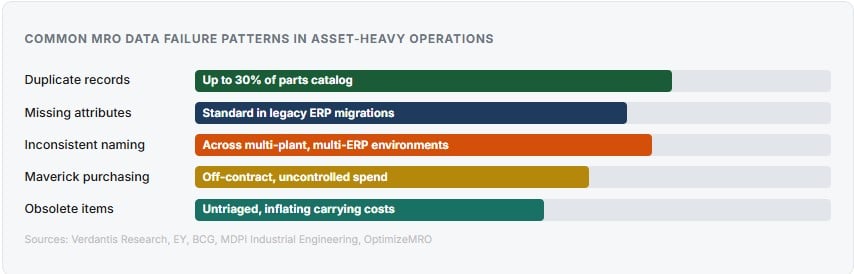
The financial exposure from MRO data failure in asset-heavy industries is direct and measurable. At $750M annual MRO spend with a 5-7% duplicate purchase rate, the cost of doing nothing is conservatively $37M to $52M per year, before accounting for downtime, emergency freight, and compliance penalties.






The Global Master Data Management Market
The global MDM market doesn’t have one agreed-upon size. Different research firms scope it differently, and the numbers vary accordingly.
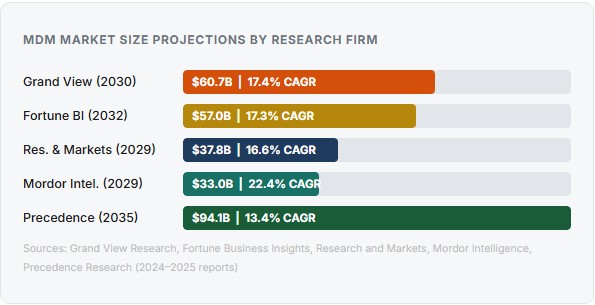
Grand View Research puts the 2023 market at $19.9 billion, projecting $60.7 billion by 2030 at a 17.4% CAGR. Fortune Business Insights tracks it at $16.07 billion in 2024, heading to $57.02 billion by 2032. Precedence Research is more aggressive, forecasting $94.08 billion by 2035.
The specific figure matters less than the consistency of direction: every major research firm covering this space is projecting mid-to-high double-digit annual growth through the end of the decade. For asset-heavy industries specifically, the relevant growth story is in the asset and location data segment.
Precedence Research identifies asset and location data as the fastest-growing MDM data type, projected at a 13.8% CAGR through 2035, driven by rising complexity in manufacturing, utilities, transportation, energy and infrastructure operations.
What's Actually Driving MDM Adoption in Industrial Sectors
Three forces are genuinely moving MDM adoption in asset-heavy operations. None of them are theoretical, they show up in procurement conversations, ERP project post-mortems, and maintenance program audits at real industrial companies.
-
ERP Modernization
Research and Markets identifies legacy system integration challenges and mergers and acquisitions as two of the primary growth drivers in the MDM market. Both describe the typical asset-heavy company profile. Organizations going through SAP S/4HANA migrations discover, usually the hard way, that a new ERP doesn't fix dirty data. It inherits it.
The cleanup conversation that should have happened three years earlier happens in the middle of a live go-live, at significantly higher cost. -
AI Readiness Pressure
Around 54% of new MDM platforms launched in 2023 to 2024 include no-code AI and auto-governance features, making the technology more accessible for mid-market industrial companies that previously couldn't justify the implementation overhead.
The underlying driver is simple: machine learning running on inconsistent material data produces unreliable outputs. Organizations building predictive maintenance and procurement automation programs are finding that the data foundation matters more than the tool sitting on top of it. -
Compliance and Regulatory Pressure
Regulatory requirements across chemicals, food and beverage, energy and manufacturing keep adding requirements, not removing them.
The need to demonstrate data lineage, prove material provenance and maintain auditable procurement records is now built into operating licenses across many regulated sectors. MDM is the data layer that makes compliance demonstrable rather than something organizations scramble to assemble before an audit.
Where MDM Investment Is Coming From and Where It's Heading
Global MDM revenue share in 2023. The U.S. alone accounts for more than 32% of North American revenue. High cloud adoption rates, large enterprise concentration, and presence of major MDM vendors all contribute.
Industrial MDM spend is concentrated in oil and gas, discrete manufacturing, and chemicals. Grand View Research
CAGR for European enterprise data management market from 2025 to 2030. GDPR compliance requirements created early and sustained demand for data governance infrastructure that is now extending into MRO and asset management domains across chemicals, automotive manufacturing, and energy. Grand View Research EDM
Of Asia-Pacific companies shifting to cloud MDM for faster deployment and reduced IT overhead. Industrial expansion across India, Southeast Asia and Australia is generating fragmented data environments at scale.
Manufacturing-heavy economies adopting ERP for the first time are creating MDM demand earlier in the maturity curve than Western counterparts typically did. Global Growth Insights
O&G sector investment driving MDM adoption at pace. Large national energy companies in the Gulf region are among the most active early adopters of AI-native MRO master data programs, given the scale of their asset bases and annual procurement spend.
Vision 2030 industrial diversification programs are accelerating data infrastructure investment across Saudi Arabia and UAE. Research and Markets
Not all MDM segments are growing at the same rate. For industrial companies prioritizing where to focus, the segment breakdown matters. Asset and location data, the domain covering equipment hierarchies, spare parts catalogs, and MRO records is the fastest-growing segment by CAGR.
Services are growing fast because implementation complexity is rising as organizations deploy more domain-specific programs. And AI-native platforms are gaining share from traditional rule-based MDM tools at an accelerating rate.
Segment | 2024 Status | Growth Signal | Source |
Asset and location data | Fastest-growing MDM data type | 13.8% CAGR to 2035 | |
Cloud deployment | Dominant at ~75% of market value | Continued migration from on-premises | |
Implementation and services | Strong growth as program complexity rises | 14% CAGR to 2035 | |
AI-native MDM platforms | 54% of new launches included AI features | Rapidly accelerating adoption | |
O&G data management | $27.3B in 2024 | $86B by 2034 at 12.3% CAGR | |
Manufacturing MDM | 37% part redundancy reduction with MDM | ERP migration wave accelerating adoption | |
AI-initiated MRO purchasing | Early deployments in 2024 | 50% of MRO purchases AI-initiated by 2028 |
Oil and Gas: The Data Behind $500K Shutdowns
Oil and Gas are the sector where the distance between data quality and operational consequence is shortest and most expensive. A maintenance event that should take four hours stretches to three days when the maintenance team can’t find or trust the right spare part record.
In a refinery or upstream production environment, that delay has a price attached to it that most other industries never experience.
Market Context
- According to Research and Markets, the global O&G data management market was valued at $27.3 billion in 2024 and is on track to reach $86 billion by 2034, growing at a 12.3% CAGR. This is the largest sector-specific data management market globally.
- The upstream segment (exploration and drilling) alone accounts for a 31% share of the O&G data management market, reflecting the scale of seismic, subsurface, and drilling data that requires structured governance to be operationally useful.
- The Society of Petroleum Engineers documented that most mid-to-large O&G companies have left master data management effectively unaddressed, assuming ERP implementation alone would solve the underlying data fragmentation. In practice, ERP systems inherit and preserve the fragmentation, they don’t resolve it.
Operational Consequences
- EY documents that downtime in oil, gas and chemical operations can cost upwards of $500,000 per start/stop event. Unplanned stops that result from missing or inaccurate spare parts data compound this cost across multiple events per year.
- Poor MRO data forces maintenance teams to raise new purchase orders for parts already in stock under a different description. Duplicate inventory from this pattern can lock up $37M to $52M in working capital at a typical large O&G operator’s MRO spend levels, per Verdantis research.
10% Expected reduction in total annual MRO spend over 3 years post-implementation ↗ Source: EY US
- Internal review identified significant duplicate entries across the company's ERP, with the same parts recorded multiple ways across sites
- More than 100,000 data sets were processed through AI-powered cleansing and standardization software
- An industry-standard material master template was built and applied across all sites with governance rules to prevent recurrence
- Outcomes included reduced duplicate inventory, improved supplier pricing leverage, and projected 10% savings on annual MRO expenditure through cost avoidance and standing inventory reduction
At a typical O&G operator spending $750M annually on MRO, a 10% improvement over 3 years translates to $75M in cumulative savings. The EY case establishes this is achievable within a single MDM implementation cycle when AI-powered cleansing is applied systematically.
Mining: Aging Equipment, Remote Sites, No Storerooms
Mining sits in a category of its own when it comes to MRO data challenges. Open-cut operations have no storerooms. Parts and materials need tracking through GPS tags, telemetry data, and equipment asset records that are often spread across systems with limited connectivity to central ERP platforms.
Underground operations face communication constraints that create data gaps between field events and what actually gets recorded.
And most of the assets, haul trucks, draglines, crushers, SAG mills, are enormous, expensive, and often decades old.
Spare Parts and Asset Data Challenges
- Industry research on MRO inventory management shows that between 10 and 30% of total MRO stock in mining operations is slow-moving or obsolete, inflating carrying costs while providing no operational coverage benefit.
- Gartner predicts that by 2028, 60% of organizations will deploy agentic AI to streamline operational workflows and autonomous decision-making.
- McKinsey & Company notes that industrial equipment such as turbines, mining machinery, and heavy manufacturing systems can remain in service for 30 years or more, even though many of their internal components have much shorter lifecycles.
This creates ongoing challenges in sourcing legacy spare parts and often requires organizations to identify substitute or equivalent components to maintain operational continuity.
Replacement parts for decades-old mining equipment are available from limited manufacturers, making commercial equivalent identification through clean material master data not just a cost-saving measure but an operational continuity requirement.
- IoT-based condition monitoring on mining assets, vibration analysis on conveyor drives, thermal imaging on crushers, load data on haul trucks, only produces actionable maintenance alerts when it references accurate equipment records. Inconsistent asset hierarchies between ERP and CMMS systems cause alerts to route incorrectly or get lost entirely, erasing the investment in the monitoring technology.
In mining, the business case for MDM often starts with obsolete and slow-moving inventory (10-30% of stock) and commercial equivalent identification for aging OEM parts. Both require a clean, enriched material master as the starting point. Without it, the storeroom is essentially unauditable.
Chemicals: When Bad Data Is a Safety Issue
In chemicals and petrochemicals, master data errors have consequences that go beyond inventory inefficiency.
A pump seal ordered under an incomplete or incorrect material description might meet functional specs on paper but fail under actual process conditions. In hydrocarbon or reactive chemical environments, that’s not a procurement error. It’s a potential incident.
Safety and Compliance Data
- Gartner found that 49% of procurement leaders say their organization’s data isn’t good enough to support current digital transformation programs. In chemicals, where procurement data includes safety classifications, hazardous material codes, and process compatibility attributes, data gaps create direct regulatory exposure.
- IBM Institute for Business Value projects that AI-driven procurement adopters will see a 36% improvement in compliance tracking by 2027. In chemicals, this maps directly to better enforcement of material specification requirements at the point of purchase order creation.
- In one documented MDM implementation at a global chemical manufacturer, more than 100,000 unharmonized material records were consolidated across multiple languages into a single global taxonomy, with AI parsing manufacturer names, correcting attribute gaps, and eliminating duplicates across regional ERP instances. (Source: Verdantis case study)
Procurement and Spend Control
- BCG identified that proprietary OEM parts comprise 40 to 70% of machine replacements in chemical plants, sourced from single vendors with limited negotiation leverage. Better specification management through MDM enables alternative sourcing for 5-20% cost reduction on this category.
- When supplier records are inconsistent and duplicated, organizations lose the ability to see total spend with any given vendor. Clean vendor master data consolidation consistently moves maverick spend from 40% toward 25% of total MRO expenditure, unlocking contract leverage that was previously invisible.
- EY modeled that at a $1B MRO spend operation with 80% contract coverage, disciplined data governance creates an annualized net cost reduction opportunity of $19.8 million through procurement rationalization alone.
In chemicals, MDM governance rules that enforce mandatory safety and compatibility attributes at record creation serve two simultaneous purposes: they reduce procurement cost through better vendor consolidation and they eliminate the data pathway through which dangerous material substitutions can occur. These aren't separate benefits. They come from the same governance infrastructure.
Manufacturing: MRO Chaos, Multi-Plant ERP, the $20M Inventory Story
Manufacturing covers more ground than any other category here, from automotive suppliers to cement producers to food packaging lines.
What they share is a predictable data degradation pattern: each acquisition adds a new ERP, each new site adds a new crew with different naming habits, and after a few years the material catalog has four entries for the same bearing and nobody’s sure which one reflects current procurement agreements.
Inventory and Working Capital
- Deloitte’s 2025 manufacturing survey found that nearly 70% of manufacturers identify data quality, contextualization and validation as the biggest obstacles to AI implementation – which is really just another way of saying that inventory and procurement decisions are running on guesswork wherever master data hasn’t been cleaned up. (Source: Deloitte Manufacturing Trends 2025 )
- McKinsey’s 2024 analysis of AI in industrial operations found that embedding AI-driven inventory management delivers reductions of 20 to 30% in inventory levels, alongside 5 to 15% in procurement spend savings. Those numbers come from operations where the underlying material data was clean enough for the AI to work with. That’s the part that rarely makes it into the headline stat. (Source: McKinsey, Harnessing the Power of AI in Distribution Operations, 2024)
Maintenance and Uptime Impact
- McKinsey found that predictive maintenance programs with upfront data governance deliver 1.8x more ROI than those that skip the master data foundation. This is possibly the most actionable number for manufacturers currently planning condition-monitoring investments.
- McKinsey also demonstrates that digital work order management reduces planned downtime costs by 15 to 30%, but only when the underlying equipment hierarchy and spare parts data are reliable enough to support accurate scheduling.
- MarketReportsWorld reports that manufacturers with mature MDM programs see a 37% reduction in part redundancy across their supplier networks, directly reducing both procurement complexity and carrying costs.
- McKinsey research shows that every $1 in critical spares stock safeguards $7 in contribution margin. The implication: spare parts data quality is not a cost center problem. It’s a revenue protection strategy.
ERP Migration as a Forcing Function
- Mordor Intelligence’s 2025 MDM market analysis found that early-stage S/4HANA programs which embedded MDM upfront cut cutover timelines and reduced system complexity significantly.
The single most common trigger for MDM investment in manufacturing right now is SAP S/4HANA migration. A well-implemented MDM program can pay for itself within 6 to 12 months in manufacturing, primarily through inventory rationalization and procurement savings unlocked during the migration clean-up.
- Deloitte identifies dirty data as the number one project killer for industrial digital transformation programs, with successful programs allocating roughly 25% of total project budget to data cleansing and integration work.
The $20M inventory case from Verusen isn't about exceptional circumstances. It's about what becomes visible when fragmented SAP instances are harmonized into a single deduplicated view. The inventory was always there. The data was hiding it. That pattern repeats in virtually every multi-plant MDM implementation.
Food and Beverage: The Food-Grade Attribute That Stops a Recall
Food and beverage manufacturing runs on tight tolerances. Equipment downtime disrupts production schedules that were planned around perishable inputs. Ingredient substitutions carry compliance implications.
And managing 2 million-plus SKUs across regions with different languages, labeling requirements, and supplier naming conventions creates a data complexity that most other industries never encounter. The regulatory consequences of getting this wrong are severe.
Compliance and Safety Data
- Production lines in food processing use pumps, seals and lubricants that must be food-grade certified for product-contact applications under FSMA and FALCPA frameworks. Without MDM-enforced mandatory attributes at record creation, there is no system-level gate preventing a non-compliant component from being ordered and installed in a product-contact application.
- In one documented F&B implementation, a manufacturer enforced mandatory “Food-Grade” attributes for all pump parts through MDM governance rules. Ordering errors that could have led to contamination incidents, product recalls, and regulatory investigations were eliminated at the data layer, before they could reach the plant floor.
- Food Manufacturing notes that with MDM in place, companies can determine exactly which batches are affected during a recall and issue a targeted recall rather than a broad one. The financial difference between a targeted and a broad recall can easily reach tens of millions of dollars in recovered product and avoided write-offs.
Operational Scale and Technology Adoption
- CRB’s 2024 Horizons report on F&B manufacturing found that 48% of food and beverage manufacturers are now directing capital toward automation, all of which requires clean master data as a prerequisite for machine-level integration with ERP systems.
- RSM’s Food and Beverage Monitor reports that 68% of food manufacturers planned technology investment increases in their most recent fiscal year, with data integration cited as a top barrier to realizing expected returns from that investment.
- Global F&B companies operating across multiple countries face a multilingual master data challenge. Implementations covering 2+ million SKUs across 8 regions and 12 languages have been completed using AI-driven MDM with automated translation, classification and normalization, processes that previously required years of manual data team effort.
In food and beverage, the MDM business case includes a risk dimension that doesn't appear in most ROI calculations: recall cost avoidance. A single broad recall that MDM-governed batch traceability could have narrowed to a targeted recall often represents more financial exposure than the entire cost of an MDM implementation.
Energy and Building Materials: Aging Infrastructure, Long Asset Lives, Post-Merger Data
Energy utilities and building materials manufacturers share a structural characteristic with other asset-heavy sectors: their operational data is as geographically distributed as their physical assets.
For a transmission and distribution network, that means transformers and switching equipment installed 30 to 40 years ago from manufacturers that may no longer exist.
For a cement or glass producer, it means continuous-process kilns and mills that run 24 hours a day with very limited tolerance for unplanned stops.
Energy and Utilities Data
- Smart Grid systems require accurate, real-time asset data to function. Addressing aging T&D infrastructure while deploying new grid technologies requires a reliable equipment master. World Economic Forum notes that modern grid operations depend heavily on high-quality asset and infrastructure data to support reliability, maintenance planning, and technology deployment.
- ESG reporting is emerging as a new MDM use case in energy. MarketReportsWorld reports that over 1,300 global enterprises used MDM to govern ESG-related data in 2024, tracking carbon metrics, supply chain risk, and material sourcing as part of regulatory reporting obligations.
- Gartner projects that 86% fewer emergency air-freights occur at organizations with supplier portals integrated with clean master data, directly reducing emergency procurement costs in utilities and energy operations where remote asset failures create rapid sourcing pressure.
Building Materials
- Building materials companies, cement, glass, aggregates, and roofing, have experienced significant M&A consolidation over the past decade. Post-acquisition data harmonization is an immediate operational requirement: procurement synergies across a combined entity are unachievable if both operations are buying the same part under different names from different suppliers at different prices, with no system to see the overlap.
- In continuous-process building materials production, a single unplanned kiln or mill shutdown can cost hundreds of thousands of dollars in lost production and restart energy costs. Spare parts data quality, specifically the availability of correct, enriched part records linked to accurate equipment hierarchies, is a direct input to maintenance reliability in these environments.
In both energy utilities and building materials, MDM investment tends to get triggered by one of two events: a Smart Grid or digital infrastructure program that can't run without clean asset data, or a post-acquisition integration that reveals how incompatible the inherited data environments really are. In both cases, MDM is the practical solution, not an optional improvement.
What MDM Actually Delivers: Cross-Industry Results
The numbers on MDM outcomes in asset-heavy industries come primarily from vendor case studies, independent research firms, and consulting post-project analyses. It’s worth being transparent about that. The figures below reflect results from implementations that were completed and measured.
They represent what’s achievable, not what’s guaranteed. That said, the pattern across multiple independent sources is consistent enough to be meaningful.
Productivity and Efficiency Gains
- Gartner benchmarks show a 20% average improvement in data accuracy and a 15% average gain in organizational efficiency for organizations that implement MDM solutions. These are aggregate figures; asset-heavy companies starting from more fragmented baselines tend to see larger improvements.
- MarketReportsWorld reports 67% faster decision-making cycles at organizations with mature MDM programs, a result of having reliable, single-source data available at the point where operational decisions are made rather than requiring manual reconciliation across systems.
Procurement and Spend Control
- BCG documented a steel manufacturer reducing MRO spending by 10% and transaction volume by 25% through optimized spare parts planning and catalog governance, along with a 15% improvement in spare parts inventory levels from better stocking practices enabled by clean data.
- Emergency air-freight reduction of 86% at organizations with integrated supplier portals and clean master data (Gartner). Emergency freight is one of the most expensive line items in industrial MRO procurement and one of the most directly attributable to poor part availability data.
Outcome | Result | Source |
Data accuracy improvement | +20% average | Gartner |
Organizational efficiency gain | +15% average | Gartner |
MRO spend savings over 3 years (O&G) | ~10% of annual spend | EY Case Study |
Working capital released via stock review | 8–12% reduction | Bain |
Emergency freight reduction | 86% fewer air-freights | Gartner 2025 |
Predictive maintenance ROI multiplier | 1.8x with data governance | McKinsey 2024 |
Part redundancy reduction | 37% across supplier networks | MarketReportsWorld |
Downtime reduction with clean spare parts data | 50% improvement | Verdantis Research |
The pattern across sources is consistent: the fastest financial return from MDM in asset-heavy industries comes from MRO inventory rationalization (weeks to months), followed by procurement spend governance (months), followed by maintenance reliability improvement (12-18 months). All three are enabled by the same underlying capability: clean, enriched, governed material and asset master data.
AI-Native MDM in 2026: What's Actually Different Now
The single biggest shift in industrial MDM over the past two years is the collapse in time-to-value. A 200,000-record material master normalization that used to take 18 months of manual effort now completes in weeks using AI-powered enrichment and deduplication.
That change makes a different class of business case possible, because it eliminates the primary objection to MDM investment in most industrial organizations: “the company can’t afford the time.”
Specific AI Capabilities Changing Industrial MDM
- Autonomous material record enrichment: AI models trained on industrial material data can identify missing specifications, cross-reference manufacturer catalogs, and fill attribute gaps without requiring a human to research each record. A catalog with 40% incomplete records can realistically reach 90%+ completeness in weeks.
- Multi-language harmonization: AI translation and classification tools enable real-time harmonization of material records across languages. This is critical for global chemical, F&B, and manufacturing companies running multi-lingual ERP environments across 10 or more countries.
- Alternate parts and commercial equivalent discovery: AI cross-references material records against live supplier catalogs to automatically identify functional equivalents for obsolete or hard-to-source components. In mining and aging manufacturing assets, this capability directly prevents unplanned downtime caused by OEM sourcing failures.
- Self-cleansing ongoing governance: Modern AI-native platforms operate as continuous governance systems, learning from inventory activity, purchase history, and usage patterns to maintain data quality without periodic manual audit cycles. The data stays clean because the platform detects and corrects drift in real time.
The organizations that build clean, governed material masters now will have a structural advantage in 2026 and 2027 as AI-initiated MRO purchasing, predictive maintenance, and autonomous procurement workflows become standard. The data foundation isn't a technology project. It's a prerequisite for everything that comes next.
How Verdantis Approaches MDM in Asset-Heavy Industries
Verdantis is built specifically for the data challenges that manufacturing, oil and gas, mining, chemicals, food and beverage, and energy companies deal with. That means MRO data, spare parts catalogs, equipment hierarchies, supplier records, and the multi-plant, multi-ERP environments that define these sectors.
The platform combines AI-powered enrichment with ongoing governance that prevents data from drifting back into fragmentation after the initial standardization.
Verdantis brings Agentic AI into Master Data Management, moving beyond one-time cleansing projects to autonomous, self-learning agents that continuously monitor, enrich and govern master data quality – without requiring permanent manual intervention to sustain it.
Specific AI Capabilities Changing Industrial MDM
AI agents parse unstructured sources including equipment manuals, supplier invoices, specification sheets, drawings and OEM documents, eliminating manual data entry and the errors that come with it.
Extracted data is automatically classified and enriched using verified sources, manufacturer catalogs, and industry taxonomies including UNSPSC and eClass. Accuracy improves continuously rather than degrading between manual audit cycles.
Agents flag duplicate records, enforce mandatory attribute rules before new records are approved, identify obsolete parts and recommend disposition, and trigger alternate supplier discovery when preferred sources are unavailable or lead times are unacceptable.
The platform learns in real time from purchase history, consumption patterns, failure events and inventory movements.
Stocking parameters update to reflect actual operational reality rather than original estimates that were set years ago and never revisited.
Core Products and Agents for Asset-Heavy Operations
AI-native material master normalization and deduplication across ERP and CMMS systems.
Automated ongoing governance enforcing data quality rules at the point of record creation.
Spare parts criticality assessment, AI forecasting, and multi-plant inventory visibility.
Web-based AI enrichment filling missing attributes from manufacturer data and industry taxonomies
Obsolescence detection and commercial equivalent recommendation for aging OEM parts
Multilingual translation and harmonization for global multi-plant deployments
Platform Integration and Spare Parts Intelligence
Verdantis integrates directly with leading ERP and EAM platforms, ensuring clean master data flows consistently across maintenance, inventory and procurement systems without requiring replacement of existing infrastructure.
Beyond integration, Verdantis delivers advanced spare parts intelligence: obsolescence detection to proactively identify supply risk, criticality assessment to prioritize high-impact assets and spares, commercial equivalent identification to reduce OEM dependency, and optimized stocking strategies aligned with asset criticality and actual consumption data.