









La MDM en la industria pesada no es la misma disciplina de la que se preocupa una empresa de software. No hay un recorrido del cliente que personalizar, ni un modelo de atribución de campañas que ajustar. En los campos petrolíferos, las minas, las plantas químicas y las instalaciones de procesamiento de alimentos, los datos que importan son los materiales, los equipos, las piezas de repuesto, los proveedores, las jerarquías de listas de materiales y los registros de mantenimiento.
Cuando esos datos son erróneos o incoherentes, las consecuencias se manifiestan en paradas de producción, aprovisionamientos de emergencia, compras de inventario duplicadas y exposición a la normativa. No está mal el análisis.
Este artículo examina cómo se está desarrollando la adopción de MDM en los sectores con gran volumen de activos, cuáles son los retos específicos de cada sector y qué cifras presentan realmente las organizaciones cuando las cosas van bien.
Se basa en estudios de casos publicados, investigaciones del sector y datos operativos sobre petróleo y gas, minería, productos químicos, fabricación, alimentación y bebidas, energía y materiales de construcción.
Números detrás del problema de los datos MRO antes de MDM
Existe la idea errónea de que la calidad de los datos es principalmente un problema tecnológico. En las operaciones con muchos activos, se trata sobre todo de un problema de acumulación. Cada adquisición de una planta añade una nueva instancia de ERP con sus propias convenciones de nomenclatura. Cada nuevo sistema de gestión del mantenimiento es utilizado por un equipo diferente con normas distintas.
A lo largo de diez años, acabas teniendo un catálogo de materiales en el que la misma bomba industrial aparece bajo diecinueve descripciones diferentes y nadie se ha molestado en consolidarlas porque la planta de producción siempre es más urgente que un proyecto de limpieza de datos.
La realidad financiera de esa negligencia es cruda. Gartner calcula que el coste medio de la mala calidad de los datos es de $12,9 millones anuales por organización.. Para los grandes industriales, es casi seguro que es mayor.
Sólo los tiempos de inactividad imprevistos cuestan a las empresas de Fortune Global 500 cerca de $1,5 billones al año.Y aunque no todo se debe a problemas de datos, la relación entre la inexactitud de los registros de piezas de recambio y el retraso en la respuesta de mantenimiento está bien documentada y es real.
- Gartner estima que la mala calidad de los datos cuesta a la organización media $12,9 millones al año. En las grandes empresas industriales con operaciones complejas en múltiples emplazamientos, esa cifra suele ser significativamente superior.
- NetSuite informa de que los tiempos de inactividad imprevistos cuestan a los fabricantes de Fortune Global 500 $1,5 billones anualmenteuna parte significativa de los cuales está directamente relacionada con fallos en los datos de mantenimiento, pedidos de piezas erróneos e inexactitud en los registros de los equipos.
- Según Investigación de Verdantis entre 1.900 responsables de operaciones, entre 5 y 7% de todas las compras de MRR son duplicados causados por la escasa precisión del maestro de materiales. Para una organización que gasta $750M anualmente en MRO, esto supone entre $37,5M y $52,5M en gastos evitables cada año.
- McKinsey encontró que 80% de organizaciones informan de que al menos algunas divisiones operan en silos de datos, cada una con sistemas separados sin estándares de datos compartidos. En las empresas con muchos activos, múltiples plantas o entidades adquiridas, este porcentaje suele ser mayor.
- Boston Consulting Group encontró que El gasto en MRR oscila entre 0,5 a 4,5% de ingresos en las industrias pesadascon fabricación pesada en el extremo superior. La escasez de datos de catálogo es la principal causa del gasto excesivo en esta categoría.
- BCG también descubrió que 20% del gasto en MRR se distribuye entre más de 1.600 proveedoresLa fragmentación de proveedores a largo plazo es casi siempre un síntoma de datos maestros deficientes, no de una mala estrategia de compras. La fragmentación de los proveedores de cola larga es casi siempre un síntoma de datos maestros deficientes, no de una mala estrategia de compras.
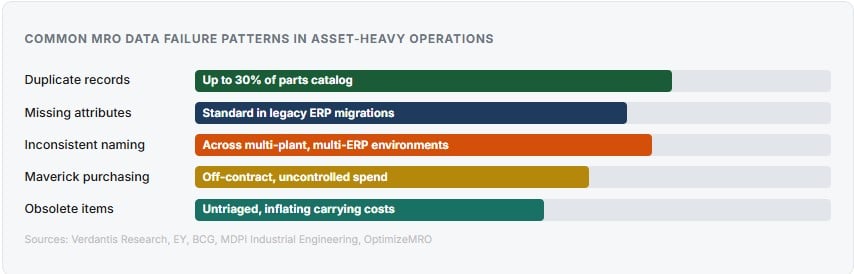
La exposición financiera derivada del fallo de los datos de MRR en los sectores con gran volumen de activos es directa y cuantificable. Con un gasto anual en MRO de $750M y una tasa de duplicación de compras de 5-7%, el coste de no hacer nada es de conservadoramente de $37M a $52M al año, antes de contabilizar el tiempo de inactividad, los fletes de emergencia y sanciones por incumplimiento.






El mercado mundial de la gestión de datos maestros
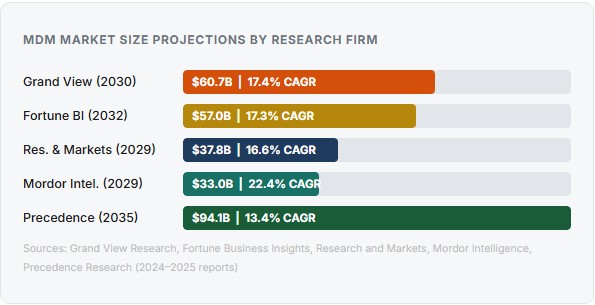
El mercado global de MDM no tiene un tamaño acordado. Las distintas empresas de investigación lo dimensionan de forma diferente, y las cifras varían en consecuencia.
Según Grand View Research, el mercado en 2023 ascenderá a 1.400 millones de euros, con una previsión de 1.460 millones de euros en 2030 y una tasa de crecimiento interanual del 17,41%. Fortune Business Insights calcula que alcanzará los 16.070 millones de euros en 2024 y los 57.020 millones de euros en 2032. Precedence Research es más agresivo y prevé $94.080 millones para 2035.
La cifra concreta importa menos que la coherencia de la dirección: todas las principales empresas de investigación que cubren este espacio proyectan un crecimiento anual de dos dígitos medios a altos hasta el final de la década. En el caso concreto de los sectores con gran volumen de activos, la historia de crecimiento relevante se sitúa en el segmento de los datos de activos y localización.
Precedence Research identifica los datos de activos y localización como el tipo de datos MDM de mayor crecimiento, con una CAGR prevista de 13,8% hasta 2035.impulsado por la creciente complejidad de las operaciones de fabricación, servicios públicos, transporte, energía e infraestructuras.
Qué está impulsando realmente la adopción de MDM en los sectores industriales
Hay tres fuerzas que están impulsando realmente la adopción de MDM en las operaciones con muchos activos. Ninguna de ellas es teórica, sino que aparecen en las conversaciones sobre adquisiciones, las autopsias de proyectos ERP y las auditorías de programas de mantenimiento en empresas industriales reales.
-
Modernización de ERP
Research and Markets identifica los retos de integración de sistemas heredados y las fusiones y adquisiciones como dos de los principales impulsores del crecimiento en el mercado de MDM. Ambos describen el típico perfil de empresa con muchos activos. Las organizaciones que realizan migraciones a SAP S/4HANA descubren, normalmente por las malas, que un nuevo ERP no corrige los datos sucios. Los hereda.
La conversación de limpieza que debería haber tenido lugar tres años antes se produce en medio de una puesta en marcha en directo, con un coste significativamente mayor. -
Presión sobre la preparación para la IA
Alrededor de 54% de las nuevas plataformas MDM lanzadas entre 2023 y 2024 incluyen funciones de IA sin código y autogobierno.Esta tecnología es más accesible para las empresas industriales medianas que antes no podían justificar los gastos de implantación.
El motivo subyacente es sencillo: el aprendizaje automático basado en datos de materiales incoherentes produce resultados poco fiables. Las empresas que crean programas de mantenimiento predictivo y automatización de compras se están dando cuenta de que la base de datos es más importante que la herramienta que se coloca encima. -
Cumplimiento y presión normativa
Las normativas sobre productos químicos, alimentos y bebidas, energía y fabricación siguen añadiendo requisitos, en lugar de eliminarlos.
La necesidad de demostrar el linaje de los datos, probar la procedencia de los materiales y mantener registros de aprovisionamiento auditables ya forma parte de las licencias de funcionamiento de muchos sectores regulados. MDM es la capa de datos que permite demostrar el cumplimiento, en lugar de algo que las organizaciones se esfuerzan por reunir antes de una auditoría.
De dónde viene la inversión en MDM y hacia dónde se dirige
Cuota de ingresos mundiales de MDM en 2023. Solo Estados Unidos representa más de 32% de los ingresos norteamericanos. A ello contribuyen las altas tasas de adopción de la nube, la concentración de grandes empresas y la presencia de los principales proveedores de MDM.
El gasto industrial en MDM se concentra en petróleo y gas, fabricación discreta y productos químicos. Investigación de Grand View
CAGR para el mercado europeo de gestión de datos empresariales de 2025 a 2030. Los requisitos de cumplimiento del GDPR crearon una demanda temprana y sostenida de infraestructura de gobernanza de datos que ahora se está extendiendo a los dominios de MRO y gestión de activos en los sectores químico, de fabricación de automóviles y energético. Grand View Research EDM
De las empresas de Asia-Pacífico que optan por la MDM en la nube para agilizar el despliegue y reducir los gastos generales de TI. La expansión industrial en la India, el Sudeste Asiático y Australia está generando entornos de datos fragmentados a gran escala.
Las economías con un alto componente manufacturero que adoptan por primera vez un ERP están generando una demanda de MDM en una fase más temprana de la curva de madurez que sus homólogos occidentales. Perspectivas de crecimiento mundial
La inversión en el sector de O&G impulsa la adopción de MDM. Las grandes empresas energéticas nacionales de la región del Golfo se encuentran entre los primeros adoptantes más activos de programas de datos maestros de MRO nativos de IA, dada la escala de sus bases de activos y el gasto anual en adquisiciones.
Los programas de diversificación industrial Visión 2030 están acelerando la inversión en infraestructuras de datos en Arabia Saudí y los EAU. Investigación y mercados
No todos los segmentos de MDM crecen al mismo ritmo. Para las empresas industriales que priorizan dónde centrarse, el desglose por segmentos es importante. Los datos de activos y localización, el dominio que abarca las jerarquías de equipos, los catálogos de piezas de repuesto y los registros de MRO, es el segmento de mayor crecimiento CAGR.
Los servicios están creciendo rápidamente porque la complejidad de la implementación está aumentando a medida que las organizaciones despliegan más programas específicos de dominio. Y las plataformas nativas de IA están ganando cuota a las herramientas MDM tradicionales basadas en reglas a un ritmo acelerado.
Segmento | 2024 Estado | Señal de crecimiento | Fuente |
Datos sobre activos y localización | Tipo de datos MDM de mayor crecimiento | 13,8% TACC hasta 2035 | |
Despliegue en la nube | Dominante con ~75% de valor de mercado | Migración continuada desde los locales | |
Implantación y servicios | Fuerte crecimiento a medida que aumenta la complejidad de los programas | 14% TACC hasta 2035 | |
Plataformas MDM nativas de IA | 54% de los nuevos lanzamientos incluyen funciones de IA | Adopción acelerada | |
Gestión de datos de O&G | $27,3B en 2024 | $86B en 2034 con una TACC del 12,3% | |
Fabricación MDM | 37% reducción de la redundancia de piezas con MDM | La ola de migración a ERP acelera su adopción | |
Compras de MRR iniciadas por IA | Primeros despliegues en 2024 | 50% de compras MRO iniciadas por IA para 2028 |
Petróleo y gas: los datos detrás de los cierres de $500K
El petróleo y el gas son el sector en el que la distancia entre la calidad de los datos y las consecuencias operativas es más corta y más cara. Una operación de mantenimiento que debería durar cuatro horas se alarga hasta tres días cuando el equipo de mantenimiento no puede encontrar o confiar en el registro de piezas de repuesto correcto.
En una refinería o en un entorno de producción ascendente, ese retraso tiene un precio que la mayoría de las demás industrias nunca experimentan.
Contexto del mercado
- Según Investigación y mercados, el mercado mundial de gestión de datos de O&G se valoró en $27.300 millones en 2024 y va camino de alcanzar $86 mil millones para 2034creciendo a una CAGR del 12,3%. Se trata del mayor mercado mundial de gestión de datos sectoriales.
- En El segmento de exploración y perforación representa por sí solo un 31% compartir del mercado de gestión de datos de O&G, lo que refleja la magnitud de los datos sísmicos, del subsuelo y de perforación que requieren una gobernanza estructurada para ser útiles desde el punto de vista operativo.
- La Sociedad de Ingenieros del Petróleo documentado que la mayoría de las medianas y grandes empresas de petróleo y gas no han abordado la gestión de los datos maestrosEn la práctica, los sistemas ERP heredan y conservan la fragmentación, pero no la resuelven. En la práctica, los sistemas ERP heredan y conservan la fragmentación, no la resuelven.
Consecuencias operativas
- EY documentos que El tiempo de inactividad en las operaciones petrolíferas, gasísticas y químicas puede costar más de 1.000 millones de euros al año. $500,000 por evento de inicio/parada. Las paradas imprevistas derivadas de la falta de datos o de datos inexactos sobre piezas de recambio agravan este coste en múltiples eventos al año.
- La escasez de datos de MRR obliga a los equipos de mantenimiento a cursar nuevos pedidos de piezas ya almacenadas con una descripción diferente. El inventario duplicado de este patrón puede bloquearse $37M a $52M en capital circulante a los niveles de gasto en MRO de un gran operador típico de O&G, por Investigación Verdantis.
10% Reducción prevista del gasto total anual en MRR en los 3 años posteriores a la implantación Fuente: EY US
- La revisión interna identificó importantes entradas duplicadas en el ERP de la empresa, con las mismas piezas registradas de varias formas en los distintos centros.
- Se procesaron más de 100.000 conjuntos de datos mediante un software de depuración y normalización basado en IA.
- Se creó una plantilla maestra de materiales estándar en el sector y se aplicó en todos los centros con normas de gobernanza para evitar que se repitiera.
- Los resultados incluyeron la reducción del inventario duplicado, la mejora de los precios de los proveedores y un ahorro previsto de 10% en el gasto anual de MRR gracias a la evitación de costes y la reducción del inventario permanente.
En un operador típico de O&G que gasta $750M anualmente en MRO, una mejora de 10% en 3 años se traduce en $75M en ahorros acumulados. El caso de EY establece que esto se puede conseguir en un solo ciclo de implementación de MDM cuando la limpieza basada en IA se aplica sistemáticamente.
Minería: Equipos anticuados, emplazamientos remotos, sin almacenes
La minería se sitúa en una categoría propia en lo que respecta a los retos que plantean los datos de MRR. Las explotaciones a cielo abierto carecen de almacenes. Las piezas y los materiales deben rastrearse mediante etiquetas GPS, datos telemétricos y registros de activos de equipos que a menudo están repartidos entre sistemas con conectividad limitada a plataformas ERP centrales.
Las operaciones subterráneas se enfrentan a limitaciones de comunicación que crean lagunas de datos entre los sucesos sobre el terreno y lo que realmente se registra.
Y la mayoría de los activos, camiones de transporte, dragalinas, trituradoras, molinos SAG, son enormes, caros y a menudo tienen décadas de antigüedad.
Piezas de repuesto y datos de activos Retos
- Investigación industrial sobre la gestión de inventarios de MRR muestra que entre 10 y 30% de las existencias totales de MRR en las explotaciones mineras son de baja rotación u obsoletasEl coste de transporte se infla, mientras que la cobertura operativa no aporta ninguna ventaja.
- Gartner predice que para 2028, 60% de las organizaciones desplegará la IA agéntica para agilizar los flujos de trabajo operativos y la toma de decisiones autónoma.
- McKinsey & Company señala que equipos industriales como turbinas, maquinaria minera y sistemas de fabricación pesada pueden permanecer en servicio durante 30 años o mása pesar de que muchos de sus componentes internos tienen ciclos de vida mucho más cortos.
Esto crea retos constantes en el aprovisionamiento de piezas de repuesto heredadas y a menudo obliga a las organizaciones a identificar componentes sustitutivos o equivalentes para mantener la continuidad operativa.
Las piezas de repuesto para equipos mineros de décadas de antigüedad están disponibles en fabricantes limitados, lo que hace que la identificación de equivalentes comerciales mediante datos maestros de materiales limpios no sea sólo una medida de ahorro, sino un requisito de continuidad operativa.
- Monitorización del estado de los activos mineros basada en IoTanálisis de vibraciones en cintas transportadoras, imágenes térmicas en trituradoras y datos de carga en camiones de transporte, sólo genera alertas de mantenimiento procesables cuando hace referencia a registros precisos de los equipos. Las jerarquías de activos incoherentes entre los sistemas ERP y GMAO hacen que las alertas se dirijan de forma incorrecta o se pierdan por completo, borrando la inversión en la tecnología de supervisión.
En el sector minero, el argumento comercial a favor de la MDM suele empezar por el inventario obsoleto y de baja rotación (10-30% de existencias) y la identificación de equivalentes comerciales para piezas OEM obsoletas. En ambos casos, el punto de partida es un maestro de materiales limpio y enriquecido. Sin él, el almacén es esencialmente inauditable.
Sustancias químicas: Cuando los datos erróneos son un problema de seguridad
En los sectores químico y petroquímico, los errores en los datos maestros tienen consecuencias que van más allá de la ineficacia de los inventarios.
Una junta de bomba pedida con una descripción de material incompleta o incorrecta puede cumplir las especificaciones funcionales sobre el papel, pero fallar en las condiciones reales del proceso. En entornos de hidrocarburos o productos químicos reactivos, esto no es un error de aprovisionamiento. Es un incidente potencial.
Datos de seguridad y conformidad
- Gartner encontró que 49% de los líderes de compras dicen que los datos de su organización no son lo suficientemente buenos como para respaldar los programas actuales de transformación digital. En el caso de los productos químicos, donde los datos de aprovisionamiento incluyen clasificaciones de seguridad, códigos de materiales peligrosos y atributos de compatibilidad de procesos, las lagunas de datos crean una exposición normativa directa.
- Instituto IBM para el Valor Empresarial proyectos que Los que adopten la contratación impulsada por la IA verán un 36% mejora del seguimiento del cumplimiento en 2027. En el sector químico, esto se traduce directamente en una mejor aplicación de los requisitos de especificación de materiales en el punto de creación del pedido de compra.
- En una implantación de MDM documentada en un fabricante mundial de productos químicos, más de 100,000 los registros de material no armonizados se consolidaron en varios idiomas en una única taxonomía global, con IA que analiza los nombres de los fabricantes, corrige las lagunas en los atributos y elimina los duplicados en las instancias regionales de ERP. (Fuente: Estudio de caso Verdantis)
Adquisiciones y control del gasto
- BCG identificó que Las piezas OEM patentadas comprenden 40 a 70% de sustitución de maquinaria en plantas químicasEn esta categoría, los productos se adquieren a proveedores únicos con una capacidad de negociación limitada. Una mejor gestión de las especificaciones a través de MDM permite el abastecimiento alternativo para la reducción de costes en esta categoría.
- Cuando los registros de proveedores son incoherentes y están duplicados, las organizaciones pierden la capacidad de ver el gasto total con un proveedor determinado. La consolidación de datos maestros de proveedores limpia desplaza sistemáticamente el gasto inconformista de 40% hacia 25% del gasto total en MRRdesbloqueando el apalancamiento contractual que antes era invisible.
- EY modeló que en una operación de gastos de MRR de $1B con una cobertura de contratos de 80%, un gobierno disciplinado de los datos crea una oportunidad de reducción de costes netos anualizada de $19,8 millones sólo mediante la racionalización de las adquisiciones.
En el sector químico, las normas de gobernanza de MDM que imponen atributos obligatorios de seguridad y compatibilidad en la creación de registros sirven a dos propósitos simultáneos: reducen los costes de adquisición mediante una mejor consolidación de proveedores y eliminan la vía de datos a través de la cual pueden producirse sustituciones de materiales peligrosos. No son ventajas independientes. Proceden de la misma infraestructura de gobernanza.
Fabricación: Caos MRO, ERP multiplanta, la historia del inventario $20M
La industria manufacturera es la que abarca más terreno, desde los proveedores de automóviles a los productores de cemento o las líneas de envasado de alimentos.
Lo que comparten es un patrón predecible de degradación de datos: cada adquisición añade un nuevo ERP, cada nuevo emplazamiento añade una nueva tripulación con diferentes hábitos de nomenclatura y, al cabo de unos años, el catálogo de materiales tiene cuatro entradas para el mismo rodamiento y nadie está seguro de cuál refleja los acuerdos de aprovisionamiento actuales.
Inventario y capital circulante
- La encuesta de fabricación 2025 de Deloitte descubrió que casi 70% de los fabricantes identifican la calidad de los datos, la contextualización y la validación como los mayores obstáculos para la implementación de la IA, lo que en realidad no es más que otra forma de decir que las decisiones de inventario y aprovisionamiento se basan en conjeturas allí donde no se han depurado los datos maestros. (Fuente: Deloitte Tendencias de Fabricación 2025 )
- El análisis 2024 de McKinsey sobre la IA en las operaciones industriales reveló que la integración de la gestión de inventarios basada en la IA permite reducir los niveles de inventario entre 20 y 30%, y ahorrar entre 5 y 15% en gastos de aprovisionamiento. Estas cifras proceden de operaciones en las que los datos de material subyacentes estaban lo suficientemente limpios como para que la IA pudiera trabajar con ellos. Esa es la parte que rara vez aparece en los titulares. (Fuente: McKinsey, Aprovechar el poder de la IA en las operaciones de distribución, 2024)
Mantenimiento y tiempo de actividad
- McKinsey encontró que los programas de mantenimiento predictivo con gobernanza de datos por adelantado ofrecen 1.8x más ROI que los que omiten la base de datos maestros. Esta es posiblemente la cifra más procesable para los fabricantes que actualmente planifican inversiones en Condition Monitoring.
- McKinsey también demuestra que la gestión digital de las órdenes de trabajo reduce los costes de los tiempos de inactividad planificados mediante 15 a 30%pero sólo cuando la jerarquía de equipos subyacente y los datos sobre piezas de recambio sean lo suficientemente fiables como para permitir una programación precisa.
- MarketReportsMundo informa de que Los fabricantes con programas MDM maduros ven un 37% reducción de la redundancia de piezas a través de sus redes de proveedores, reduciendo directamente tanto la complejidad de las compras como los costes de transporte.
- Investigación de McKinsey muestra que cada $1 en existencias de repuestos críticos salvaguarda $7 en margen de contribución. La consecuencia: la calidad de los datos sobre piezas de recambio no es un problema de centro de costes. Es una estrategia de protección de ingresos.
Migración ERP como función forzosa
- Análisis del mercado de MDM para 2025 de Mordor Intelligence descubrió que los programas S/4HANA en fase inicial que incorporaban MDM por adelantado acortaban los plazos de transición y reducían la complejidad del sistema de forma significativa.
El desencadenante más común de la inversión en MDM en la industria manufacturera en este momento es la migración a SAP S/4HANA. Un programa MDM bien implantado puede amortizarse en un plazo de 6 a 12 meses en la fabricaciónprincipalmente a través de la racionalización de inventarios y el ahorro en compras desbloqueado durante la limpieza de la migración.
- Deloitte identifica datos sucios como el asesino de proyectos número uno para los programas de transformación digital industrialLos programas que han tenido éxito asignan aproximadamente 25% del presupuesto total del proyecto al trabajo de limpieza e integración de datos.
El caso del inventario $20M de Verusen no trata de circunstancias excepcionales. Se trata de lo que se hace visible cuando instancias fragmentadas de SAP se armonizan en una única vista deduplicada. El inventario siempre ha estado ahí. Los datos lo ocultaban. Este patrón se repite en prácticamente todas las implementaciones MDM de varias plantas.
Alimentos y bebidas: El atributo de calidad alimentaria que detiene una retirada
La fabricación de alimentos y bebidas se basa en tolerancias estrictas. Las paradas de los equipos alteran los programas de producción que se planificaron en función de los insumos perecederos. Las sustituciones de ingredientes conllevan implicaciones de cumplimiento.
Además, la gestión de más de 2 millones de referencias en distintas regiones con diferentes idiomas, requisitos de etiquetado y convenciones de denominación de proveedores crea una complejidad de datos que la mayoría de los demás sectores nunca han experimentado. Las consecuencias normativas de equivocarse son graves.
Cumplimiento de la normativa y datos de seguridad
- Las líneas de producción del sector alimentario utilizan bombas, juntas y lubricantes que deben ser de calidad alimentaria certificada para aplicaciones en contacto con el producto. FSMA y FALCPA marcos. Sin atributos obligatorios reforzados por MDM en la creación de registros, no hay ninguna puerta a nivel de sistema que impida que se pida y se instale un componente no conforme. en una aplicación de contacto con el producto.
- En una aplicación documentada de F&B, un fabricante impuso atributos obligatorios de "calidad alimentaria" para todas las piezas de la bomba mediante reglas de gobernanza MDM. Los errores de pedido que podrían haber provocado incidentes de contaminación, retiradas de productos e investigaciones reglamentarias se eliminaron en la capa de datos.antes de que pudieran llegar a la planta.
- Fabricación de alimentos señala que con MDM en funcionamiento, las empresas pueden determinar con exactitud los lotes afectados durante una retirada y proceder a una retirada selectiva en lugar de una amplia. La diferencia financiera entre una retirada selectiva y una amplia puede alcanzar fácilmente decenas de millones de dólares en productos recuperados y pérdidas evitadas.
Escala operativa y adopción de tecnología
- Informe Horizontes 2024 de CRB sobre la fabricación de alimentos y bebidas encontró que 48% de los fabricantes de alimentos y bebidas destinan ahora capital a la automatizacióntodo lo cual requiere datos maestros limpios como requisito previo para la integración a nivel de máquina con los sistemas ERP.
- Monitor de alimentos y bebidas de RSM informa de que 68% de los fabricantes de alimentos prevé aumentar la inversión en tecnología en su ejercicio fiscal más reciente, y la integración de datos se cita como el principal obstáculo para obtener los beneficios esperados de esa inversión.
- Las empresas internacionales de restauración que operan en varios países se enfrentan al reto de los datos maestros multilingües. Aplicaciones que abarcan Más de 2 millones de referencias en 8 regiones y 12 idiomas se han completado utilizando MDM basado en IA con traducción, clasificación y normalización automatizadas, procesos que antes requerían años de esfuerzo manual del equipo de datos.
En el sector de la alimentación y las bebidas, el caso de negocio de MDM incluye una dimensión de riesgo que no aparece en la mayoría de los cálculos de ROI: evitar costes de retirada. Una sola retirada de productos que la trazabilidad de lotes controlada por MDM podría haber reducido a una retirada selectiva representa a menudo un riesgo financiero mayor que el coste total de la implantación de MDM.
Energía y materiales de construcción: Infraestructura envejecida, larga vida de los activos, datos posteriores a la fusión
Las empresas de servicios energéticos y los fabricantes de materiales de construcción comparten una característica estructural con otros sectores con muchos activos: sus datos operativos están tan distribuidos geográficamente como sus activos físicos.
Para una red de transmisión y distribución, eso significa transformadores y equipos de conmutación instalados hace 30 o 40 años por fabricantes que quizá ya no existan.
Para un productor de cemento o vidrio, significa hornos y molinos de proceso continuo que funcionan 24 horas al día con una tolerancia muy limitada a las paradas imprevistas.
Datos sobre energía y servicios públicos
- Los sistemas de redes inteligentes requieren datos precisos y en tiempo real sobre los activos para funcionar. Para hacer frente al envejecimiento de las infraestructuras de transmisión y distribución y, al mismo tiempo, implantar nuevas tecnologías de red, es necesario contar con un maestro de equipos fiable. Foro Económico Mundial señala que las modernas operaciones de red dependen en gran medida de datos de alta calidad sobre activos e infraestructuras para apoyar la fiabilidad, la planificación del mantenimiento y el despliegue tecnológico.
- Los informes ESG están surgiendo como un nuevo caso de uso de MDM en el sector de la energía. MarketReportsMundo informa de que en 1,300 empresas mundiales utilizaron MDM para gobernar los datos relacionados con ESG en 2024Seguimiento de las emisiones de carbono, los riesgos de la cadena de suministro y el abastecimiento de materiales como parte de las obligaciones reglamentarias de información.
- Gartner proyectos que 86% menos vuelos de emergencia se producen en organizaciones con portales de proveedores integrados con datos maestros limpios, lo que reduce directamente los costes de aprovisionamiento de emergencia en operaciones de servicios públicos y energía en las que los fallos de activos remotos crean una rápida presión de aprovisionamiento.
Materiales de construcción
- Las empresas de materiales de construcción, cemento, vidrio, áridos y tejados, han experimentado una importante consolidación de fusiones y adquisiciones en la última década. La armonización de los datos tras la adquisición es un requisito operativo inmediatoSinergias de aprovisionamiento en una entidad combinada: las sinergias de aprovisionamiento en una entidad combinada son inalcanzables si ambas operaciones compran la misma pieza con nombres diferentes a proveedores diferentes y a precios diferentes, sin ningún sistema para ver los solapamientos.
- En la producción de materiales de construcción en proceso continuo, una sola parada imprevista de un horno o una fábrica puede costar cientos de miles de dólares en pérdidas de producción y costes energéticos de reinicio. La calidad de los datos sobre piezas de recambio, en concreto la disponibilidad de registros de piezas correctos y enriquecidos vinculados a jerarquías de equipos precisas, es una aportación directa a la fiabilidad del mantenimiento en estos entornos.
Tanto en los servicios públicos de energía como en los materiales de construcción, la inversión en MDM tiende a desencadenarse por uno de estos dos acontecimientos: un programa de red inteligente o infraestructura digital que no puede funcionar sin datos de activos limpios, o una integración posterior a la adquisición que revela lo incompatibles que son realmente los entornos de datos heredados. En ambos casos, MDM es la solución práctica, no una mejora opcional.
Lo que realmente ofrece MDM: Resultados intersectoriales
Las cifras sobre los resultados de MDM en industrias con muchos activos proceden principalmente de estudios de casos de proveedores, empresas de investigación independientes y análisis posteriores a proyectos de consultoría. Merece la pena ser transparentes al respecto. Las cifras que figuran a continuación reflejan los resultados de implantaciones que se completaron y midieron.
Representan lo que se puede conseguir, no lo que está garantizado. Dicho esto, el patrón de múltiples fuentes independientes es lo bastante coherente como para ser significativo.
Aumento de la productividad y la eficiencia
- Gartner muestran un 20% mejora media de la precisión de los datos y un 15% aumento medio de la eficacia organizativa para las organizaciones que implantan soluciones MDM. Se trata de cifras agregadas; las empresas con muchos activos que parten de bases más fragmentadas tienden a ver mejoras mayores.
- MarketReportsMundo informa 67% ciclos de decisión más rápidos en organizaciones con programas MDM maduros, resultado de disponer de datos fiables y de una única fuente en el punto en el que se toman las decisiones operativas, en lugar de tener que reconciliar manualmente los distintos sistemas.
Adquisiciones y control del gasto
- BCG documentó que un fabricante de acero redujo el gasto en MRR en un 10% y el volumen de transacciones por 25% mediante una planificación optimizada de las piezas de recambio y la gestión de los catálogos, junto con una 15% mejora de los niveles de existencias de piezas de recambio de unas mejores prácticas de repoblación gracias a unos datos limpios.
- Reducción urgente del transporte aéreo de 86% en organizaciones con portales de proveedores integrados y datos maestros limpios (Gartner). El flete de emergencia es una de las partidas más caras en las compras industriales de MRR y una de las más directamente atribuibles a la escasez de datos sobre disponibilidad de piezas.
Resultado | Resultado | Fuente |
Mejora de la precisión de los datos | +20% media | Gartner |
Aumento de la eficacia organizativa | +15% media | Gartner |
Ahorro en gastos de MRR en 3 años (O&G) | ~10% de gasto anual | Caso práctico de EY |
Liberación de capital circulante mediante revisión de existencias | Reducción 8-12% | Bain |
Reducción urgente del transporte de mercancías | 86% menos fletes aéreos | Gartner 2025 |
Multiplicador del ROI del mantenimiento predictivo | 1,8 veces con gobernanza de datos | McKinsey 2024 |
Reducción de la redundancia de piezas | 37% en las redes de proveedores | MarketReportsMundo |
Reducción del tiempo de inactividad con datos limpios sobre piezas de recambio | Mejora 50% | Investigación Verdantis |
El patrón entre las fuentes es consistente: el retorno financiero más rápido de MDM en industrias con muchos activos proviene de la racionalización del inventario de MRO (semanas a meses), seguido de la gobernanza del gasto en compras (meses), seguido de la mejora de la fiabilidad del mantenimiento (12-18 meses). Las tres son posibles gracias a la misma capacidad subyacente: datos maestros de materiales y activos limpios, enriquecidos y controlados.
MDM nativo de IA en 2026: qué es realmente diferente ahora
El mayor cambio en la MDM industrial en los últimos dos años es el colapso del tiempo de obtención de valor. A 200.000 registros de material maestro La normalización que solía llevar 18 meses de esfuerzo manual ahora se completa en semanas utilizando el enriquecimiento y la deduplicación impulsados por IA.
Ese cambio hace posible una clase diferente de caso de negocio, porque elimina la principal objeción a la inversión en MDM en la mayoría de las organizaciones industriales: "la empresa no puede permitirse el tiempo".
Capacidades específicas de IA que cambian la MDM industrial
- Enriquecimiento autónomo del registro de materiales: Los modelos de IA entrenados en datos de materiales industriales pueden identificar las especificaciones que faltan, cruzar referencias con catálogos de fabricantes y rellenar las lagunas de atributos sin necesidad de que un humano investigue cada registro. Un catálogo con 40% registros incompletos puede llegar a 90%+ en semanas.
- Armonización multilingüe: Las herramientas de traducción y clasificación de IA permiten armonizar en tiempo real los registros de materiales en distintos idiomas. Esto es fundamental para las empresas químicas, de restauración y de fabricación que operan en entornos ERP multilingües en 10 o más países.
- Descubrimiento de piezas alternativas y equivalentes comerciales: La IA compara los registros de materiales con los catálogos de proveedores para identificar automáticamente equivalentes funcionales de componentes obsoletos o difíciles de obtener. En la minería y en los activos de fabricación envejecidos, esta capacidad evita directamente los tiempos de inactividad imprevistos causados por fallos de aprovisionamiento de los OEM.
- Gobernanza autolimpiante en curso: Las modernas plataformas nativas de IA funcionan como sistemas de gobernanza continua, aprendiendo de la actividad de inventario, el historial de compras y los patrones de uso para mantener la calidad de los datos sin ciclos periódicos de auditoría manual. Los datos se mantienen limpios porque la plataforma detecta y corrige las desviaciones en tiempo real.
Las organizaciones que construyan ahora maestros de materiales limpios y gobernados tendrán una ventaja estructural en 2026 y 2027, a medida que la compra de MRO iniciada por IA, el mantenimiento predictivo y los flujos de trabajo de aprovisionamiento autónomo se conviertan en estándar. La base de datos no es un proyecto tecnológico. Es un requisito previo para todo lo que venga después.
Cómo aborda Verdantis la MDM en industrias con gran volumen de activos
Verdantis se ha creado específicamente para los retos de datos a los que se enfrentan las empresas de fabricación, petróleo y gas, minería, productos químicos, alimentación y bebidas, y energía. Es decir, datos MRO, catálogos de piezas de repuesto, jerarquías de equipos, registros de proveedores y los entornos multiplanta y multiERP que definen estos sectores.
La plataforma combina el enriquecimiento basado en IA con una gobernanza continua que impide que los datos vuelvan a la fragmentación tras la normalización inicial.
Verdantis introduce la IA agéntica en Gestión de datos maestrosEl objetivo es ir más allá de los proyectos de limpieza puntuales para convertirse en agentes autónomos y autodidactas que supervisen, enriquezcan y controlen continuamente la calidad de los datos maestros, sin necesidad de una intervención manual permanente para mantenerla.
Capacidades específicas de IA que cambian la MDM industrial
Los agentes de IA analizan fuentes no estructuradas, como manuales de equipos, facturas de proveedores, hojas de especificaciones, planos y documentos OEM, eliminando la introducción manual de datos y los errores que conlleva.
Los datos extraídos se clasifican y enriquecen automáticamente utilizando fuentes verificadas, catálogos de fabricantes y taxonomías industriales como UNSPSC y eClass. La precisión mejora continuamente en lugar de degradarse entre ciclos de auditoría manual.
Los agentes marcan los registros duplicados, aplican normas de atributos obligatorias antes de aprobar nuevos registros, identifican las piezas obsoletas y recomiendan su eliminación, y activan la detección de proveedores alternativos cuando las fuentes preferidas no están disponibles o los plazos de entrega son inaceptables.
La plataforma aprende en tiempo real del historial de compras, los patrones de consumo, los eventos de fallo y los movimientos de inventario.
Los parámetros de repoblación se actualizan para reflejar la realidad operativa real en lugar de las estimaciones originales establecidas hace años y nunca revisadas.
Productos básicos y agentes para operaciones con gran volumen de activos
Normalización y deduplicación de maestros de materiales nativos de IA en sistemas ERP y CMMS.
Gobernanza continua automatizada que aplica normas de calidad de datos en el punto de creación de registros.
Evaluación de la criticidad de las piezas de repuesto, previsión de la IA y visibilidad del inventario en varias plantas.
Enriquecimiento AI basado en web para completar los atributos que faltan en los datos del fabricante y las taxonomías del sector
Detección de obsolescencia y recomendación de equivalentes comerciales para piezas OEM envejecidas
Traducción multilingüe y armonización para implantaciones globales en varias plantas
Integración de plataformas e inteligencia de recambios
Verdantis se integra directamente con las principales plataformas ERP y EAM, garantizando que los datos maestros limpios fluyan de forma coherente a través de los sistemas de mantenimiento, inventario y aprovisionamiento sin necesidad de sustituir la infraestructura existente.
Más allá de la integración, Verdantis ofrece inteligencia avanzada en piezas de repuesto: detección de obsolescencia para identificar de forma proactiva el riesgo de suministro, evaluación de la criticidad para priorizar los activos y repuestos de alto impacto, identificación de equivalentes comerciales para reducir la dependencia de los OEM y estrategias de almacenamiento optimizadas alineadas con la criticidad de los activos y los datos de consumo reales.