

Los sistemas empresariales como SAP, Maximo u Oracle EAM están diseñados para ser modulares, configurables y escalables. Proporcionan marcos estructurados para las compras, el mantenimiento, las finanzas y la logística. Sin embargo, todos estos sistemas se basan en un único supuesto fundamental:
Los datos que entran en el sistema están estructurados, normalizados y son coherentes desde el punto de vista semántico.
En este supuesto es donde fallan la mayoría de los programas de MRR.
En las organizaciones con uso intensivo de activos, Datos MRO suele crearse bajo presión, por técnicos, planificadores, compradores o contratistas, utilizando descripciones de texto libre, el lenguaje de los proveedores o convenciones locales de nomenclatura.
Con el tiempo, esto da lugar a materiales duplicados, inventarios abultados, análisis poco fiables y tiempos de inactividad evitables.
MRO Data Taxonomy existe para resolver este problema, transformando texto no estructurado en datos estructurados y semánticamente significativos que apoyan la eficiencia operativa y el análisis.
Introducción a las taxonomías de datos
Una taxonomía de datos es un sistema de clasificación jerárquica utilizado para organizar y categorizar los activos de datos.
Proporciona un marco estructurado para comprender, gestionar y aprovechar los datos con eficacia. En el contexto de la Gestión de Datos Maestros (MDM), Las taxonomías son cruciales para garantizar la coherencia, precisión y facilidad de uso de los datos en toda la organización.
Permiten una gobernanza eficaz de los datos, mejoran su calidad y facilitan la toma de decisiones basada en datos.
Tipos de taxonomías:
Las taxonomías pueden clasificarse a grandes rasgos en dos categorías:
- Taxonomías normalizadas: Se trata de sistemas de clasificación predefinidos y reconocidos por la industria, diseñados para una amplia aplicabilidad. Algunos ejemplos son eClass, PIDx y UNSPSC.
- Taxonomías personalizadas: Se adaptan a las necesidades y requisitos específicos de una organización, y a menudo reflejan procesos empresariales, ofertas de productos o entornos normativos únicos.
¿Qué es la taxonomía de datos MRO?
La taxonomía de datos MRO no es sólo un ejercicio de catalogación o denominación.
Se trata de una disciplina de arquitectura de la información y modelización semántica que define cómo MRO los datos de los materiales se clasifican, describen y rigen, e interpretada en toda la empresa.
A escala, se sitúa en la intersección de:
- Gestión de datos maestros (MDM)
- Gestión de activos empresariales (EAM / GMAO)
- Maestros de materiales ERP (SAP MM, Oracle, IFS)
- Análisis de las compras y la cadena de suministro
- Ingeniería de fiabilidad y ejecución del mantenimiento
Sin taxonomía, los datos MRO son una colección de cadenas vagamente relacionadas, por ejemplo
"Junta de bomba - grande"
"Junta para bomba centrífuga"
"Cierre mecánico SS"
Para un ser humano, pueden parecer relacionados, pero para un sistema son registros separados. La taxonomía sustituye la concordancia de cadenas por el conocimiento estructurado, lo que permite una lógica determinista, la agregación y el análisis avanzado.
Combina tres elementos esenciales:
- Taxonomía → Clasificación jerárquica (Categoría → Clase → Subclase → Artículo).
- Conocimiento del ámbito MRO → Ingeniería, eléctrica, mecánica, consumibles
- Gobernanza de datos maestros → Atributos, denominación y códigos normalizados.
Juntos, estos elementos transforman las descripciones materiales no estructuradas en entidades estructuradas con relaciones.
Elementos básicos de una taxonomía de datos MRO
Clasificación jerárquica
Una jerarquía proporciona contexto y herencia.
Por ejemplo:
Equipos mecánicos → Bombas → Bombas centrífugas → Cierres mecánicos
Esta estructura permite que los materiales hereden características de su clase, lo que permite un comportamiento coherente en la elaboración de informes, la planificación y el análisis.
Vocabulario controlado (sustantivo-modificador-submodificador)
Un vocabulario controlado garantiza que el mismo material se describa siempre de la misma manera.
Sustantivo define de qué elemento se trata (bomba, válvula, sensor)
Modificador define el tipo funcional (Centrífuga, Bola, Presión)
Submodificador añade especificidad técnica (Sumergible, SS316, Digital)
Esta estructura reduce la ambigüedad, mejora la precisión de la búsqueda y facilita la automatización.
Ontología de atributos
En los atributos es donde la taxonomía aporta más valor operativo.
En lugar de basarse en texto libre, los detalles técnicos clave se capturan en campos estructurados, como:
- Tamaño, presión nominal, tensión
- Material de construcción
- Capacidad, caudal, precisión
- Tipo de conexión y montaje
Los atributos permiten que los sistemas validen la compatibilidad, detecten duplicados y admitan análisis avanzados.
Cómo afecta la taxonomía a las transacciones diarias de MRO
La taxonomía de datos MRO no funciona de forma aislada, sino que afecta directamente a las transacciones operativas diarias a lo largo del ciclo de vida MRO.
Solicitud y creación de material
Cuando se solicita un nuevo material, la taxonomía garantiza que el solicitante seleccione una clase adecuada antes de describir el artículo. Esto refuerza la coherencia, evita clasificaciones erróneas y reduce la creación innecesaria de material.
Con el tiempo, esto reduce drásticamente los materiales duplicados y mejora la confianza en el catálogo.
Planificación y ejecución del mantenimiento
Durante la planificación del mantenimiento, la taxonomía permite a los planificadores y técnicos encontrar rápidamente el repuesto correcto filtrando por clase y atributos en lugar de adivinar a partir de las descripciones.
Cuando se emite una pieza durante la ejecución del mantenimiento, el sistema registra no sólo "una pieza", sino qué tipo de pieza se ha utilizado. Esta distinción es fundamental para el análisis de fiabilidad y la identificación de patrones de fallo.
Inventario y reposición
Las decisiones de inventario se basan en gran medida en el consumo histórico.
Sin taxonomía, los artículos similares se dispersan en varios registros, lo que hace que la demanda parezca menor o más volátil de lo que es en realidad.
La taxonomía permite agregar la demanda al nivel apropiado de clase o subclase, lo que mejora las decisiones de reabastecimiento y reduce el aprovisionamiento de emergencia.
Adquisiciones y contratación
Para los equipos de compras, la taxonomía permite:
Mejor visibilidad de lo que se compra
Identificación de artículos equivalentes o intercambiables
Consolidación de proveedores y análisis de gastos
En lugar de negociar pieza por pieza, la contratación puede negociar a nivel de categoría o clase, con el apoyo de datos precisos.
Taxonomías MRO normalizadas frente a personalizadas
Las normas del sector, como UNSPSC, eClass o PIDx, proporcionan estructuras de clasificación ampliamente aplicables. Son útiles para la alineación de proveedores, la elaboración de informes de compras y la interoperabilidad externa.
Sin embargo, a menudo son demasiado genéricos para la ejecución del mantenimiento y la toma de decisiones específicas de los activos.
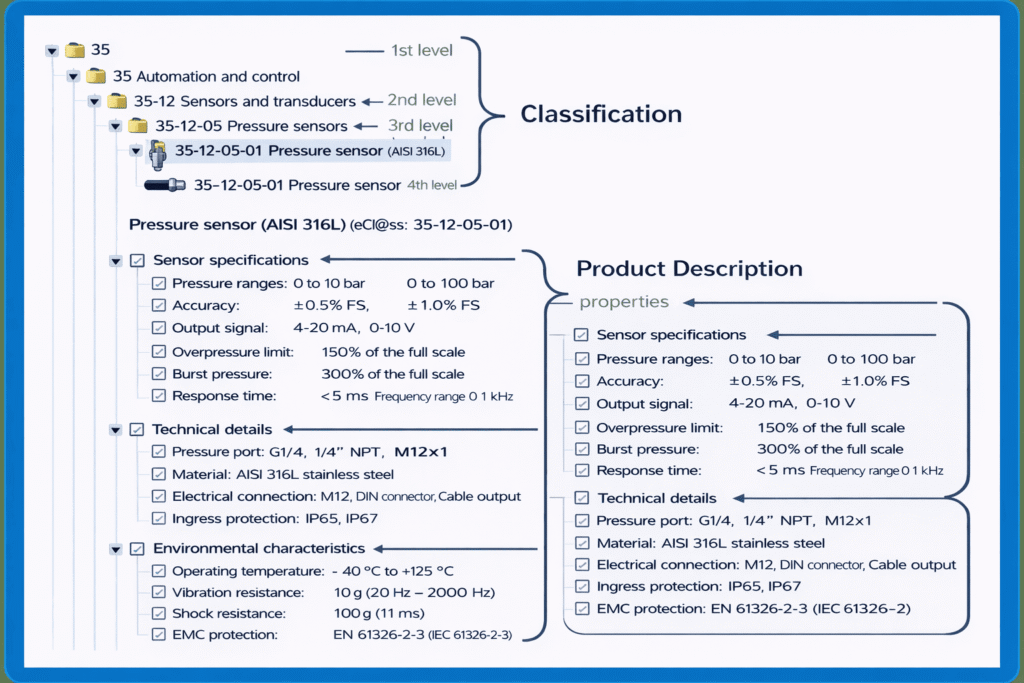
eClass
eClass es una norma de clasificación de productos exhaustiva y reconocida internacionalmente que se utiliza principalmente en los sectores de fabricación, ingeniería y compras.
Proporciona una estructura jerárquica para clasificar productos y servicios, lo que permite un intercambio electrónico de datos eficaz y una mejor gestión de la cadena de suministro.
Estructura: eClass utiliza una jerarquía de cuatro niveles:
- Segmento: El nivel más alto, que representa categorías amplias (por ejemplo, Ingeniería Eléctrica).
- Familia: Una agrupación más específica dentro de un segmento (por ejemplo, Cables e hilos).
- Clase: Un perfeccionamiento de la familia (por ejemplo, los cables de alimentación).
- Bloque: El nivel más granular, que describe características específicas del producto (por ejemplo, tensión nominal, material del conductor).
PIDx (Intercambio de datos de la industria de procesos)
PIDx es una norma de intercambio de datos diseñada específicamente para las industrias de procesos, incluidos los sectores del petróleo y el gas, químico y farmacéutico.
Se centra en la normalización del intercambio de datos de ingeniería, adquisición y construcción (EPC).
Estructura: PIDx define un modelo de datos y un vocabulario comunes para describir los equipos, materiales y servicios de las plantas de proceso. Utiliza una combinación de clases, propiedades y relaciones para representar los datos de forma estructurada.
Por ejemplo:
- Clase: Bomba
- Propiedad 1: Caudal
- Propiedad 2: Presión de descarga
- Relación: Conectado al sistema de tuberías
Aplicación industrial: Petróleo y gas, productos químicos y farmacéuticos
Estadísticas: PIDx cuenta con el apoyo de importantes empresas de EPC y operadores propietarios de las industrias de procesos.
UNSPSC (Código Uniforme de Productos y Servicios de las Naciones Unidas)
UNSPSC es un sistema de clasificación de productos y servicios ampliamente utilizado, mantenido por GS1 US. Proporciona una estructura jerárquica para categorizar bienes y servicios, facilitando la adquisición, análisis de gastosy gestión de la cadena de suministro.
Estructura: UNSPSC utiliza un código de ocho dígitos, dividido en cuatro niveles:
- Dos primeros dígitos → Segmento (grupo industrial amplio)
- 2.º dos dígitos → Familia (grupo de productos relacionados)
- 3º dos dígitos → Clase (artículos con uso similar)
- 4º dos dígitos → Commodity (producto o servicio exacto)
Por ejemplo:
Nivel de segmento: Segmento 40000000
Significado: Productos industriales y de construcción en general.
Nivel familiar: Familia 40150000
Significado: Distribución de fluidos y gases.
Nivel de clase: Clase 40151500
Significado: Bombas.
Nivel de materias primas: Materias primas 40151503
Significado: Bombas centrífugas.
Aplicación industrial: Adquisiciones, Análisis del gasto, Gestión de la cadena de suministro
En la práctica, los marcos de clasificación basados en taxonomías, incluidos los implantados por proveedores como Verdantis, se utilizan para aplicar taxonomías normalizadas y personalizadas de forma coherente en todos los datos maestros de MRO.
Taxonomías personalizadas
Taxonomías personalizadas, como MESCreflejan cómo se construyen, mantienen y averían los activos en una organización o sector concretos.
Incorporan:
- Contexto patrimonial
- Estrategias de mantenimiento
- Modos de fallo
- Restricciones reglamentarias y operativas
La mayoría de las organizaciones maduras utilizan taxonomías estandarizadas para la alineación externa y taxonomías personalizadas para la ejecución interna.
Saudi Aramco (por ejemplo), una de las mayores empresas integradas de energía y productos químicos del mundo, necesita una taxonomía muy personalizada para gestionar su amplia y compleja base de activos.
Su taxonomía se adapta a sus necesidades operativas específicas, tipos de equipos y diferentes prácticas de mantenimiento.
Características clave de la taxonomía:
- Centrado en los activos: La taxonomía se organiza principalmente en torno a activos físicos, como bombas, compresores, tuberías y recipientes.
- Estructura jerárquica: Emplea una jerarquía de varios niveles para clasificar los activos en función de su función, tipo y características.
- Especificaciones técnicas: La taxonomía incorpora especificaciones técnicas detalladas, como tipos de material, dimensiones, índices de rendimiento y requisitos de mantenimiento.
- Integración con sistemas de mantenimiento: Está estrechamente integrado con su Sistema Informático de Gestión del Mantenimiento (GMAO) para facilitar una planificación y ejecución eficaces del mantenimiento.
Por ejemplo:
- Tipo de activo: Bomba
- Tipo de bomba: Bomba centrífuga
- Aplicación: Inyección de agua
- Material: Acero inoxidable
- Capacidad: 500 m3/h
Sustantivo, modificador y submodificador Ejemplo:
- Sustantivo: Bomba
- Modificador: Centrífuga
- Submodificador/Tipo: Sumergible
Aplicación industrial: Petróleo y gas
Ventajas de los atributos de datos en la taxonomía personalizada
Una taxonomía personalizada ofrece importantes ventajas para extracción y enriquecimiento de datosespecialmente en los entornos de MRR, donde las descripciones de los artículos suelen ser poco estructuradas, incoherentes o específicas de cada proveedor.
Al definir clases, atributos y reglas de valor específicos de la organización, las taxonomías personalizadas permiten identificar, normalizar y enriquecer con precisión atributos de datos críticos como el tipo, el material, el tamaño, la presión y el fabricante.
Por ejemplo, al extraer datos para Compresores o sensores, una taxonomía personalizada garantiza que atributos como "Capacidad, Presión, Potencia nominal, Tensión, Intervalo de medida, Precisión y tipo de conexión" se capturen en campos normalizados en lugar de texto libre.
Esto mejora capacidad de búsqueda, detección de duplicados y calidad de los catálogos, al tiempo que apoya automatización mediante herramientas de extracción AI/ML.
Los datos enriquecidos a nivel de atributos permiten a los equipos de mantenimiento seleccionar rápidamente las piezas de repuesto correctas, mejoran las comprobaciones de compatibilidad, reducen las compras incorrectas y refuerzan los análisis para la optimización del inventario y la ingeniería de fiabilidad.
Artículo | Atributos de los datos | Importancia |
Compresores | Tipo de compresor: Reciprocantes, de tornillo rotativo, centrífugas | – Tipo de compresor determina la idoneidad y el rendimiento de la aplicación. – Capacidad y presión garantizar que el compresor satisfaga la demanda del sistema. – Potencia y tensión son fundamentales para la compatibilidad eléctrica. – Tipos de refrigeración y lubricación afectan al mantenimiento y la fiabilidad. – Fabricante y número de modelo ayuda en la búsqueda de repuestos y recambios. |
Sensores | – Tipo de sensor: Presión, temperatura, caudal, nivel | – Tipo de sensor y alcance definir la capacidad de medición. |
Ventajas de una taxonomía personalizada:
- Mejora de la gestión de activos: Permite un mejor seguimiento, control y mantenimiento de los activos.
- Mejora de la calidad de los datos: Garantiza la coherencia y exactitud de los datos en toda la organización.
- Adquisición racionalizada: Facilita el abastecimiento y la adquisición eficaces de piezas de repuesto y equipos.
- Reducción del tiempo de inactividad: Minimiza el tiempo de inactividad de los equipos mediante un mantenimiento proactivo y una solución de problemas eficaz.
La importancia de los sustantivos, modificadores y submodificadores
El uso de sustantivos, modificadores y submodificadores es fundamental para construir taxonomías eficaces. Este enfoque permite una clasificación granular y descriptiva de los datos, lo que posibilita una identificación y recuperación precisas de la información.
- Sustantivo: El objeto o concepto central que se clasifica (por ejemplo, Bomba, Válvula, Cable).
- Modificador: Característica o atributo que define mejor al sustantivo (por ejemplo, Centrífugo, Pelota, Potencia).
- Submodificador: Un atributo aún más específico que refina el modificador (por ejemplo, Sumergible, Acero inoxidable, Aislado XLPE).
Combinando estos elementos, una taxonomía puede proporcionar una representación muy detallada y matizada de los datos, facilitando la búsqueda, el filtrado y el análisis precisos.
Análisis comparativo de sistemas taxonómicos y resumen
Esta comparación pone de relieve cómo UNSPSC, eClass, PIDx y taxonomías personalizadas para diferentes datos maestros y necesidades empresariales.
- UNSPSC es el más adecuado para el análisis de compras y gastos entre sectores con una profundidad de clasificación moderada.
- eClass ofrece una estructura más detallada y basada en las propiedades, por lo que resulta ideal para el intercambio de datos de ingeniería y productos.
- PIDx se centra en datos estandarizados y basados en transacciones específicamente para la industria del petróleo y el gas.
- Taxonomías personalizadas ofrecen la máxima flexibilidad, permitiendo a las organizaciones adaptar las estructuras de datos a sus requisitos operativos y de cumplimiento de normativas específicos, aunque con una estandarización externa limitada.
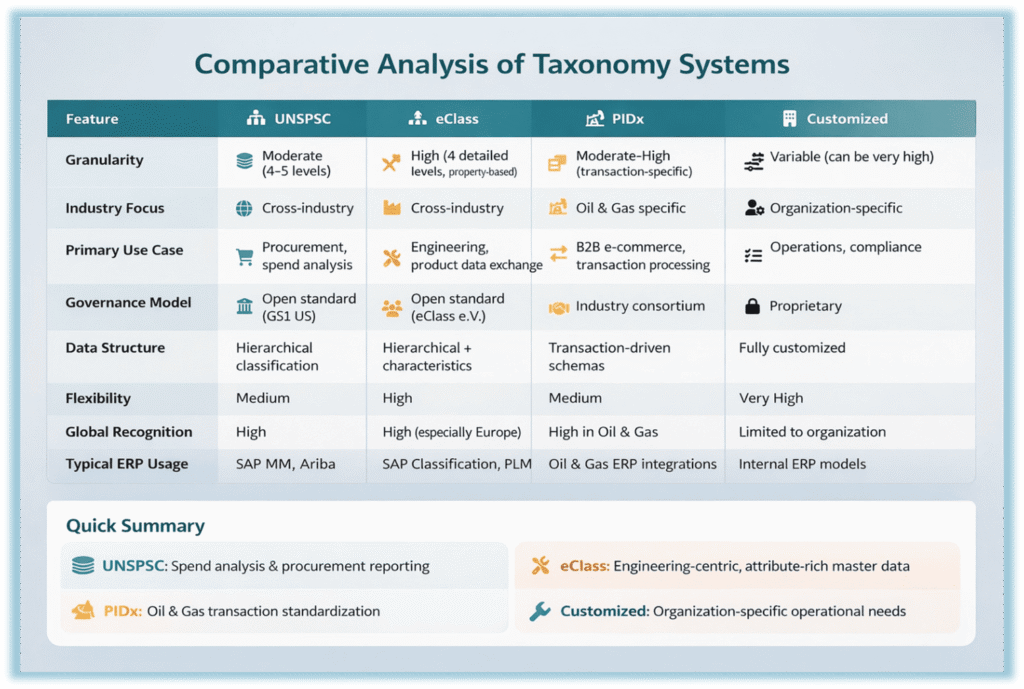
Las taxonomías estandarizadas proporcionan una alineación externa, mientras que las taxonomías personalizadas garantizan la relevancia operativa y la precisión a nivel de activos y atributos.
La taxonomía de datos MRO es más que un sistema de clasificación, es la columna vertebral de unos procesos operativos y de mantenimiento fiables, eficientes y basados en datos.
Al proporcionar un marco estructurado, jerárquico y semánticamente coherente, convierte los datos materiales no estructurados en conocimientos procesables, lo que constituye la base de una gestión eficaz. Catalogación de datos MRO.
En última instancia, una taxonomía de datos MRO robusta permite a las organizaciones tomar decisiones informadas, minimizar el tiempo de inactividad, mejorar la fiabilidad de los activos y aprovechar plenamente los análisis avanzados y las perspectivas impulsadas por IA, formando una base para el mantenimiento de clase mundial, la adquisición y la excelencia de la cadena de suministro.